
Safety
General information, not medical advice
Your prescriber and the leaflet in your pack know your situation. This page does not.
- Follow your prescriber and the leaflet
- Don't start, stop, or change a dose on your own
- Doses and warnings differ by country and product
Rybrevant Injection: Uses, Dosage, Side Effects, Precautions and Alternates
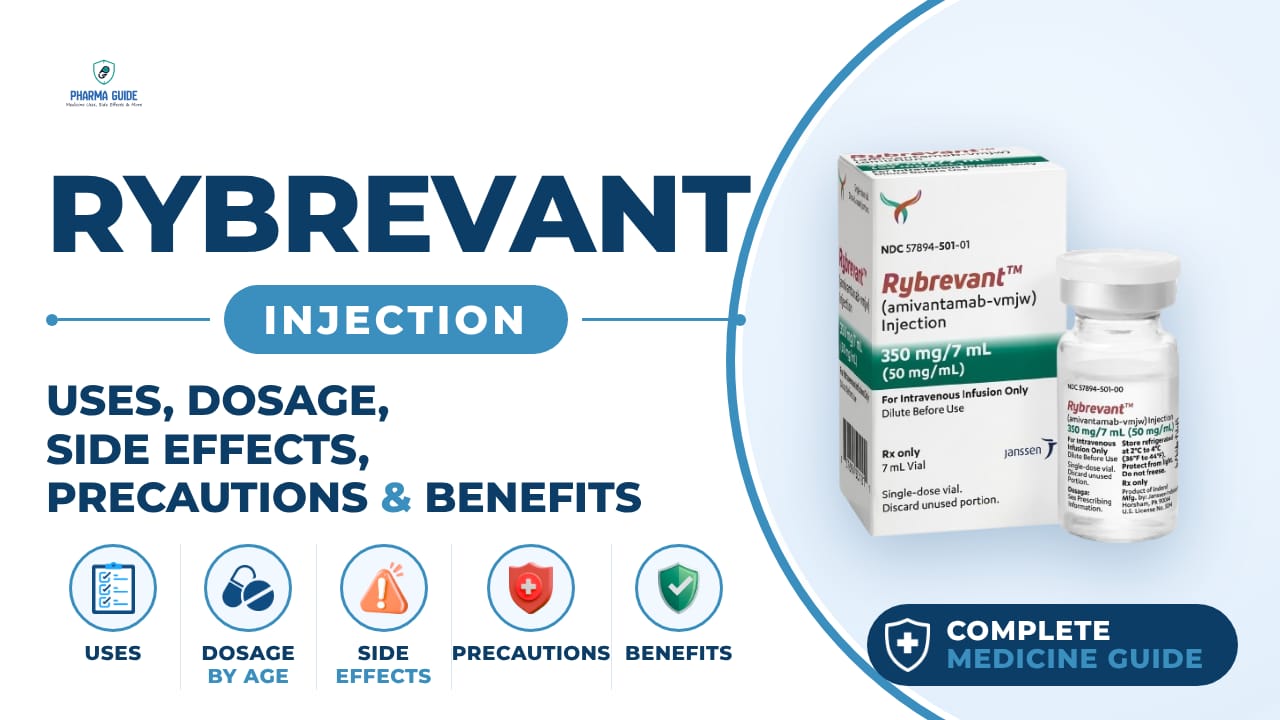
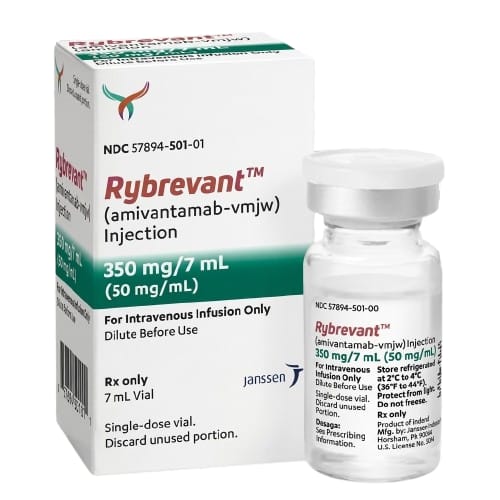
| Generic name | amivantamab-vmjw |
|---|---|
| Drug class | Bispecific EGF receptor-directed and MET receptor-directed antibody |
| Forms | Injection |
Quick overview
Rybrevant Injection (amivantamab-vmjw) is a bispecific antibody biologic medicine given as an IV infusion to treat certain types of non-small cell lung cancer (NSCLC) in adults with specific EGFR gene mutations. It works by blocking growth signals from two proteins, EGFR and MET, and helps the immune system target cancer cells. It may be used alone or combined with other cancer drugs, depending on the mutation type and prior treatment.
What is Rybrevant Injection
Rybrevant is a brand-name biologic medicine given as an IV infusion. It is used to treat certain types of non-small cell lung cancer (NSCLC) in adults whose cancer has specific gene changes in a protein called EGFR.
Rybrevant Injection uses
- Treats certain forms of non-small cell lung cancer (NSCLC) in adults whose cancer has specific EGFR gene mutations (exon 19 deletions, exon 21 L858R substitutions, or exon 20 insertions)
- Used alone or combined with other cancer drugs such as lazertinib, or carboplatin and pemetrexed, depending on the type of mutation and prior treatment
- Used when cancer has spread, cannot be removed by surgery, or has worsened after other cancer treatments
Benefits of Rybrevant Injection
- Can slow down or stop cancer growth by blocking signals that tell cancer cells to grow
- May help shrink tumors
- Helps the immune system find and destroy cancer cells
How Rybrevant Injection works
Rybrevant attaches to two proteins found on the surface of certain lung cancer cells, called EGFR and MET. These proteins normally send signals that tell cells to grow, but in cancer they send those signals constantly due to a gene change. By attaching to EGFR and MET, Rybrevant blocks these growth signals, which can help slow or stop the cancer from growing. It also marks the cancer cells so immune cells can find and destroy them.
Rybrevant Injection dosage
Rybrevant is given as an intravenous (IV) infusion by a doctor or nurse in a hospital or clinic; you will not take this medicine at home. Your first dose is usually split into two separate infusions on day 1 and day 2 of week 1 to help prevent infusion reactions. After the first week, infusions are typically given weekly for several weeks before switching to a longer gap between doses (such as every 2 or 3 weeks).
The first two infusions take longer (several hours) because they are given more slowly to reduce the risk of reactions; later infusions are usually shorter. You will be given other medicines, such as an antihistamine, a fever reducer, and a steroid, before each infusion to help prevent reactions.
If Rybrevant is given with lazertinib, lazertinib is usually taken by mouth before the Rybrevant infusion on the same day. If Rybrevant is given with chemotherapy, it is typically given after the chemotherapy drugs on the same day.
If you miss an infusion appointment, contact your healthcare provider right away to reschedule.
| Age group | Dose |
|---|---|
| Under 18 years | Not recommended |
| 18–64 years | 1,050 mg, once/week initially |
| 65+ years | 1,050 mg, once/week initially |
Available forms and strengths
- Injection
Side effects of Rybrevant Injection
Common
- Rash
- Infusion reactions
- Infected skin around the fingernails (paronychia)
- Shortness of breath or trouble breathing
- Nausea and vomiting
- Fatigue (tiredness)
- Muscle and joint pain
- Sores in the mouth
- Swelling of hands, feet, ankles, face, or body
- Constipation or diarrhea
- Dry, itchy skin
- Decreased appetite
- Cough
- Changes in certain blood test results
Serious
- Severe infusion-related reactions, including life-threatening allergic reactions (anaphylaxis)
- Lung problems (interstitial lung disease or pneumonitis) that can be life-threatening
- Blood clots in the legs (deep vein thrombosis) or lungs (pulmonary embolism), especially when combined with lazertinib
- Severe skin reactions, including a rare life-threatening condition with blistering and peeling skin (toxic epidermal necrolysis)
- Eye problems, including vision changes, eye pain, dryness, redness, or inflammation
Warnings and precautions
- Rybrevant can cause lung problems, which may be serious or life-threatening. Tell your doctor right away about any new or worsening breathing problems, cough, or fever.
- When combined with lazertinib, Rybrevant can cause blood clots in the legs or lungs, which can be life-threatening. Your doctor may give you medicine to lower this risk for the first 4 months of treatment.
- Rybrevant can cause severe skin reactions, including blistering and peeling of the skin. You should protect your skin from the sun, use a non-drying moisturizer, and wash your hands and feet daily with a special antiseptic solution as directed by your doctor.
- Rybrevant can cause eye problems. Stop using contact lenses if you develop new eye symptoms and have your eyes checked by a healthcare provider before using them again.
- Infusion-related reactions are common, especially with the first dose, and can be severe or life-threatening. You'll be given medicines before each infusion to help lower this risk.
- You should limit sun exposure during treatment and for 2 months after your last dose, and use protective clothing and sunscreen, because Rybrevant can make skin very sensitive to sunlight.
- Rybrevant is not safe during pregnancy because it could harm an unborn baby. If you can become pregnant, you'll need a pregnancy test before starting treatment, and you should use effective birth control during treatment and for 3 months after your last dose.
- You should not breastfeed while receiving Rybrevant and for 3 months after your last dose, since it is not known if the drug passes into breast milk and could harm a breastfed child.
- Rybrevant isn't known to interact directly with alcohol, but drinking alcohol could make some side effects worse, such as headache, nausea, vomiting, diarrhea, dizziness, and fatigue. Ask your doctor how much alcohol, if any, is safe for you during treatment.
- Be careful before driving or using machines until you know how Rybrevant affects you, since side effects like tiredness, dizziness, or eye problems can temporarily affect your ability to do these safely.
Storage
- Rybrevant is usually stored at the hospital, clinic, or pharmacy
- Your doctor, pharmacist, or nurse is responsible for storing this medicine and disposing of any unused product correctly
- You will not store this medicine at home
When to see a doctor
- Get help right away if you have trouble breathing, wheezing, chest discomfort, swelling of your eyes, lips, or tongue, fever, chills, numbness of the tongue or lips, flushing, rash, hives, itching, nausea, vomiting, stomach cramps, lightheadedness, dizziness, or fainting during or after an infusion — these can be signs of a serious infusion reaction.
- Get emergency help if you have new or worsening shortness of breath, cough, or fever, as these may be signs of serious lung inflammation.
- Tell your healthcare provider right away if you notice swelling, pain, or tenderness in your leg, sudden unexplained chest pain, or shortness of breath, as these could be signs of a blood clot.
- Get emergency help right away if you develop painful red or purple skin that looks burned and peels off, blisters on your skin, mouth, nose, or genitals, red painful watery eyes, or flu-like symptoms such as fever, chills, and muscle aches — these can be signs of a severe, life-threatening skin reaction.
- Contact your eye specialist right away if you have eye redness, itchiness, pain, swollen or itchy eyelids, a feeling of something in your eye, eye dryness, watering or discharge, or vision changes such as blurriness or light sensitivity.
- Tell your doctor immediately if you or your partner become pregnant while receiving this medicine.
Alternatives
- Gefitinib
- Lazertinib
- Osimertinib
Watch the video
FAQs
What is Rybrevant Injection used for?
Rybrevant treats certain forms of non-small cell lung cancer (NSCLC) in adults whose cancer has specific EGFR gene mutations (exon 19 deletions, exon 21 L858R substitutions, or exon 20 insertions). It's used alone or combined with other cancer drugs like lazertinib or carboplatin and pemetrexed, depending on the mutation type and prior treatment.
How is Rybrevant Injection given?
Rybrevant is given as an IV infusion by a doctor or nurse in a hospital or clinic. The first dose is usually split into two infusions on day 1 and day 2 of week 1 to help prevent infusion reactions, followed by weekly infusions before switching to a longer gap between doses.
What are the serious side effects of Rybrevant Injection?
Serious side effects include severe infusion-related reactions and anaphylaxis, life-threatening lung problems (interstitial lung disease or pneumonitis), blood clots (especially when combined with lazertinib), severe skin reactions including toxic epidermal necrolysis, and eye problems.
Can Rybrevant Injection be used during pregnancy?
Rybrevant is not safe during pregnancy because it could harm an unborn baby. A pregnancy test is needed before starting treatment, and effective birth control should be used during treatment and for 3 months after the last dose.
Does Rybrevant Injection interact with alcohol?
Rybrevant isn't known to interact directly with alcohol, but drinking alcohol could worsen side effects such as headache, nausea, vomiting, diarrhea, dizziness, and fatigue. Ask your doctor how much alcohol, if any, is safe during treatment.
General information, not medical advice
Your prescriber and the leaflet in your pack know your situation. This page does not.
- Follow your prescriber and the leaflet
- Don't start, stop, or change a dose on your own
- Doses and warnings differ by country and product
Sources
Video
Related medicines

Injectafer Injection: Uses, Dosage, Side Effects, Precautions and Alternates
Iron products
Injectafer (ferric carboxymaltose) treats iron deficiency anemia and heart failure-related iron deficiency via IV. Learn uses, dosage, side effects, and

Gliclazide Tablet: Uses, Dosage, Side Effects, Precautions and Alternates
Sulfonylurea (hypoglycemic/antidiabetic agent)
Gliclazide Tablet is a sulfonylurea for type 2 diabetes that boosts insulin release. Learn about dosage, side effects, warnings, and precautions.