
Safety
General information, not medical advice
Your prescriber and the leaflet in your pack know your situation. This page does not.
- Follow your prescriber and the leaflet
- Don't start, stop, or change a dose on your own
- Doses and warnings differ by country and product
Saizen Injection: Uses, Dosage, Side Effects, Precautions and Alternates
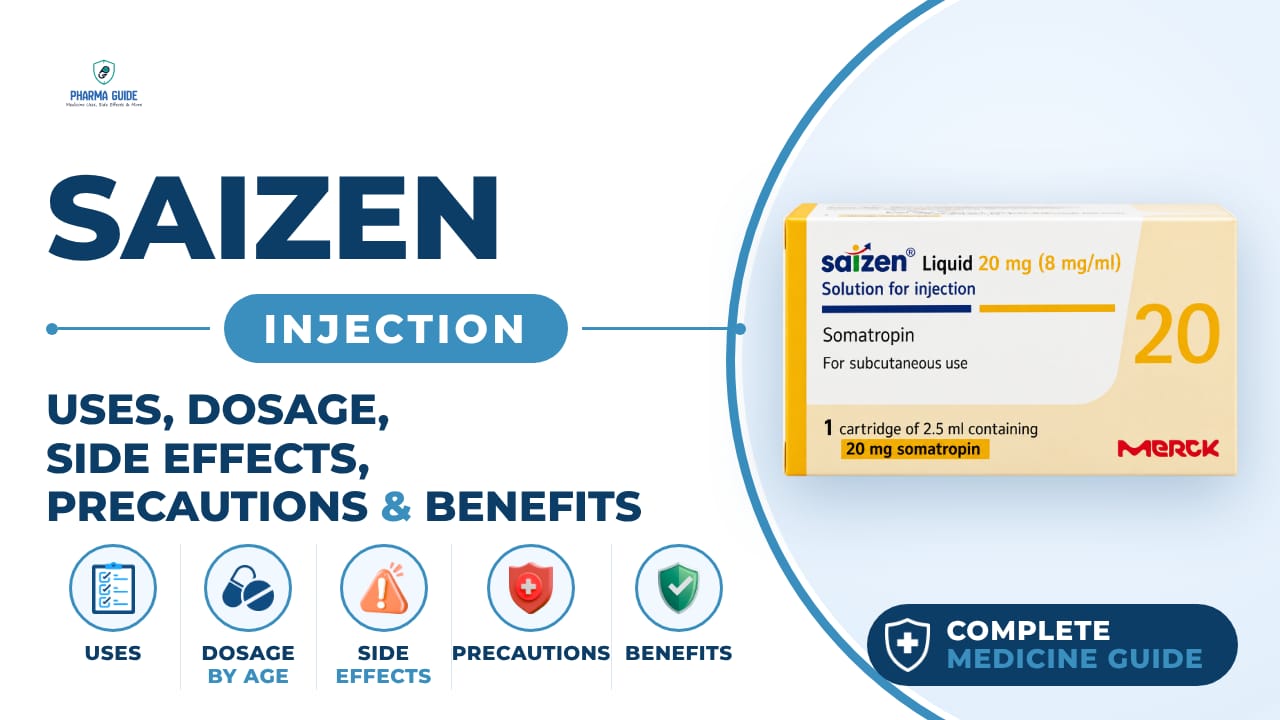
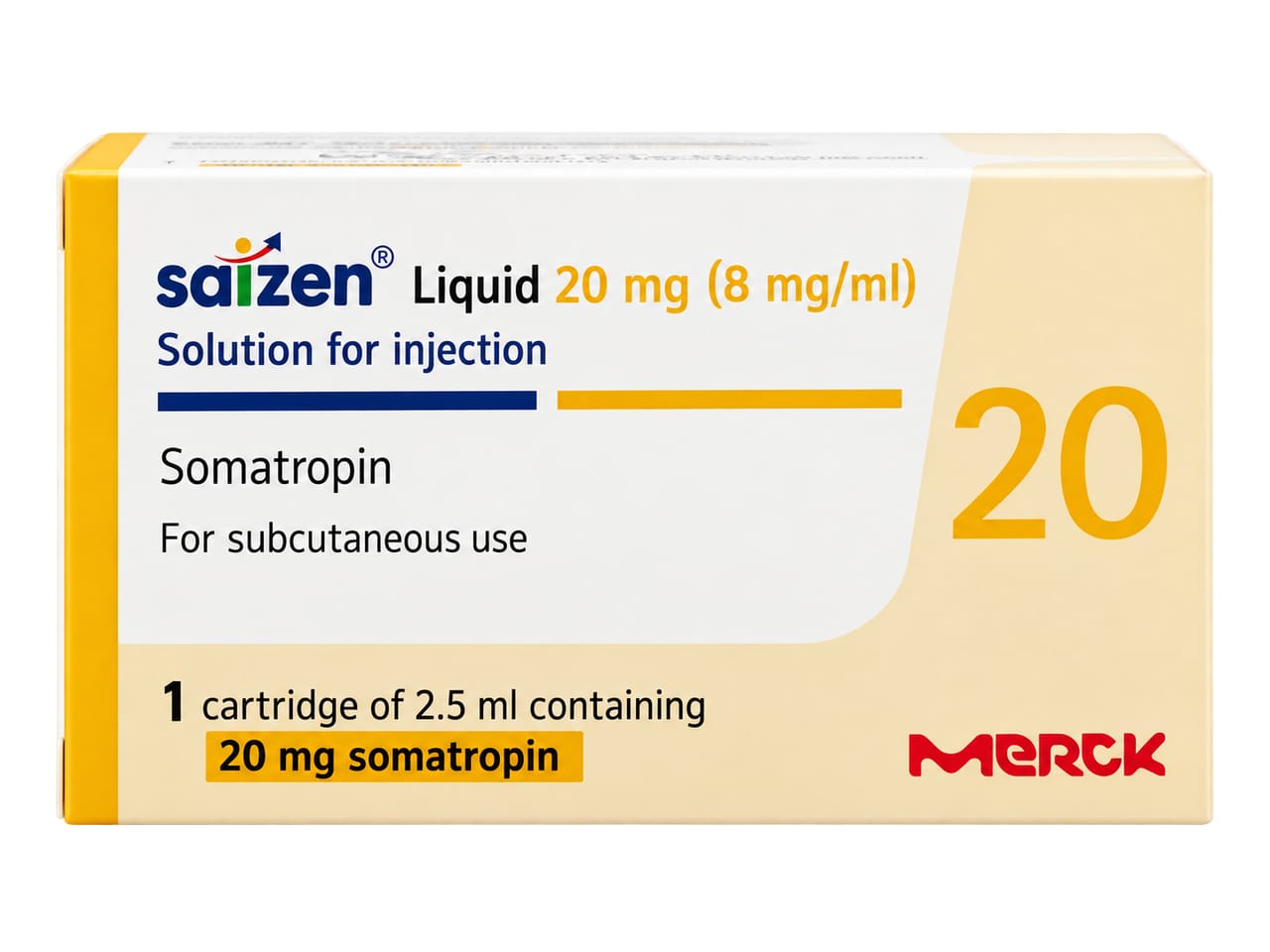
| Generic name | somatropin |
|---|---|
| Drug class | Growth Hormone Analogs |
| Forms | Solution for injection in a cartridge (for use with an autoinjector device), Lyophilized (freeze-dried) powder in a vial, to be mixed with a diluent before injection |
Quick overview
Saizen Injection contains somatropin, a man-made version of human growth hormone that works the same way as the natural hormone your body makes. It is used to treat growth failure in children with growth hormone deficiency, girls with Turner Syndrome, adults with growth hormone deficiency, children with chronic kidney problems, and children born small for gestational age who have not caught up in growth. It is given as an injection under the skin and must be used exactly as prescribed by your doctor.
What is Saizen Injection
Saizen contains somatropin, a man-made version of human growth hormone that works the same way as the natural hormone your body makes.
Saizen Injection uses
- Growth failure in children who have a deficiency of natural human growth hormone
- Growth failure in girls with Turner Syndrome (a genetic condition that may cause short stature)
- Growth hormone deficiency in adults
- Growth disturbance in pre-pubertal children with chronic renal insufficiency (CRI)
- Growth disturbance in short children born small for gestational age (SGA) who do not catch up in growth by four years of age or later
Benefits of Saizen Injection
- Helps children with growth hormone deficiency grow taller and at a more normal rate
- Improves height outcomes in girls with Turner Syndrome
- Increases lean body mass and reduces body fat in adults with growth hormone deficiency
- Improves growth in children with chronic kidney problems or born small for gestational age
How Saizen Injection works
Growth hormone works by raising levels of a substance called IGF-1 in the blood, which helps bones, muscles, and other body tissues grow. It also affects how the body uses fat, protein, and sugar.
Saizen Injection dosage
Your doctor will decide how many times a week you inject, depending on why you are being treated and your body size. It is preferable to give the injection in the evening. It is given as an injection under the skin (subcutaneous). Use a different injection site each time to reduce the risk of damage to the fat and tissue under the skin. Follow the Instructions for Use provided with your injection device carefully. Do not attempt self-injection until you are sure how to do it. Do not inject it if the solution contains particles or is not clear.
Use it regularly at the same time each day. If you miss a dose, do not double up - skip the missed dose and take the next one as scheduled. Do not change your dose unless your doctor tells you to. Do not stop using this medicine suddenly without telling your doctor.
| Age group | Dose |
|---|---|
| 0–2 years | 0.18 mg/kg/week |
| 6–11 years | 0.18 mg/kg/week |
| 12–17 years | 0.18 mg/kg/week |
| 18–35 years | 0.2 mg/day |
| 36–64 years | 0.15–0.30 mg/day |
Available forms and strengths
- Solution for injection in a cartridge (for use with an autoinjector device)
- Lyophilized (freeze-dried) powder in a vial, to be mixed with a diluent before injection
Side effects of Saizen Injection
Common
- Pain, numbness, redness or swelling at the injection site
- Local fat loss (lipoatrophy)
- Pain in muscles or joints, stiffness, swelling of limbs
- Upper respiratory tract infection, ear infection, chickenpox
- Abdominal pain
- Inflammation in parts of the respiratory tract such as throat, bronchial tube, tonsils or nose
- Increased thirst, increased need to pass urine, dry mouth or skin (signs of high blood sugar)
- Shaking and/or light-headedness (signs of low blood sugar)
- Extreme tiredness, lethargy, muscle weakness or cramps (signs of low thyroid hormone)
- Tingling, numbness, weakness or pain in the fingers or hand, or pain between hand and elbow
- Pins and needles sensation
- Headache
Serious
- Symptoms of allergic reaction: shortness of breath, wheezing or difficulty breathing, swelling of the face, lips, tongue or other parts of the body, rash, itching or hives on the skin
- Difficulty in walking, unexplained limp or hip/knee pain
- Strong or recurrent headache with nausea, vomiting or sight disturbances
- Severe stomach pain spreading to the back, with nausea and vomiting (possible pancreatitis)
- Sudden and severe pain behind the eyes, vision changes (possible pressure inside the skull)
- Swelling in the head, face, hands, or feet
- Numbness or tingling in the wrist, hand, or fingers (possible carpal tunnel syndrome)
Warnings and precautions
- If you are pregnant or planning to become pregnant, talk to your doctor before using this medicine, as it should only be used if clearly needed.
- Talk to your doctor if you are breastfeeding, as it is not known if this medicine passes into breast milk.
- Your doctor may need to adjust your dose if you have kidney problems, since the body clears this medicine more slowly in people with reduced kidney function.
- Your doctor may need to adjust your treatment if you have liver problems, as this medicine may be cleared from the body more slowly.
- This medicine is unlikely to affect your ability to drive or operate machinery.
- Do not use this medicine if you currently have any type of active cancer. Any cancer treatment must be finished before starting.
- Do not use if you have an active brain lesion such as a brain injury, abscess, or tumour.
- Do not use if you have diabetic retinopathy, an eye disease caused by diabetes complications.
- Do not use this medicine if you have a serious acute illness, such as after major surgery (like open-heart or abdominal surgery), serious accident, or severe breathing problems, because it has been linked to higher risk of death in these situations.
- This medicine should not be used to promote growth in children whose bones have already stopped growing.
- Children with Prader-Willi syndrome who are severely obese or have severe breathing problems should not use this medicine, as sudden deaths have been reported.
- This medicine can raise blood sugar levels, so people with diabetes need close monitoring.
- Watch for signs of scoliosis (curved spine), as rapid growth can make it worse.
- If you or your child has difficulty walking, or complains of hip or knee pain, or starts limping, contact the doctor right away as this could indicate a serious joint problem.
- In children with chronic renal insufficiency, treatment must be stopped at the time of a kidney transplant.
Storage
- Keep SAIZEN injection solution in the original package, in a refrigerator where the temperature is between 2°C to 8°C (Refrigerate. Do not freeze) and it is not exposed to light.
- Do not store it in the freezer.
- After first injection, store at 2°C to 8°C (Refrigerate. Do not freeze) for a maximum of 28 days.
- After first injection, if refrigeration is temporarily unavailable, it can be stored for up to 7 days below 25°C. Protect from light. Following this, it must be returned to the refrigerator and stored at 2°C to 8°C (Refrigerate. Do not freeze) for a maximum of 28 days and discard any leftovers.
- The autoinjector containing a cartridge of SAIZEN must be stored in the device storage box.
- Store it in a cool dry place away from moisture, heat or sunlight; for example, do not store it: in the bathroom or near a sink, or in the car or on window sills.
- Keep it where young children cannot reach it.
- Discard all sharps into a disposal unit.
- If you no longer need to use this medicine or it is out of date, take it to any pharmacy for safe disposal.
- Do not use this medicine after the expiry date.
When to see a doctor
- Call your doctor straight away if you notice symptoms of an allergic reaction, such as shortness of breath, wheezing, difficulty breathing, swelling of the face, lips, tongue, or rash, itching, or hives.
- Go straight to the Emergency Department or call your doctor immediately if you have difficulty walking, an unexplained limp, or hip/knee pain.
- Seek immediate medical help for a strong or repeated headache along with nausea, vomiting, or vision problems.
- If you think you have used too much of this medicine, seek urgent medical attention even if you feel fine, by contacting your doctor, calling your local poison control center, or going to the nearest hospital emergency department.
- Tell your doctor as soon as possible if you do not feel well while using this medicine.
Alternatives
- Genotropin
- Humatrope
- Norditropin
Watch the video
FAQs
What is Saizen Injection used for?
Saizen Injection is used to treat growth failure in children with growth hormone deficiency, girls with Turner Syndrome, adults with growth hormone deficiency, children with chronic kidney problems, and children born small for gestational age who have not caught up in growth.
How is Saizen Injection given?
It is given as an injection under the skin (subcutaneous), preferably in the evening. A different injection site should be used each time to reduce the risk of damage to the fat and tissue under the skin.
What are the common side effects of Saizen Injection?
Common side effects include pain, numbness, redness or swelling at the injection site, local fat loss, muscle or joint pain, headache, abdominal pain, and signs of high or low blood sugar.
Who should not use Saizen Injection?
It should not be used by people with active cancer, an active brain lesion, diabetic retinopathy, or a serious acute illness such as after major surgery. It should also not be used to promote growth in children whose bones have stopped growing, or in children with Prader-Willi syndrome who are severely obese or have severe breathing problems.
How should Saizen Injection be stored?
It should be kept in its original package in a refrigerator between 2°C and 8°C, protected from light, and not frozen. After first use, it can be stored at 2°C to 8°C for a maximum of 28 days, or up to 7 days below 25°C if refrigeration is temporarily unavailable.
General information, not medical advice
Your prescriber and the leaflet in your pack know your situation. This page does not.
- Follow your prescriber and the leaflet
- Don't start, stop, or change a dose on your own
- Doses and warnings differ by country and product
Sources
Video
Related medicines

Injectafer Injection: Uses, Dosage, Side Effects, Precautions and Alternates
Iron products
Injectafer (ferric carboxymaltose) treats iron deficiency anemia and heart failure-related iron deficiency via IV. Learn uses, dosage, side effects, and

Gliclazide Tablet: Uses, Dosage, Side Effects, Precautions and Alternates
Sulfonylurea (hypoglycemic/antidiabetic agent)
Gliclazide Tablet is a sulfonylurea for type 2 diabetes that boosts insulin release. Learn about dosage, side effects, warnings, and precautions.