
Safety
General information, not medical advice
Your prescriber and the leaflet in your pack know your situation. This page does not.
- Follow your prescriber and the leaflet
- Don't start, stop, or change a dose on your own
- Doses and warnings differ by country and product
Saridon Tablet: Uses, Dosage, Side Effects, Precautions and Alternates
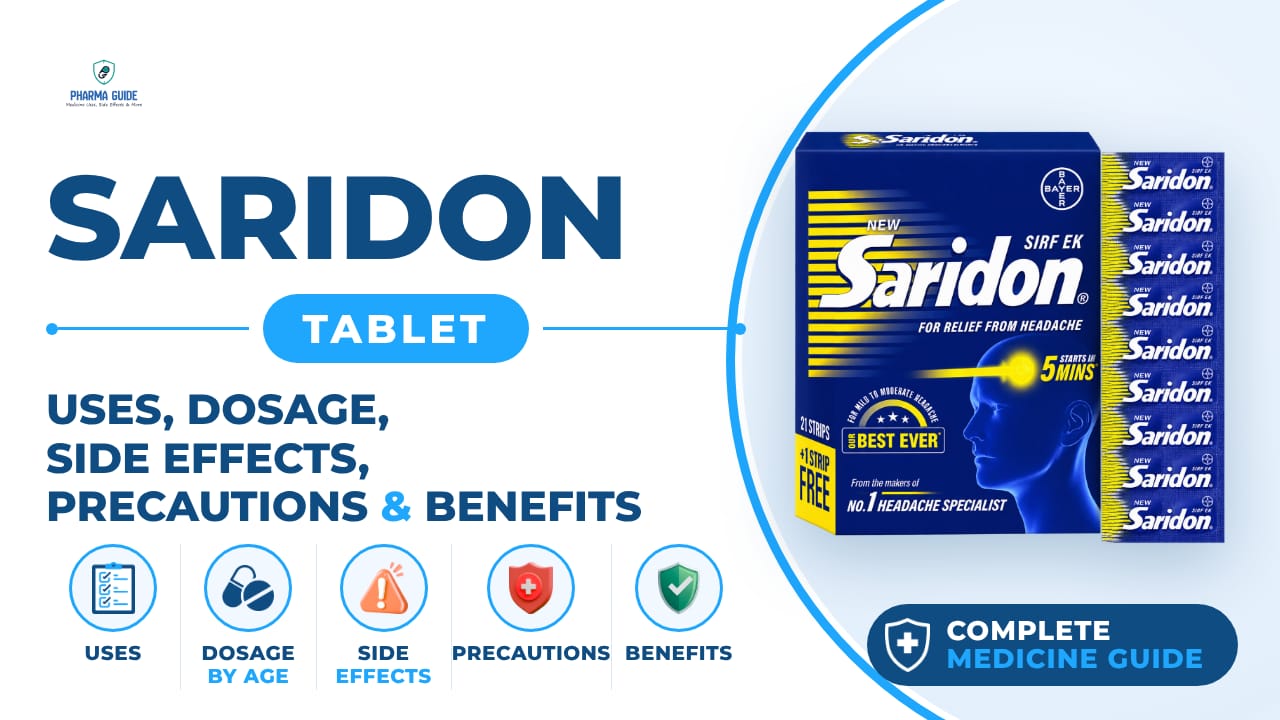
| Generic name | Propyphenazone (150 mg) + Paracetamol (250 mg) + Caffeine (50 mg) |
|---|---|
| Drug class | Analgesic combinations |
| Forms | Tablet |

Quick overview
Saridon Tablet is a combination medicine containing Propyphenazone (150 mg), Paracetamol (250 mg), and Caffeine (50 mg), belonging to the analgesic combinations drug class. It is an over-the-counter pain reliever used mainly to relieve mild to severe headaches and other aches. It is available as a tablet and should be used exactly as advised by your doctor or pharmacist.
What is Saridon Tablet
Saridon Tablet is a combination medicine containing Propyphenazone, Paracetamol, and Caffeine. It is an over-the-counter pain reliever used mainly to relieve mild to severe headaches and other aches.
Saridon Tablet uses
- Headache
- Sinusitis
- Fever-associated weakness and muscle aches
- Pain from menstrual cramps (dysmenorrhoea)
- Joint aches caused by arthritis
- Dental pain
- Chronic migraine
Benefits of Saridon Tablet
- Provides relief from mild to severe headaches
- Helps reduce fever and related weakness
- Helps relieve various body aches and pains
How Saridon Tablet works
Propyphenazone and Paracetamol work by stopping the production of a chemical substance in the body that causes pain. Caffeine narrows the blood vessels and restricts blood flow, which helps relieve pain.
Saridon Tablet dosage
Saridon Tablet may be taken with or without food, as advised by your doctor. Do not break, chew, or crush the tablet in your mouth. Avoid taking more than the recommended dose or for more than one week unless directed by your doctor. Avoid taking Saridon Tablet with other Paracetamol-containing medicine. Tablets should be taken at an interval of a few hours, or as your doctor advises. It is not recommended for use in children below 12 years of age. If a dose is missed, take it as soon as possible, but do not double up to make up for a missed dose.
| Age group | Dose |
|---|---|
| Under 12 years | Not recommended unless specifically prescribed |
| 12–15 years | Use only according to the specific product label or medical advice |
| 16–17 years | Follow the product-specific dosage; medical advice is recommended |
| 18–64 years | Commonly 1 tablet as needed, with the exact maximum depending on the formulation |
| 65+ years | Use only after checking with a doctor or pharmacist, particularly for regular use |
Available forms and strengths
Saridon Tablet is available as a tablet, containing Propyphenazone (150 mg), Paracetamol (250 mg), and Caffeine (50 mg).
Side effects of Saridon Tablet
Common
- Nausea and vomiting
- Stomach pain
- Stomach upset
- Indigestion
- Skin rash
- Decrease in appetite
- Diarrhea
- Faster heartbeat (tachycardia)
- Mood changes such as anxiousness, restlessness, or nervousness
- Trouble sleeping
Serious
- Bloody and cloudy urine
- Difficulty in breathing
- Serious skin allergy with reddening, rash, blisters or peeling
- Swelling of the face, tongue, or throat
- Severe dizziness
Warnings and precautions
- Saridon Tablet is not recommended during pregnancy because there is not enough safety information. Talk to your doctor if you are pregnant.
- Saridon Tablet is not recommended while breastfeeding because it is not known if the medicine passes into breast milk. Talk to your doctor if you are breastfeeding.
- Use Saridon Tablet with caution if you have kidney problems as it may increase the risk of side effects. Your doctor may suggest tests to monitor your kidney function.
- Saridon Tablet is broken down in the liver, so it should be used with caution if you have liver problems as it may increase the risk of liver damage.
- The interaction with alcohol is unknown. It is best to talk to your doctor before drinking alcohol while taking this medicine.
- Saridon Tablet may cause a serious skin allergy in some cases. Get medical help right away if you notice skin reddening, rash, blisters, or peeling.
- Do not use Saridon Tablet with other medicines that contain acetaminophen (paracetamol). Overdose may cause severe or possibly fatal liver damage.
- Do not take Saridon Tablet if you are allergic to it or to acetaminophen.
- Use with extreme caution if you are malnourished, as it may increase the risk of side effects. Your doctor may adjust the dose based on your body weight.
- Use with caution if you have a history of NSAID-sensitive asthma, as this medicine may worsen your condition.
- This medicine can interfere with the 5-HIAA urine test and give a false-positive result. Tell your doctor and lab technician that you take this medicine before the test.
Storage
- Store at room temperature, generally below 25°C or according to the product label.
- Keep the tablets in their original packaging and protect them from moisture and direct sunlight.
- Keep the medicine in a dry place, away from heat and humidity.
- Do not freeze the tablets.
- Keep out of the reach and sight of children.
When to see a doctor
- Get medical help right away if you notice allergy signs such as skin rash, itching or swelling (especially of the face, tongue, or throat), severe dizziness, or breathing difficulty.
- Never take more than the prescribed dose. Get emergency medical help in case of an overdose.
- In case of overdose, call your local poison control center or a doctor right away, even if you do not notice symptoms such as increased sweating, nausea, vomiting, stomach pain, and loss of appetite.
- See a doctor if your symptoms do not get better even after a few doses, or if symptoms last more than 5 days or fever lasts more than 3 days.
Alternatives
- Paracetamol (Acetaminophen)
- Ibuprofen
- Naproxen
- Aspirin
- Diclofenac
- Mefenamic Acid
- Ketoprofen
Watch the video
FAQs
What is Saridon Tablet used for?
Saridon Tablet is used to relieve headaches, sinusitis, fever-associated weakness and muscle aches, menstrual cramps, joint aches from arthritis, dental pain, and chronic migraine.
What are the ingredients in Saridon Tablet?
Saridon Tablet contains Propyphenazone (150 mg), Paracetamol (250 mg), and Caffeine (50 mg).
How does Saridon Tablet work?
Propyphenazone and Paracetamol stop the production of a chemical substance in the body that causes pain, while Caffeine narrows blood vessels and restricts blood flow to help relieve pain.
Can Saridon Tablet be taken during pregnancy?
Saridon Tablet is not recommended during pregnancy because there is not enough safety information, so you should talk to your doctor if you are pregnant.
What are the common side effects of Saridon Tablet?
Common side effects include nausea, vomiting, stomach pain, stomach upset, indigestion, skin rash, decreased appetite, diarrhea, faster heartbeat, mood changes, and trouble sleeping.
General information, not medical advice
Your prescriber and the leaflet in your pack know your situation. This page does not.
- Follow your prescriber and the leaflet
- Don't start, stop, or change a dose on your own
- Doses and warnings differ by country and product
Sources
- State Institute for Drug Control (Sukl.eu), SARIDON 250MG/150MG/50MG TBL NOB 10, 2021
- PubChem, Propyphenazone, 2021
- Medicines.org.uk, Paracetamol 500mg Tablets - Summary of Product Characteristics (SmPC), 2021
- Medicines.org.uk, Boots Cold and Flu Relief Tablets - Summary of Product Characteristics (SmPC), 2021
- PubChem, Caffeine, 2021
- FDA (DailyMed), SARIDON-A acetaminophen tablet, OASIS TRADING, 2018
Video
Related medicines
Advil Dual Action Tablet: Uses, Dosage, Side Effects, Precautions and Alternates
analgesic combinations
Advil Dual Action Tablet combines ibuprofen and acetaminophen for fast, 8-hour pain relief. Learn about uses, dosage, side effects, and warnings.
Excedrin Tablet: Uses, Dosage, Side Effects, Precautions and Alternates
Analgesic combinations
Excedrin Tablet combines acetaminophen, aspirin, and caffeine to relieve headaches and migraines. Learn about its uses, dosage, side effects, and precautions.