
Safety
General information, not medical advice
Your prescriber and the leaflet in your pack know your situation. This page does not.
- Follow your prescriber and the leaflet
- Don't start, stop, or change a dose on your own
- Doses and warnings differ by country and product
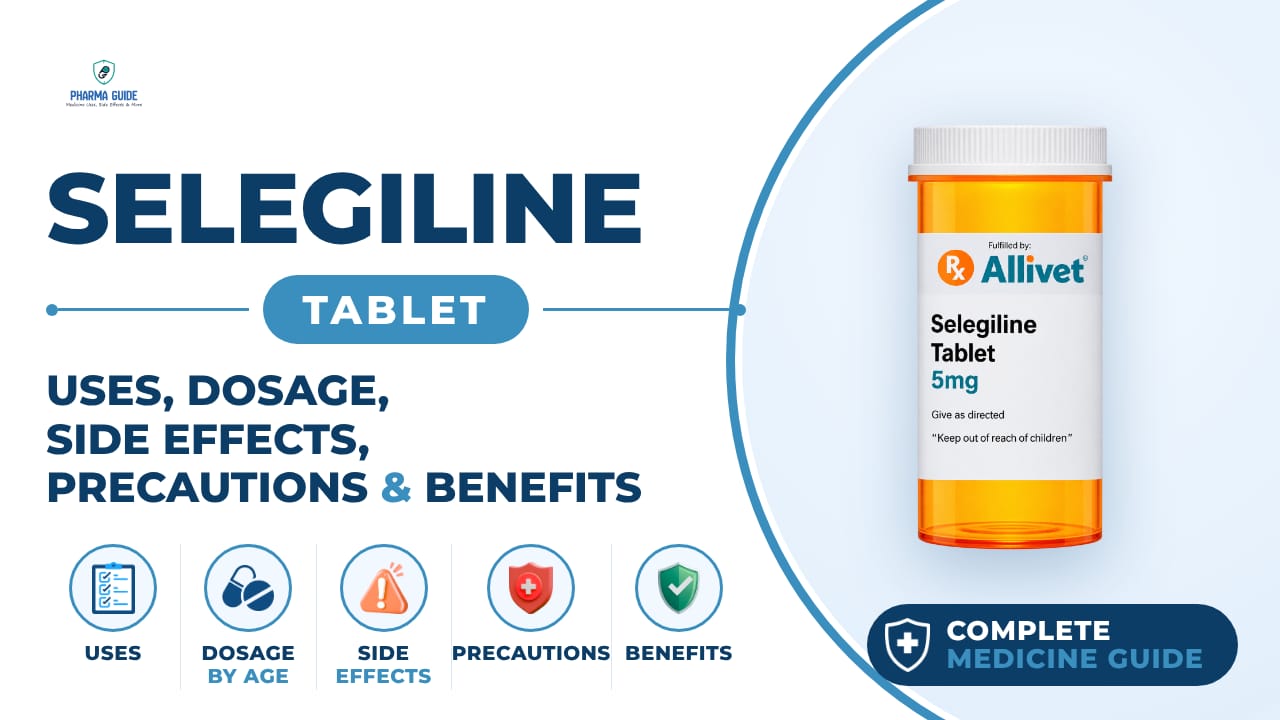
Selegiline Tablet: Uses, Dosage, Side Effects, Precautions and Alternates
| Generic name | selegiline |
|---|---|
| Drug class | MAO-B inhibitor |
| Forms | oral capsule (5 mg), oral tablet (5 mg), oral tablet, disintegrating (1.25 mg) |
Quick overview
Selegiline is a prescription MAO-B inhibitor used to treat Parkinson's disease, typically alongside carbidopa/levodopa. It helps relieve "off" episodes and supports better symptom control by extending the effects of carbidopa/levodopa. Selegiline is available as capsules, tablets, and an orally disintegrating tablet, each with specific instructions for use.
What is Selegiline Tablet
Selegiline is a prescription medicine used to treat Parkinson's disease. It is in a group of medicines called monoamine oxidase type B (MAO-B) inhibitors. It is usually taken together with another medicine called carbidopa/levodopa.
Selegiline Tablet uses
- Relief of "off" episodes in people with Parkinson's disease (PD) who are taking a carbidopa/levodopa medication
- Helps control the symptoms of Parkinson's disease in people who are taking levodopa and carbidopa combination
Benefits of Selegiline Tablet
- Extends the actions of carbidopa/levodopa to relieve PD symptoms
- May help decrease the dose of levodopa/carbidopa needed to control symptoms
- May stop the effects of levodopa/carbidopa from wearing off between doses
- May increase the length of time that levodopa/carbidopa continues to control symptoms
How Selegiline Tablet works
Selegiline blocks an enzyme called MAO-B, which normally breaks down dopamine in the brain. By blocking this enzyme, selegiline keeps dopamine around longer, which helps control movement problems caused by Parkinson's disease.
Selegiline Tablet dosage
Selegiline capsules and tablets are usually taken twice a day, at breakfast and at lunch. The orally disintegrating tablet (Zelapar) is usually taken once a day before breakfast, without food, water, or other liquids. If taking the orally disintegrating tablet, avoid eating or drinking anything for 5 minutes before and after your dose.
Do not remove the orally disintegrating tablet from its blister pack until you are ready to take it; peel back the foil gently with dry hands instead of pushing the tablet through it. Place the orally disintegrating tablet on your tongue and let it dissolve on its own; do not chew or swallow it whole.
Do not stop taking selegiline suddenly or change your dose without talking to your doctor first, since this can cause serious withdrawal symptoms. Your doctor may lower your carbidopa/levodopa dose after you start selegiline, depending on how well it controls your symptoms.
| Age group | Dose |
|---|---|
| Under 18 years | Not recommended |
| 18–64 years | 5 mg, twice/day |
| 65+ years | 5 mg, twice/day |
Available forms and strengths
- Oral capsule (5 mg)
- Oral tablet (5 mg)
- Oral tablet, disintegrating (1.25 mg)
Side effects of Selegiline Tablet
Common
- Nausea
- Dizziness
- Stomach pain
- Confusion
- Hallucinations
- Dry mouth
- Headache
- Vivid dreams
- Trouble sleeping
- Constipation
- Skin rash or other irritation
Serious
- Extreme drowsiness or falling asleep without warning
- Extremely high blood pressure: seizure, chest pain, severe headache, confusion, blurred vision, anxiety, trouble breathing
- Serotonin syndrome: hallucinations, seizure, confusion, restlessness, shivering, sweating, high fever, headache, racing heart, muscle stiffness or twitching, tremor
- Impulse-control behavior: intense urges (e.g., gambling, shopping, binge eating, engaging in sexual activity)
- Serious withdrawal symptoms (neuroleptic malignant syndrome): high fever, sweating, stiff muscles, confusion, not aware of your surroundings, fast or irregular heartbeat
- Signs of allergic reaction: hives, difficult breathing, swelling of face, lips, tongue, or throat
- Uncontrolled muscle movements (dyskinesia)
Warnings and precautions
- Selegiline can cause or worsen high blood pressure, especially at higher-than-recommended doses. Eating foods rich in tyramine while taking it, though rare, can also cause dangerously high blood pressure.
- Taking selegiline with other medicines that raise serotonin levels, such as antidepressants, can lead to a rare but potentially life-threatening condition called serotonin syndrome.
- Some people have fallen asleep suddenly during daily activities like driving, even without feeling sleepy beforehand.
- Selegiline can lower your blood pressure, especially when standing up from sitting or lying down, which can cause dizziness, fainting, or falls.
- Selegiline can cause or worsen uncontrolled body movements such as eye-twitching or lip-smacking.
- Some people taking selegiline have had hallucinations or other behavior changes like confusion, paranoia, or violent behavior. It is generally not recommended for people with a history of mental health problems.
- Some people taking selegiline have developed intense urges that are hard to control, such as gambling, sexual urges, shopping, or binge eating.
- People with phenylketonuria (PKU) should avoid the orally disintegrating tablet form (Zelapar), since it contains phenylalanine, which can be harmful to them.
- Do not stop taking selegiline suddenly, as this may cause serious withdrawal symptoms like high fever, sweating, stiff muscles, and confusion.
- People with Parkinson's disease may have a higher risk of developing a type of skin cancer called melanoma. Talk to your doctor about this risk and what skin changes to watch for.
- It is not known whether selegiline will harm an unborn baby. Tell your doctor if you are pregnant or plan to become pregnant.
- It is not known whether selegiline passes into breast milk or if it could harm a nursing baby. Tell your doctor if you are breastfeeding.
- Tell your doctor if you have kidney disease, since this medicine is not recommended for people with severe kidney problems.
- Tell your doctor if you have liver disease. Your dose may need to be lowered if you have liver problems, and this medicine is not recommended for people with severe liver impairment.
- It's best to avoid alcohol while taking selegiline, since it can worsen side effects like sleepiness and dizziness.
- Selegiline can cause sudden sleepiness, dizziness, and trouble controlling body movements. Don't drive or do other activities that require concentration until you know how this medicine affects you, and avoid these activities if you feel sleepy.
Storage
- Store this medicine at room temperature away from moisture and heat.
- Keep each Zelapar tablet in the foil blister pack until you are ready to take it.
- Throw away any Zelapar tablets not used within 3 months after you have opened the pouch containing the blister pack.
- Dispose of any unused orally disintegrating tablets three months after you open the protective pouch.
- Do not flush this medication down the toilet; use a medicine take-back program instead.
When to see a doctor
- Get emergency help right away if you have signs of an allergic reaction, such as hives, difficulty breathing, or swelling of the face, lips, tongue, or throat.
- Call your doctor right away if you feel light-headed like you might pass out, have trouble breathing, or experience confusion, hallucinations, or unusual thoughts or behavior.
- Seek help immediately if you notice signs of high serotonin levels, such as agitation, fever, fast heart rate, overactive reflexes, nausea, vomiting, diarrhea, loss of coordination, or fainting, especially if you also take an antidepressant.
- Seek help immediately if you have signs of dangerously high blood pressure, such as severe headache, blurred vision, pounding in the neck or ears, anxiety, nausea, vomiting, severe chest pain, shortness of breath, pounding heartbeats, or seizures.
- Get emergency medical attention if you think you have taken too much selegiline, or contact a poison control center for guidance.
- Call your doctor right away if you develop new or worsening urges to gamble, shop, eat, or engage in sexual activity that are hard to control.
Alternatives
- Safinamide
- Ropinirole
- Rasagiline
Watch the video
FAQs
What is Selegiline Tablet used for?
Selegiline is used to relieve "off" episodes and help control symptoms of Parkinson's disease in people who are also taking carbidopa/levodopa.
How does Selegiline Tablet work?
Selegiline blocks an enzyme called MAO-B, which normally breaks down dopamine in the brain. By blocking this enzyme, it keeps dopamine around longer, helping control movement problems caused by Parkinson's disease.
How should I take Selegiline Tablet?
Selegiline capsules and tablets are usually taken twice a day, at breakfast and at lunch. The orally disintegrating tablet (Zelapar) is taken once a day before breakfast, without food, water, or other liquids, and you should avoid eating or drinking for 5 minutes before and after the dose.
What are the serious side effects of Selegiline Tablet?
Serious side effects include extreme drowsiness or sudden sleep, dangerously high blood pressure, serotonin syndrome, impulse-control behaviors, serious withdrawal symptoms, allergic reactions, and uncontrolled muscle movements.
Can I stop taking Selegiline Tablet suddenly?
No, you should not stop taking selegiline suddenly or change your dose without talking to your doctor first, since this can cause serious withdrawal symptoms like high fever, sweating, stiff muscles, and confusion.
General information, not medical advice
Your prescriber and the leaflet in your pack know your situation. This page does not.
- Follow your prescriber and the leaflet
- Don't start, stop, or change a dose on your own
- Doses and warnings differ by country and product
Sources
Video
Related medicines

Injectafer Injection: Uses, Dosage, Side Effects, Precautions and Alternates
Iron products
Injectafer (ferric carboxymaltose) treats iron deficiency anemia and heart failure-related iron deficiency via IV. Learn uses, dosage, side effects, and

Gliclazide Tablet: Uses, Dosage, Side Effects, Precautions and Alternates
Sulfonylurea (hypoglycemic/antidiabetic agent)
Gliclazide Tablet is a sulfonylurea for type 2 diabetes that boosts insulin release. Learn about dosage, side effects, warnings, and precautions.