
Safety
General information, not medical advice
Your prescriber and the leaflet in your pack know your situation. This page does not.
- Follow your prescriber and the leaflet
- Don't start, stop, or change a dose on your own
- Doses and warnings differ by country and product
Siliq Injection: Uses, Dosage, Side Effects, Precautions and Alternates
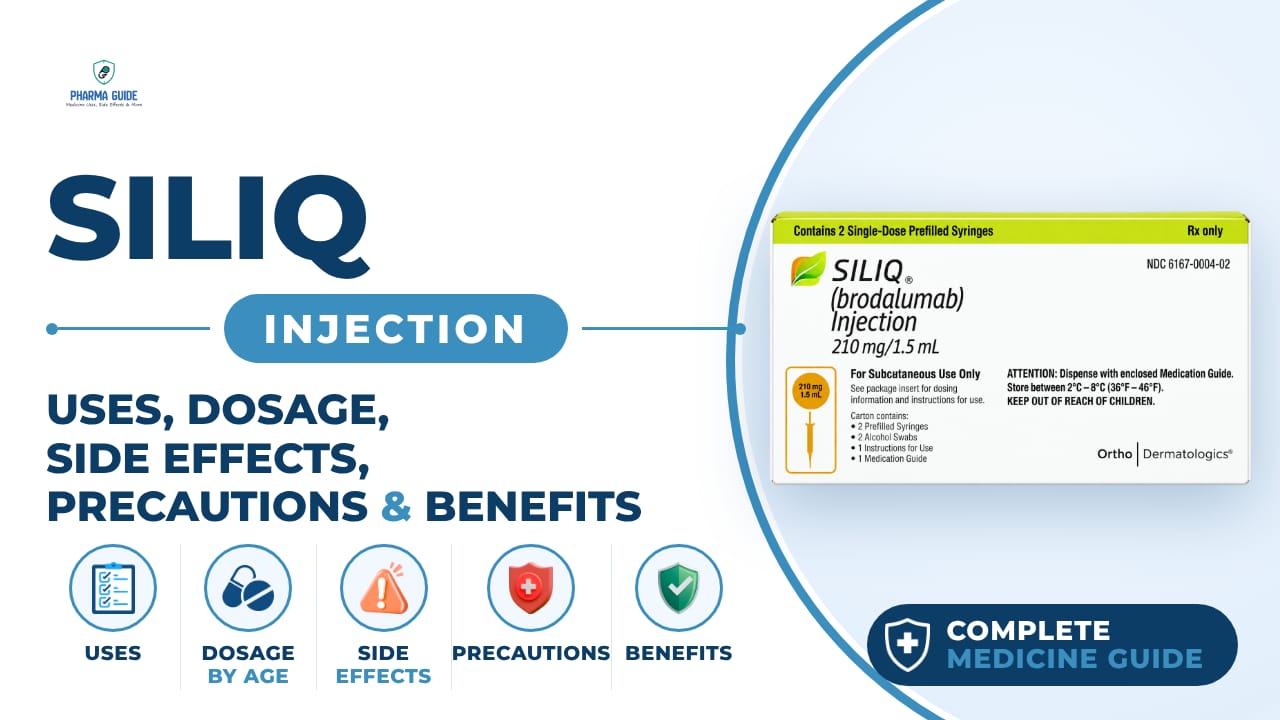
| Generic name | brodalumab |
|---|---|
| Drug class | Interleukin (IL) inhibitor / Biological Response Modifier (monoclonal antibody) |
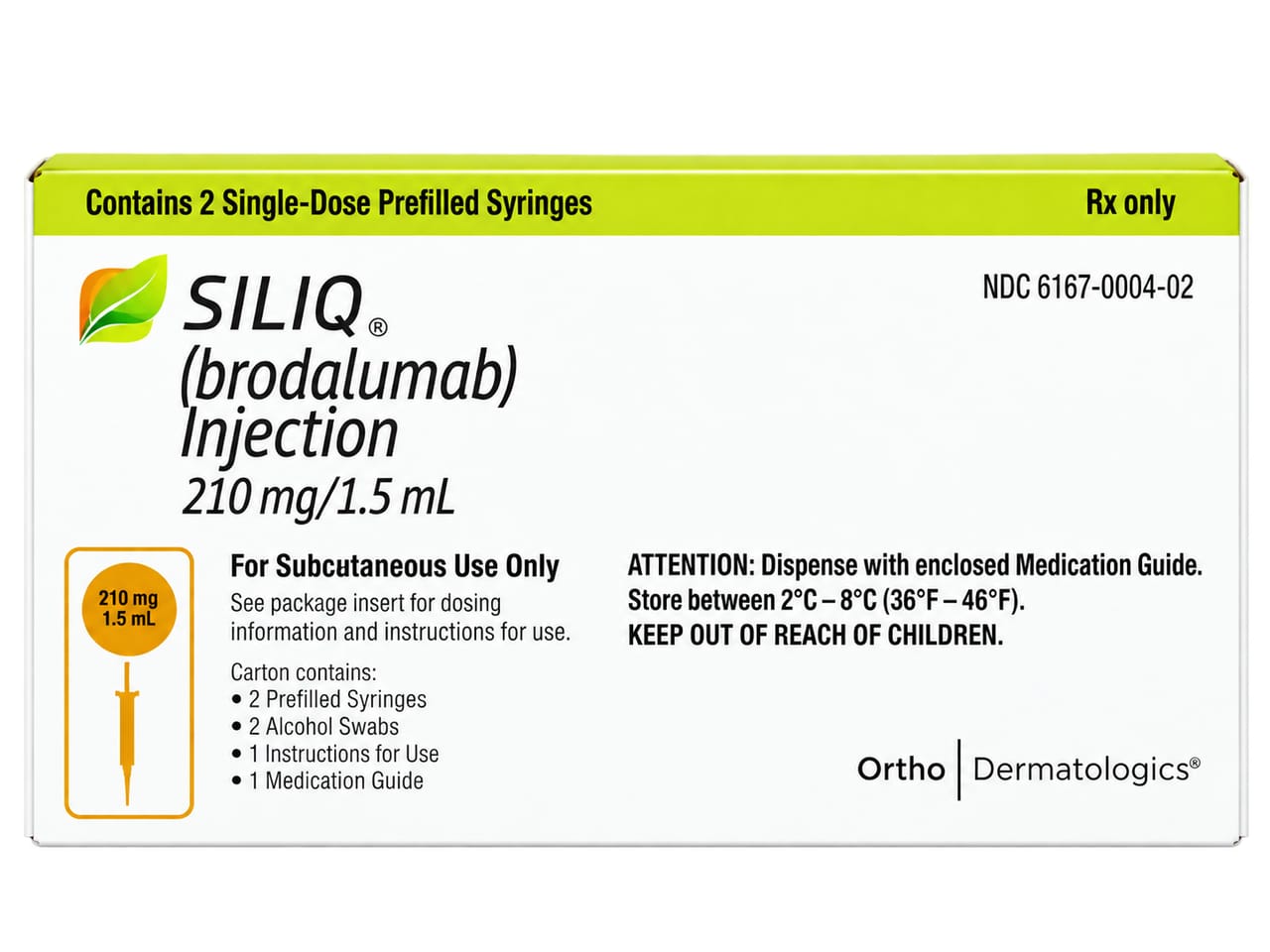
| Forms | Solution for injection in a single-use prefilled syringe (210 mg/1.5 mL) |
Quick overview
Siliq Injection (brodalumab) is a prescription biologic medicine, an interleukin (IL) inhibitor and biological response modifier, used to treat adults with moderate to severe plaque psoriasis. It is given as an injection under the skin and works by blocking a receptor involved in the inflammation that causes psoriasis. Siliq is typically used in people who have not responded well to, or have lost response to, other systemic therapies.
What is Siliq Injection
Siliq is a prescription injection medicine made from a human monoclonal antibody. It is used to treat adults with moderate to severe plaque psoriasis, a skin condition that causes red, scaly, thick patches on the skin.
Siliq Injection uses
- Treatment of moderate to severe plaque psoriasis in adults who are candidates for systemic therapy (pills or injections) or phototherapy (light treatment) and who have not responded or have lost response to other systemic therapies
Benefits of Siliq Injection
- Can lead to clearer skin, and in some people total skin clearance
- Can reduce itch, redness, scaling, burning, stinging, cracking, flaking, and pain from psoriasis
- Helps reduce skin plaques
How Siliq Injection works
Siliq contains brodalumab, an antibody that blocks a receptor called IL-17RA. This receptor is used by certain proteins (IL-17 cytokines) that are increased in psoriasis and cause inflammation. By blocking this receptor, Siliq reduces the inflammation that leads to psoriasis skin patches.
Siliq Injection dosage
Siliq is given as an injection under the skin (subcutaneous injection). A healthcare professional will give the first injection and can train the patient or a caregiver to give injections at home. Do not try to self-inject until properly trained by a healthcare provider.
Inject into the thigh or stomach area (abdomen), avoiding a 2-inch area around the navel; a caregiver may also inject into the outer upper arm. Do not inject into skin that is tender, bruised, red, hard, thick, scaly, or affected by psoriasis. Avoid injecting into areas with scars or stretch marks.
Let the prefilled syringe sit at room temperature for at least 30 minutes before injecting; do not warm it any other way. Do not shake the syringe. Each prefilled syringe is for one use only and should not be reused. Inject the full amount of medicine as instructed.
This medicine is not recommended for children and adolescents under 18 years because it has not been studied in this age group. No dose adjustment is needed for elderly patients.
| Age group | Dose |
|---|---|
| Under 18 years | Safety and effectiveness have not been established |
| 18–39 years | 210 mg subcutaneously at Weeks 0, 1, and 2, then 210 mg every 2 weeks |
| 40–64 years | 210 mg subcutaneously at Weeks 0, 1, and 2, then 210 mg every 2 weeks |
Available forms and strengths
- Solution for injection in a single-use prefilled syringe (210 mg/1.5 mL)
Side effects of Siliq Injection
Common
- Headache
- Joint pain (arthralgia)
- Feeling tired (fatigue)
- Mouth or throat pain
- Diarrhea
- Nausea
- Muscle pain
- Injection site reactions (pain, redness, bruising, bleeding, itching)
- Influenza (flu)
- Low white blood cell count (neutropenia)
- Fungal infections of the skin such as athlete's foot
- Bacterial or viral infections such as bronchitis
Serious
- Suicidal thoughts and behavior, including completed suicide
- New or worsening depression, anxiety, or other mood changes
- Crohn's disease or worsening of Crohn's disease, with diarrhea, stomach pain, or weight loss
- Serious infections, including tuberculosis and fungal infections such as cryptococcal meningitis
- Severe allergic reactions, including difficulty breathing or swallowing, swelling of the face, lips, tongue or throat, and severe itching with rash or raised bumps
Warnings and precautions
- Some people treated with this medicine have had suicidal thoughts and behaviors, including completed suicides. Tell your doctor right away about any new or worsening depression, anxiety, mood changes, or thoughts of suicide or self-harm.
- This medicine is contraindicated in people with Crohn's disease, because it can cause the disease to get worse. Tell your doctor if you develop diarrhea, bloody stools, stomach pain or cramping, loss of appetite, or weight loss.
- This medicine may increase the risk of infections, including serious ones. Tell your healthcare professional if you have a chronic infection or frequently get infections.
- Your doctor should check you for tuberculosis (TB) before you start this medicine. Do not take it if you have active TB infection.
- Do not receive live vaccines while taking this medicine, as it may increase the risk of infection from the vaccine.
- This medicine is available only through a special restricted program because of the risk of suicidal thoughts and behavior. Prescribers and patients must be enrolled in this program.
- It is not known if Siliq can harm an unborn baby. There are no adequate studies in pregnant women. Talk with your healthcare provider if you are pregnant or planning to become pregnant to decide if this medicine is right for you.
- It is not known if Siliq passes into breast milk or how it might affect a breastfed baby. Talk with your doctor if you are breastfeeding or plan to breastfeed.
- No specific studies have been done in patients with kidney problems, so effects in this group are not well known.
- No specific studies have been done in patients with liver problems, so effects in this group are not well known.
- There is no known direct interaction between alcohol and this medicine, but drinking alcohol may worsen psoriasis by increasing inflammation, and heavy drinking may make some medications work less well.
- This medicine is generally not expected to impair driving; avoid driving if dizziness or other symptoms occur.
Storage
- Store refrigerated at 2°C to 8°C in the original carton
- Prefilled syringes can be stored at room temperature between 20°C to 25°C in the original carton for a maximum single period of 14 days with protection from light and heat
- Once the prefilled syringe has reached room temperature, do not place it back into the refrigerator
- If not used within 14 days at room temperature, discard the prefilled syringe
- Keep in original carton to protect from light and physical damage
- Keep out of the sight and reach of children
- Do not freeze
- Do not shake
- Do not use beyond the expiration date on the label
- Do not throw away medicines via wastewater or household waste; ask your healthcare provider how to dispose of unused medicine
- Dispose of used syringes immediately in a sharps disposal container; do not throw them in household trash or recycling
When to see a doctor
- Get medical help right away if you have new or worsening depression, anxiety, thoughts of suicide or hurting yourself, changes in mood or behavior, acting on dangerous impulses, or a suicide attempt.
- Tell your healthcare provider right away if you have signs of an infection, such as fever, sweats or chills, muscle aches, cough, shortness of breath, sore throat or trouble swallowing, warm red or painful skin or sores, diarrhea or stomach pain, or burning or frequent urination.
- If you have a severe allergic reaction, such as difficulty breathing or swallowing, swelling of the face, lips, tongue, or throat, or severe itching with rash, stop the medicine and get immediate medical help.
- Tell your healthcare provider if you develop diarrhea, painful diarrhea, bloody stools, stomach pain or cramping, sudden or uncontrollable bowel movements, loss of appetite, constipation, weight loss, fever, or tiredness, as these may be signs of Crohn's disease.
- If you think you have used too much of this medicine, contact your healthcare professional, hospital emergency department, or your local poison control center right away, even if you have no symptoms.
Alternatives
- Skyrizi
- Tremfya
- Stelara
- Cosentyx
Watch the video
FAQs
What is Siliq Injection used for?
Siliq is used to treat moderate to severe plaque psoriasis in adults who are candidates for systemic therapy or phototherapy and who have not responded or have lost response to other systemic therapies.
How does Siliq Injection work?
Siliq contains brodalumab, an antibody that blocks a receptor called IL-17RA, which is used by IL-17 cytokines that are increased in psoriasis and cause inflammation. By blocking this receptor, Siliq reduces the inflammation that leads to psoriasis skin patches.
What is the dosage of Siliq Injection?
Siliq is given as a subcutaneous injection of 210 mg at Weeks 0, 1, and 2, followed by 210 mg every 2 weeks. It is not recommended for children and adolescents under 18 years, and no dose adjustment is needed for elderly patients.
What are the serious side effects of Siliq Injection?
Serious side effects include suicidal thoughts and behavior, new or worsening depression or anxiety, Crohn's disease or its worsening, serious infections such as tuberculosis or fungal infections, and severe allergic reactions.
How should Siliq Injection be stored?
Siliq should be stored refrigerated at 2°C to 8°C in its original carton. Prefilled syringes can be kept at room temperature (20°C to 25°C) for up to 14 days, protected from light and heat, but should not be placed back in the refrigerator once warmed, and should not be frozen or shaken.
General information, not medical advice
Your prescriber and the leaflet in your pack know your situation. This page does not.
- Follow your prescriber and the leaflet
- Don't start, stop, or change a dose on your own
- Doses and warnings differ by country and product
Sources
Video
Related medicines

Injectafer Injection: Uses, Dosage, Side Effects, Precautions and Alternates
Iron products
Injectafer (ferric carboxymaltose) treats iron deficiency anemia and heart failure-related iron deficiency via IV. Learn uses, dosage, side effects, and

Gliclazide Tablet: Uses, Dosage, Side Effects, Precautions and Alternates
Sulfonylurea (hypoglycemic/antidiabetic agent)
Gliclazide Tablet is a sulfonylurea for type 2 diabetes that boosts insulin release. Learn about dosage, side effects, warnings, and precautions.