
Safety
General information, not medical advice
Your prescriber and the leaflet in your pack know your situation. This page does not.
- Follow your prescriber and the leaflet
- Don't start, stop, or change a dose on your own
- Doses and warnings differ by country and product
Simponi Injection: Uses, Dosage, Side Effects, Precautions and Alternates
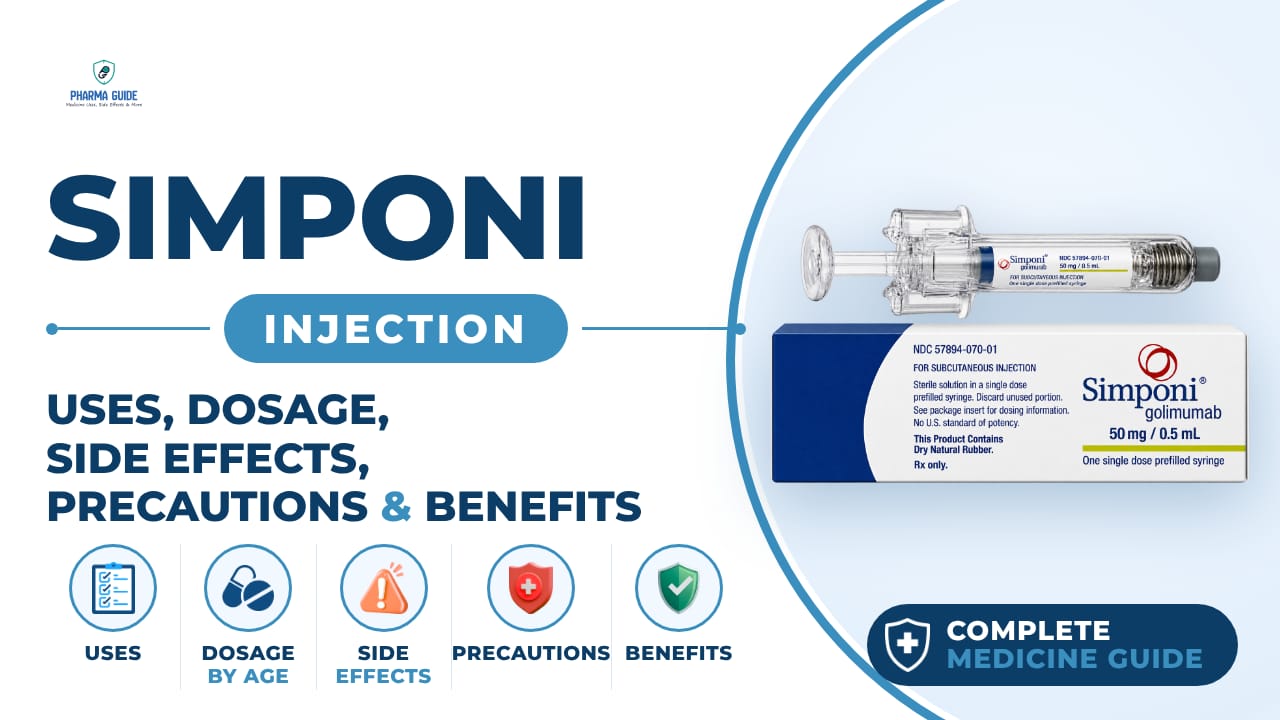
| Generic name | golimumab |
|---|---|
| Drug class | Tumor necrosis factor (TNF) blocker |
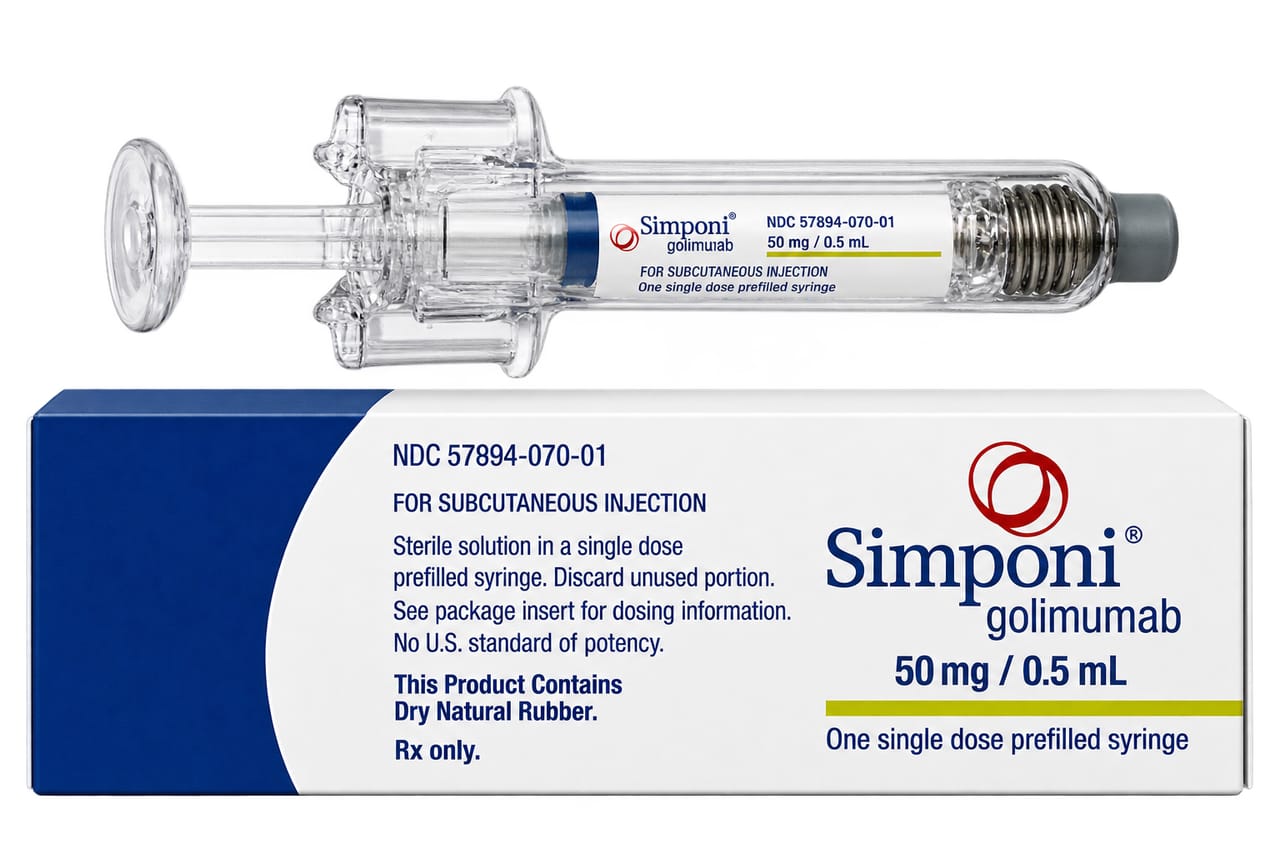
| Forms | Prefilled syringe (solution for subcutaneous injection), Prefilled SmartJect autoinjector |
Quick overview
Simponi Injection contains golimumab, a tumor necrosis factor (TNF) blocker given as an injection under the skin once a month. It is used for moderately to severely active rheumatoid arthritis, active psoriatic arthritis, and active ankylosing spondylitis in adults. Simponi works by blocking TNF, a protein involved in inflammation, and carries risks such as serious infections and other immune-related effects.
What is Simponi Injection
Simponi is a prescription medicine that affects the immune system. It contains golimumab, a human monoclonal antibody that is given as an injection under the skin once a month to treat certain inflammatory and autoimmune conditions.
Simponi Injection uses
- Moderately to severely active rheumatoid arthritis (RA) in adults, usually combined with methotrexate
- Active psoriatic arthritis (PsA) in adults, alone or with methotrexate
- Active ankylosing spondylitis (AS) in adults
Benefits of Simponi Injection
- Inflammation Control: Blocks TNF, an inflammatory protein involved in several autoimmune conditions.
- Rheumatoid Arthritis Support: Helps reduce joint inflammation, pain, and stiffness.
- Psoriatic Arthritis Support: Helps control inflammatory joint symptoms.
- Ankylosing Spondylitis Support: Helps reduce inflammation and stiffness of the spine.
- Ulcerative Colitis Support: Helps induce and maintain remission in eligible patients.
How Simponi Injection works
Golimumab attaches to a protein in the body called tumor necrosis factor (TNF) alpha. In certain inflammatory diseases, the body makes too much TNF, which causes the immune system to attack healthy parts of the body. By blocking TNF, golimumab helps stop this damage.
Simponi Injection dosage
Simponi is given as an injection under the skin, once a month, on the same date each month. It can be used with or without food or drink. Inject the full amount in the syringe or injector pen to make sure you get the correct dose.
The first injection should be given under the supervision of a healthcare professional. If you or a caregiver will give later injections at home, you should be trained first, and you should not try to inject yourself until you have been shown the right way by your doctor or nurse.
If you forget a dose, inject it as soon as you remember, then go back to your regular monthly schedule. Do not double up to make up for a missed dose.
Before injecting, let the prefilled syringe or autoinjector sit at room temperature outside the carton for 30 minutes. Do not warm it any other way, such as in a microwave or hot water. Do not remove the needle cover or cap until right before the injection. Rotate injection sites and do not inject into skin that is tender, bruised, red, or hard.
| Age group | Dose |
|---|---|
| Under 18 Years | Use only under specialist supervision; dosing depends on indication and body weight |
| 18–64 Years | Usually 50 mg subcutaneously once monthly for approved indications |
| Older Adults (65+ Years) | Usually 50 mg subcutaneously once monthly; individualized according to medical condition |
Available forms and strengths
- Prefilled syringe (solution for subcutaneous injection)
- Prefilled SmartJect autoinjector
Side effects of Simponi Injection
Common
- Upper respiratory infection (runny nose, sore throat, hoarseness or laryngitis)
- Reaction at the injection site (redness, swelling, itching, pain, bruising, or tingling)
- Viral infections such as flu and cold sores
- High blood pressure
- Abnormal liver function test results
Serious
- Serious infections such as tuberculosis, fungal infections, and sepsis that can lead to hospitalization or death
- Reactivation of hepatitis B in people who carry the virus
- Lymphoma and other cancers, including rare cases in children and teenagers
- New or worsening heart failure
- Nervous system problems such as multiple sclerosis or Guillain-Barré syndrome
- Lupus-like symptoms (rash, joint pain, chest pain, tiredness)
- Liver problems that can lead to liver failure
- Low blood cell counts (easy bruising, bleeding, fever, paleness)
- Serious allergic reactions including anaphylaxis
- New or worsening psoriasis
Warnings and precautions
- Simponi can lower your ability to fight infections. Serious infections including tuberculosis and infections that spread through the body have occurred, and some people have died from these infections.
- You should not start Simponi if you have any kind of infection unless your doctor says it is okay.
- Your doctor should test you for tuberculosis and hepatitis B before you start Simponi, and should monitor you closely for signs of TB during treatment.
- For children and adults taking TNF-blocker medicines like Simponi, the chance of developing cancer, including unusual cancers in children and teenagers, may increase.
- New or worsening heart failure can happen in people taking Simponi.
- Do not use Simponi together with the medicines abatacept (Orencia) or anakinra (Kineret), since this combination raises infection risk.
- People taking Simponi should not receive live vaccines.
- It is not known if Simponi can harm an unborn baby. Simponi should only be used during pregnancy if clearly needed, and you should use effective contraception while on treatment and for at least 6 months after the last dose.
- It is not known whether Simponi passes into breast milk. Your doctor may advise you to stop breastfeeding while using this medicine and for at least six months after the last dose.
- Serious liver problems, including liver failure and death, can happen in people using TNF blockers like Simponi. Call your doctor right away if you notice signs such as tiredness, yellowing of the skin or eyes, poor appetite, vomiting, or pain on the right side of your stomach.
- Simponi is not expected to affect your ability to drive or use machines, but be careful until you know how it affects you, especially if you feel dizzy.
Storage
- Refrigerate at 36°F to 46°F (2°C to 8°C)
- Do not freeze
- Keep in the original carton to protect from light when not in use
- Do not shake
- Keep out of the reach of children
- Do not use beyond the expiration date on the carton or syringe
- After injecting, place the used injection device immediately into a sharps/puncture-resistant container; do not put it in normal household or recycling waste
- If you need to stop treatment or the medicine has expired, ask your pharmacist what to do with any that is left over
When to see a doctor
- Call your doctor right away if you have any symptoms of infection, such as fever, chills, cough, shortness of breath, weight loss, tiredness, or pain or burning when urinating.
- Seek care if you notice signs of possible hepatitis B infection, like feeling very tired, dark urine, yellowing of skin or eyes, loss of appetite, vomiting, or stomach discomfort.
- Call your doctor right away if you get new or worsening symptoms of heart failure, such as shortness of breath or swelling of your lower legs or feet.
- Tell your doctor right away if you notice vision changes, weakness in your arms or legs, or numbness or tingling anywhere in your body.
- Call your doctor right away if you develop signs of liver problems, such as feeling very tired, yellow skin or eyes, poor appetite, vomiting, or pain on the right side of your stomach.
- Stop using Simponi and call your doctor right away, or seek emergency care, if you have signs of an allergic reaction, such as hives, swollen face, trouble breathing, or chest pain.
- Tell your doctor if you notice red scaly patches or raised pus-filled bumps on your skin, which could be new or worsening psoriasis.
Alternatives
- Adalimumab
- Etanercept
- Infliximab
Watch the video
FAQs
What is Simponi Injection used for?
Simponi is used to treat moderately to severely active rheumatoid arthritis, active psoriatic arthritis, and active ankylosing spondylitis in adults.
How often is Simponi Injection given?
Simponi is given as an injection under the skin once a month, on the same date each month, usually at a dose of 50 mg.
What are the serious side effects of Simponi?
Serious side effects include serious infections like tuberculosis, hepatitis B reactivation, lymphoma and other cancers, new or worsening heart failure, nervous system problems, liver problems, low blood cell counts, and serious allergic reactions.
What should I do if I miss a dose of Simponi?
If you forget a dose, inject it as soon as you remember, then return to your regular monthly schedule. Do not double the dose to make up for a missed one.
How should Simponi Injection be stored?
Simponi should be refrigerated at 36°F to 46°F (2°C to 8°C), not frozen, kept in its original carton to protect from light, and not shaken.
General information, not medical advice
Your prescriber and the leaflet in your pack know your situation. This page does not.
- Follow your prescriber and the leaflet
- Don't start, stop, or change a dose on your own
- Doses and warnings differ by country and product
Sources
Video
Related medicines

Injectafer Injection: Uses, Dosage, Side Effects, Precautions and Alternates
Iron products
Injectafer (ferric carboxymaltose) treats iron deficiency anemia and heart failure-related iron deficiency via IV. Learn uses, dosage, side effects, and

Gliclazide Tablet: Uses, Dosage, Side Effects, Precautions and Alternates
Sulfonylurea (hypoglycemic/antidiabetic agent)
Gliclazide Tablet is a sulfonylurea for type 2 diabetes that boosts insulin release. Learn about dosage, side effects, warnings, and precautions.