
Safety
General information, not medical advice
Your prescriber and the leaflet in your pack know your situation. This page does not.
- Follow your prescriber and the leaflet
- Don't start, stop, or change a dose on your own
- Doses and warnings differ by country and product
Singulair Tablet: Uses, Dosage, Side Effects, Precautions and Alternates
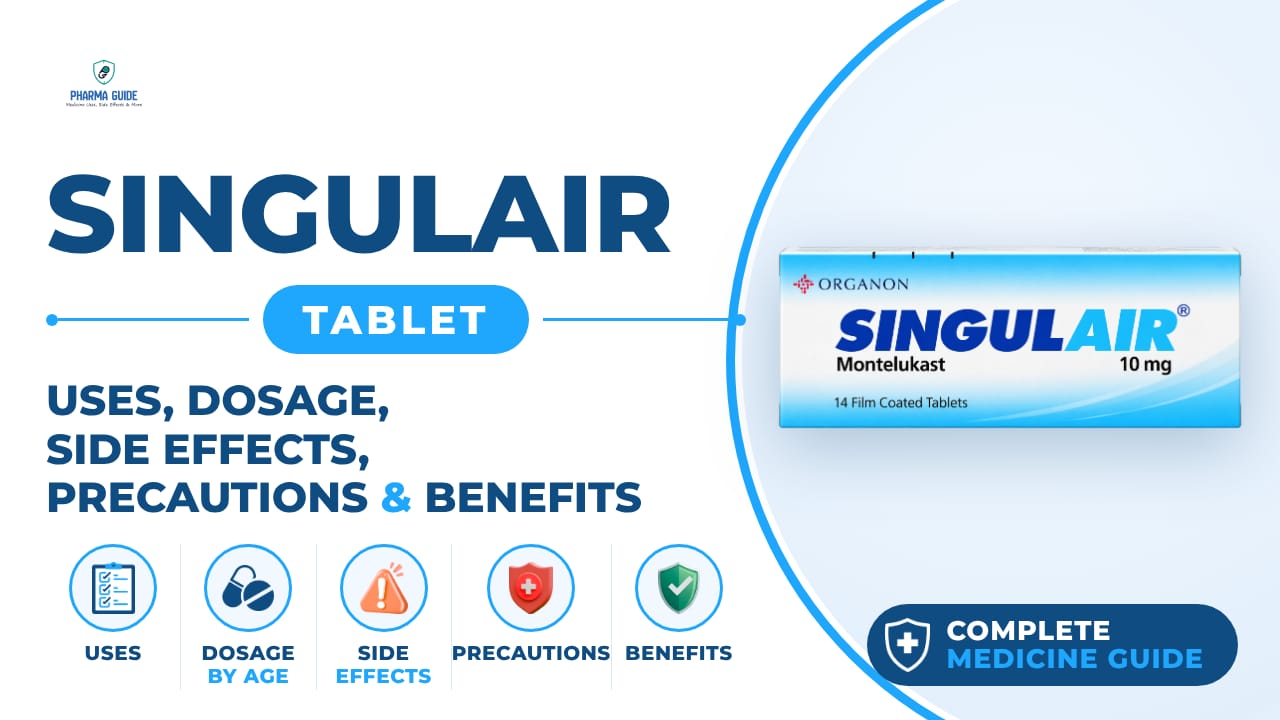
| Generic name | Montelukast (as montelukast sodium) |
|---|---|
| Drug class | Leukotriene receptor antagonist (leukotriene modifier) |
| Forms | 10-mg film-coated tablets, 4-mg and 5-mg chewable tablets, 4-mg oral granules |

Quick overview
Singulair Tablet contains montelukast (as montelukast sodium), a leukotriene receptor antagonist that does not contain a steroid. It is used to prevent and treat asthma long-term, prevent exercise-induced airway narrowing, and relieve symptoms of seasonal and perennial allergic rhinitis. It works by blocking leukotrienes, substances in the body that cause airway narrowing, swelling, and allergy symptoms. It is available as regular tablets, chewable tablets, and oral granules in different strengths for different age groups.
What is Singulair Tablet
Singulair is a prescription medicine that blocks substances in the body called leukotrienes, which cause narrowing and swelling of the airways in the lungs and contribute to allergy symptoms. It does not contain a steroid.
Singulair Tablet uses
- Prevention and long-term (chronic) treatment of asthma in adults and children 12 months of age and older
- Prevention of exercise-induced bronchoconstriction (narrowing of airways triggered by exercise) in people 6 years of age and older
- Relief of symptoms of seasonal allergic rhinitis (outdoor allergies/hay fever) in adults and children 2 years of age and older
- Relief of symptoms of perennial allergic rhinitis (year-round indoor allergies) in adults and children 6 months of age and older
Benefits of Singulair Tablet
- Helps improve asthma symptoms and helps control asthma
- Helps prevent narrowing of the airways triggered by exercise
- Helps relieve symptoms of seasonal and perennial allergic rhinitis such as sneezing, stuffy nose, runny nose, and itching of the nose
How Singulair Tablet works
Singulair blocks leukotrienes, natural substances in the body that cause the airways in the lungs to narrow and swell and that also trigger allergy symptoms. By blocking these substances, it helps improve asthma control and reduce allergy symptoms.
Singulair Tablet dosage
Take Singulair exactly as prescribed by your healthcare provider. It can be taken with or without food. For asthma, take it once daily in the evening. For allergic rhinitis, take it once daily at about the same time each day; the timing (morning or evening) may be adjusted to suit the patient's needs. For prevention of exercise-induced breathing problems, take a single dose at least 2 hours before exercise, and do not take another dose within 24 hours of the previous dose. If you already take Singulair daily for asthma or allergic rhinitis, do not take an extra dose before exercise. Patients with both asthma and allergic rhinitis should take only one dose daily, in the evening.
Swallow the regular tablet whole; the chewable tablet must be chewed before swallowing. Oral granules can be placed directly in the mouth, dissolved in a small amount of cold or room-temperature baby formula or breast milk, or mixed with a spoonful of cold or room-temperature soft food such as applesauce, mashed carrots, rice, or ice cream; only these foods should be used. Do not open the oral granule packet until ready to use, and give the full dose within 15 minutes of opening or mixing; do not store any leftover mixture for later use. Oral granules should not be dissolved in any liquid other than baby formula or breast milk, but other liquids may be taken afterward.
Do not stop taking Singulair or change how you take it without talking to your healthcare provider first. Continue taking it every day as prescribed, even when you have no symptoms. Do not use Singulair to treat a sudden asthma attack; always have your rescue inhaler available. If you miss a dose, take the next dose at the regular time; do not take two doses at the same time. Do not take other products that contain the same active ingredient, montelukast, while taking Singulair.
| Age group | Dose |
|---|---|
| Under 1 year | Not recommended |
| 1–5 years | 4 mg once daily |
| 6–14 years | 5 mg once daily |
| 15 years & older | 10 mg once daily |
| Adults | 10 mg once daily |
Available forms and strengths
- 10-mg film-coated tablets
- 4-mg and 5-mg chewable tablets
- 4-mg oral granules
Side effects of Singulair Tablet
Common
- Upper respiratory infection
- Fever
- Headache
- Sore throat (pharyngitis)
- Cough
- Stomach (abdominal) pain
- Diarrhea
- Earache or ear infection (otitis media)
- Flu (influenza)
- Runny nose (rhinorrhea)
- Sinus infection (sinusitis)
Serious
- Behavior and mood-related changes: agitation, aggressive behavior or hostility, anxiousness, depression, disorientation, dream abnormalities, hallucinations, insomnia, irritability, restlessness, sleep walking, suicidal thoughts and actions (including suicide), tremor
- Increase in certain white blood cells (eosinophils) with possible inflammation of blood vessels throughout the body (systemic vasculitis / eosinophilic granulomatosis with polyangiitis, formerly Churg-Strauss syndrome), which can cause flu-like illness, pins and needles or numbness of arms or legs, rash, or severe sinus inflammation
- Allergic reactions including swelling of the face, lips, tongue, and/or throat, which may cause difficulty breathing or swallowing, hives, and itching
- Increased bleeding tendency and low blood platelet count
- Liver problems including hepatitis, with symptoms such as nausea, vomiting, fatigue, jaundice (yellowing of skin and eyes), dark urine, or pain in the abdomen
- Severe skin reactions (erythema multiforme) that may occur without warning
- Seizures (convulsions)
- Palpitations
Warnings and precautions
- Serious mental health problems, including suicidal thoughts and actions, have occurred in people taking Singulair, sometimes even after stopping treatment. Stop the medicine and contact your healthcare provider right away if unusual changes in mood or behavior occur.
- Singulair is not meant to treat a sudden asthma attack. Always keep fast-acting rescue medicine available for attacks.
- Do not suddenly stop or lower the dose of inhaled or oral corticosteroids when starting Singulair; any reduction should be done gradually and under medical supervision.
- If you have asthma that gets worse with aspirin, continue to avoid aspirin and other NSAIDs while taking Singulair.
- Rare cases of increased eosinophils with vasculitis-like symptoms (a condition similar to Churg-Strauss syndrome) have been reported, sometimes linked to reducing oral steroid medicines.
- People with phenylketonuria should know that the 4-mg and 5-mg chewable tablets contain phenylalanine.
- Singulair should be used during pregnancy only if clearly needed. Talk to your doctor before taking it if you are pregnant or plan to become pregnant.
- It is not known if Singulair passes into breast milk. Talk to your doctor about the best way to feed your baby if you are breastfeeding.
- No dosage adjustment is needed for patients with kidney problems.
- No dosage adjustment is needed for mild-to-moderate liver problems, but caution is advised, as Singulair may increase the risk of liver damage in some cases; more severe liver impairment has not been studied.
- Avoid alcohol while taking this medicine, as it may increase dizziness and the risk of liver damage.
- Singulair is not expected to affect your ability to drive or operate machinery, but rare side effects like dizziness or drowsiness could affect some people's ability to do so.
Storage
- Store at 59°F to 86°F (15°C to 30°C)
- Protect from moisture and light
- Keep in the original container/package
- Do not remove tablets from the blister pack until ready to take
- Keep out of the sight and reach of children
- Do not use past the expiry date
- Medicines should not be disposed of via wastewater or household waste; ask your pharmacist how to dispose of medicines no longer required
When to see a doctor
- Get emergency help for signs of an allergic reaction, such as hives, blisters, severe itching, difficulty breathing, or swelling of the face, lips, tongue, or throat
- Tell your doctor right away if you notice signs of blood vessel inflammation, such as flu-like symptoms, severe sinus pain, skin rash, or numbness/pins-and-needles feeling in the arms or legs
- Stop taking the medicine and contact your healthcare provider immediately if you or your child have any unusual changes in mood or behavior, including agitation, aggression, anxiety, depression, confusion, hallucinations, sleep problems, or suicidal thoughts or actions
- Seek medical attention if your breathing problems suddenly get worse, or if you feel your asthma medications are not working as well as before
- If you think you have taken too much Singulair, contact your doctor or a poison control center right away
Alternatives
- Other brand or generic tablets containing montelukast
- Singulair 4 mg and 5 mg tablets
Watch the video
FAQs
What is Singulair Tablet used for?
Singulair is used for prevention and long-term treatment of asthma, prevention of exercise-induced bronchoconstriction, and relief of symptoms of seasonal and perennial allergic rhinitis.
How does Singulair work?
Singulair blocks leukotrienes, natural substances in the body that cause airways to narrow and swell and that trigger allergy symptoms, helping improve asthma control and reduce allergy symptoms.
When should Singulair be taken?
For asthma, it is taken once daily in the evening. For allergic rhinitis, it is taken once daily at about the same time each day. For exercise-induced breathing problems, a single dose should be taken at least 2 hours before exercise, without taking another dose within 24 hours.
Can Singulair be used to treat a sudden asthma attack?
No, Singulair is not meant to treat a sudden asthma attack. A fast-acting rescue inhaler should always be kept available for attacks.
What are the serious side effects of Singulair?
Serious side effects include behavior and mood-related changes such as agitation, depression, hallucinations, and suicidal thoughts; increased eosinophils with possible vasculitis; allergic reactions; liver problems; severe skin reactions; and seizures.
General information, not medical advice
Your prescriber and the leaflet in your pack know your situation. This page does not.
- Follow your prescriber and the leaflet
- Don't start, stop, or change a dose on your own
- Doses and warnings differ by country and product
Sources
Video
Related medicines

Injectafer Injection: Uses, Dosage, Side Effects, Precautions and Alternates
Iron products
Injectafer (ferric carboxymaltose) treats iron deficiency anemia and heart failure-related iron deficiency via IV. Learn uses, dosage, side effects, and

Gliclazide Tablet: Uses, Dosage, Side Effects, Precautions and Alternates
Sulfonylurea (hypoglycemic/antidiabetic agent)
Gliclazide Tablet is a sulfonylurea for type 2 diabetes that boosts insulin release. Learn about dosage, side effects, warnings, and precautions.