
Safety
General information, not medical advice
Your prescriber and the leaflet in your pack know your situation. This page does not.
- Follow your prescriber and the leaflet
- Don't start, stop, or change a dose on your own
- Doses and warnings differ by country and product
Sogroya Injection: Uses, Dosage, Side Effects, Precautions and Alternates
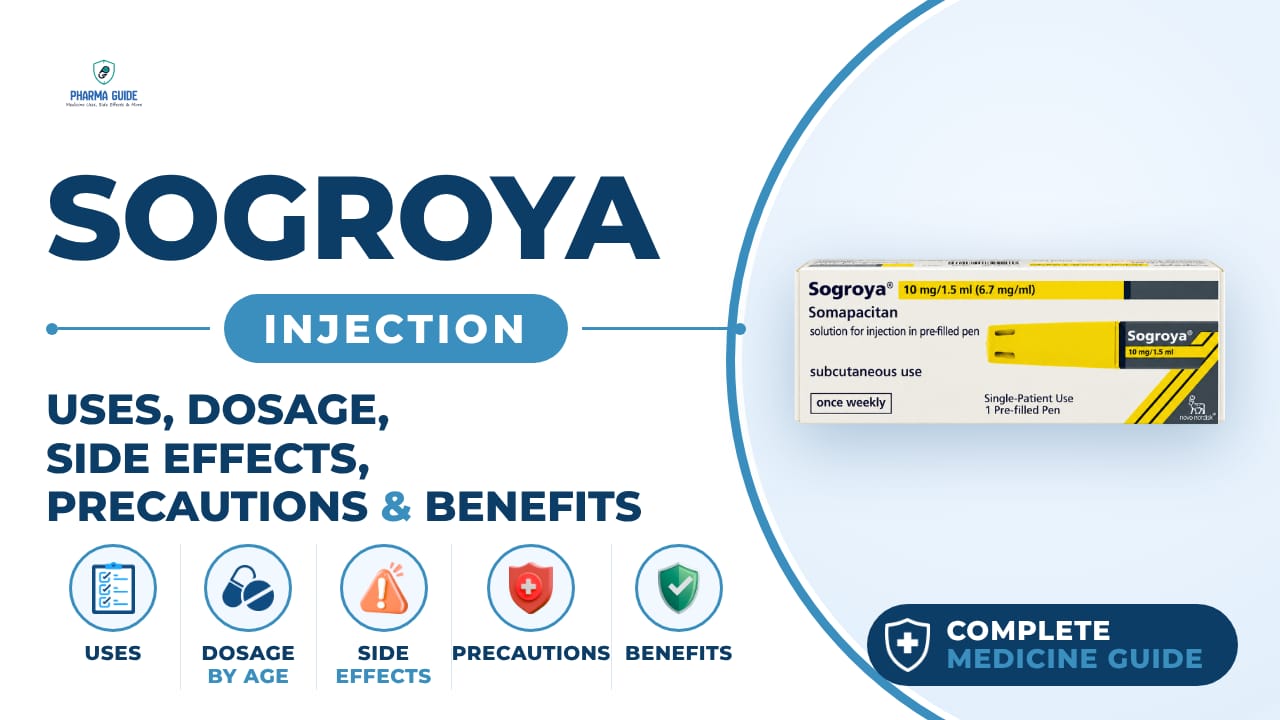
| Generic name | somapacitan |
|---|---|
| Drug class | Human growth hormone analog |
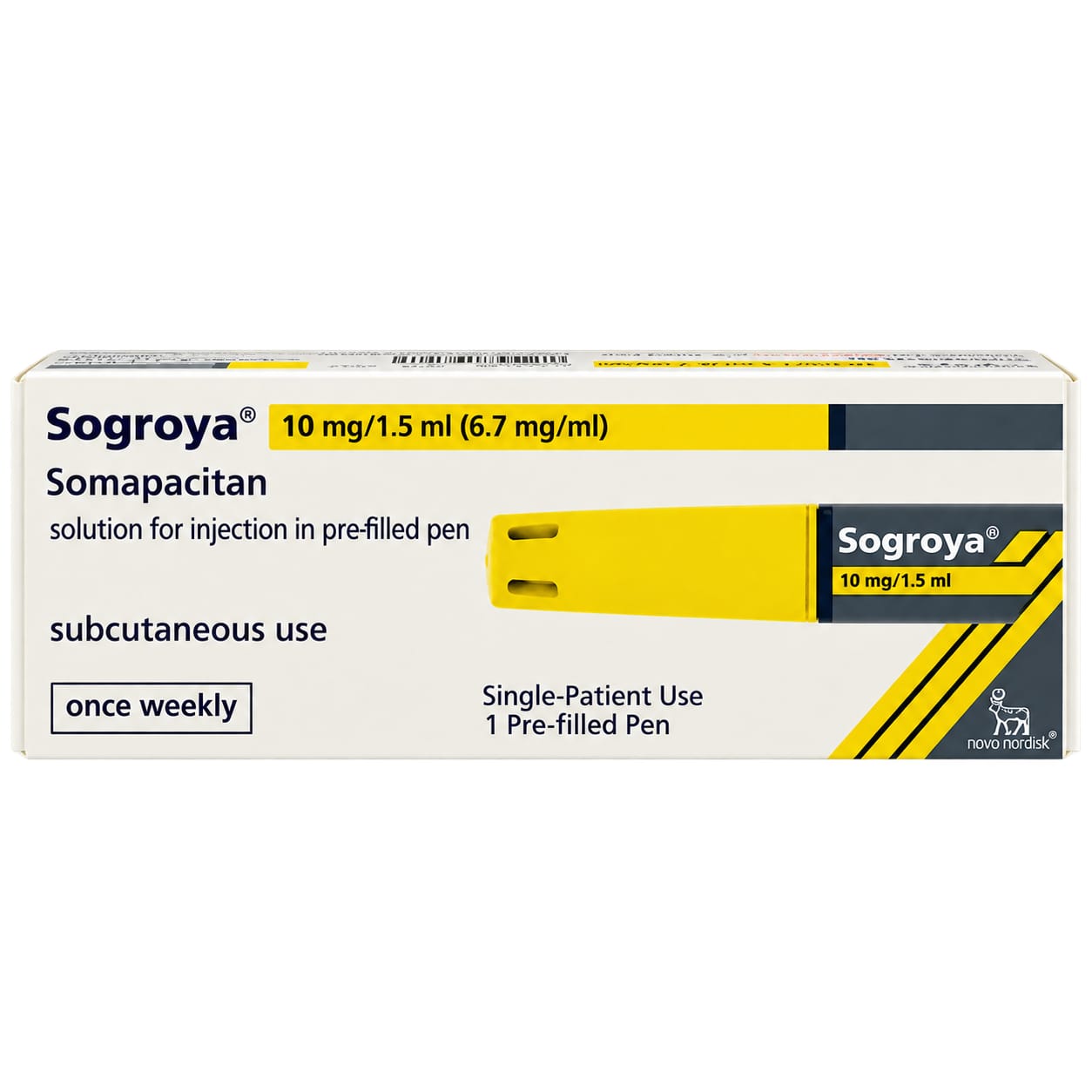
| Forms | Solution for injection in a pre-filled pen (5 mg/1.5 mL, 10 mg/1.5 mL, and 15 mg/1.5 mL strengths) |
Quick overview
Sogroya Injection (somapacitan) is a long-acting human growth hormone analog given as a once-weekly injection. It is used to treat growth hormone deficiency in children and adults, as well as certain other growth conditions in children. Its main advantage is that it requires only one injection per week instead of daily injections.
What is Sogroya Injection
Sogroya is a long-acting man-made version of human growth hormone, given as an injection once a week. It is used to treat people whose bodies do not make enough natural growth hormone.
Sogroya Injection uses
- Growth failure in children and adolescents due to growth hormone deficiency
- Short stature in children born small for gestational age with no catch-up growth by age 2 (US labeling)
- Growth failure associated with Noonan syndrome in children (US labeling)
- Idiopathic Short Stature in children (US labeling)
- Growth hormone deficiency in adults, to replace the body's natural growth hormone
Benefits of Sogroya Injection
- Needs only one injection per week instead of daily injections, which may make treatment easier to stick with
- As effective as daily growth hormone injections for improving growth in children with growth hormone deficiency
- Helps normalize body composition in adults with growth hormone deficiency (less body fat, more lean body mass)
How Sogroya Injection works
Sogroya is similar to the body's natural growth hormone but has one amino acid changed, with a special attachment that binds to a protein called albumin in the blood. This binding slows down how quickly the medicine is broken down and removed from the body, so it lasts much longer and only needs to be injected once a week instead of every day.
Sogroya Injection dosage
Inject under the skin once a week, at any time of the day, preferably on the same day each week. Inject into the front of the thighs, the abdomen, the buttocks, or the upper arms, and change the injection site every week to avoid skin changes. Do not inject into a vein or muscle.
If switching from another once-weekly growth hormone, continue injecting on the same weekly day. If switching from daily growth hormone, choose a preferred weekly day and take the last daily dose the day before, or at least 8 hours before, the first weekly dose.
If the usual injection day is missed, it can be given up to 2 days early or 3 days late, as long as at least 4 days have passed since the last dose. The weekly injection day can be changed as long as at least 4 days have passed since the last injection. Do not inject more often than once a week. Do not stop using this medicine without talking to your doctor first.
| Age group | Dose |
|---|---|
| Under 2.5 years | Safety and effectiveness are not established |
| 2.5–17 years | 0.16 mg/kg once weekly |
| 18–64 years | 1.5 mg once weekly |
Available forms and strengths
- Solution for injection in a pre-filled pen (5 mg/1.5 mL, 10 mg/1.5 mL, and 15 mg/1.5 mL strengths)
Side effects of Sogroya Injection
Common
- Headache
- Joint pain and muscle pain or stiffness
- Pain in arms or legs
- Swollen hands or feet from fluid retention
- Redness and pain at the injection site
- Feeling very tired or weak
- Decreased thyroid hormone (can cause tiredness, weight gain, feeling cold)
- High blood sugar
- Tingling or numbness in fingers, hands, or feet
- Thickening of the skin where you inject
Serious
- Increased pressure in the brain, with severe or recurring headaches, eyesight problems, nausea or vomiting
- The body not making enough adrenal steroid hormones (adrenocortical insufficiency), with symptoms like severe weakness, confusion, abdominal pain, nausea, vomiting
- Persistent hip or knee pain or limping, which could mean a problem with the hip bone (slipped capital femoral epiphysis) or loss of bone tissue (osteonecrosis)
- Serious allergic reactions, including swelling of the face, lips, tongue or throat, or widespread skin rash
- Worsening of curved spine (scoliosis) in children
- Inflammation of the pancreas (pancreatitis), which can cause severe abdominal pain
- Growth or return of tumors
Warnings and precautions
- Do not use this medicine if you have an active or growing tumor; any anti-tumor treatment must be finished first, and treatment must stop if a tumor starts growing again.
- Do not use this medicine if you have recently had major surgery (such as open-heart or abdominal surgery), serious trauma, or severe breathing problems, because growth hormone has been linked to a higher risk of death in these situations.
- Do not use this medicine if your child's bones have already stopped growing (closed growth plates), as it will no longer work for height growth.
- This medicine should not be used in children with Prader-Willi syndrome who are severely obese or have serious breathing problems, including sleep apnea, due to a risk of sudden death.
- This medicine can affect blood sugar control; people with diabetes or at risk of diabetes need regular blood sugar monitoring and may need their diabetes medicine doses adjusted.
- Rotate the injection site every week, as using the same spot repeatedly can cause changes in the skin and fatty tissue underneath.
- Children growing quickly on this medicine may be at higher risk of a hip problem called slipped capital femoral epiphysis; persistent hip or knee pain or limping should be checked by a doctor.
- Sogroya is not recommended for women who could become pregnant unless they use reliable contraception, because it is not known if it could harm an unborn baby. Tell your doctor right away if you become pregnant while using this medicine, as treatment may need to stop.
- It is not known if this medicine passes into breast milk. Talk to your doctor, who will help you decide whether to continue breastfeeding or continue treatment, weighing the benefits of each.
- No change to the starting dose is needed for people with kidney problems, but your doctor may still need to adjust your dose based on your individual needs.
- No change to the starting dose is generally needed for mild liver problems. People with moderate liver impairment may need a different starting dose and monitoring, and this medicine is not recommended for people with severe liver impairment.
- There is no information available on using this medicine together with alcohol.
- This medicine is not expected to affect your ability to drive, ride a bicycle, or use machines.
Storage
- Store in a refrigerator between 2°C and 8°C
- Do not freeze; keep away from the cooling/freezing element
- Keep the pen in the outer carton with the pen cap on to protect it from light
- If refrigeration is not possible, the pen may be kept at temperatures below 30°C for up to a total of 72 hours (3 days), then must be returned to the refrigerator
- Keep track of any time spent outside the refrigerator; total time out of the fridge must not exceed 3 days
- Discard the pen if it has been kept above 30°C for any length of time, or outside the fridge for more than 72 hours
- Use within 6 weeks after first use
- Always remove the injection needle after each injection and store the pen without a needle attached
- Do not use if the solution is cloudy, colored, or contains visible particles
- Do not use after the expiry date on the label
- Keep out of the sight and reach of children
- Take unused or expired medicine to a pharmacy for safe disposal
When to see a doctor
- Get medical help immediately if you notice swelling of the face, lips, tongue or throat, trouble breathing, or a widespread skin rash, as these can be signs of a serious allergic reaction.
- Call your doctor right away or go to the emergency department if you have severe or recurring headaches, eyesight problems, nausea, or vomiting, as these could be signs of increased pressure in the brain.
- Seek medical attention right away if you or your child develops persistent hip or knee pain or starts to limp during treatment.
- Contact your doctor if you experience symptoms such as severe weakness, confusion, abdominal pain, nausea, or vomiting, which could mean your body is not making enough adrenal steroid hormones.
- If you think you or your child has used too much of this medicine, seek urgent medical attention even if you feel fine.
- Tell your doctor immediately if you become pregnant while using this medicine.
- Talk to your doctor about any new, severe, constant abdominal pain, as this could be a sign of pancreatitis.
Alternatives
- Skytrofa
- Norditropin
- Genotropin
Watch the video
FAQs
What is Sogroya Injection used for?
Sogroya is used to treat growth failure due to growth hormone deficiency in children and adults, short stature in children born small for gestational age, growth failure linked to Noonan syndrome, and idiopathic short stature in children.
How often is Sogroya injected?
Sogroya is injected under the skin once a week, at any time of day, preferably on the same day each week, instead of requiring daily injections.
What is the dose of Sogroya for adults?
Adults aged 18 to 64 years are typically given 1.5 mg once weekly, though doctors may adjust doses based on individual needs.
What are the common side effects of Sogroya Injection?
Common side effects include headache, joint and muscle pain, pain in arms or legs, swollen hands or feet, redness and pain at the injection site, tiredness, decreased thyroid hormone, high blood sugar, and tingling or numbness.
How should Sogroya Injection be stored?
Sogroya should be stored in a refrigerator between 2°C and 8°C, protected from light, and not frozen. If needed, it can be kept below 30°C for up to 72 hours before returning to the fridge, and used within 6 weeks after first use.
General information, not medical advice
Your prescriber and the leaflet in your pack know your situation. This page does not.
- Follow your prescriber and the leaflet
- Don't start, stop, or change a dose on your own
- Doses and warnings differ by country and product
Sources
Video
Related medicines

Injectafer Injection: Uses, Dosage, Side Effects, Precautions and Alternates
Iron products
Injectafer (ferric carboxymaltose) treats iron deficiency anemia and heart failure-related iron deficiency via IV. Learn uses, dosage, side effects, and

Gliclazide Tablet: Uses, Dosage, Side Effects, Precautions and Alternates
Sulfonylurea (hypoglycemic/antidiabetic agent)
Gliclazide Tablet is a sulfonylurea for type 2 diabetes that boosts insulin release. Learn about dosage, side effects, warnings, and precautions.