
Safety
General information, not medical advice
Your prescriber and the leaflet in your pack know your situation. This page does not.
- Follow your prescriber and the leaflet
- Don't start, stop, or change a dose on your own
- Doses and warnings differ by country and product
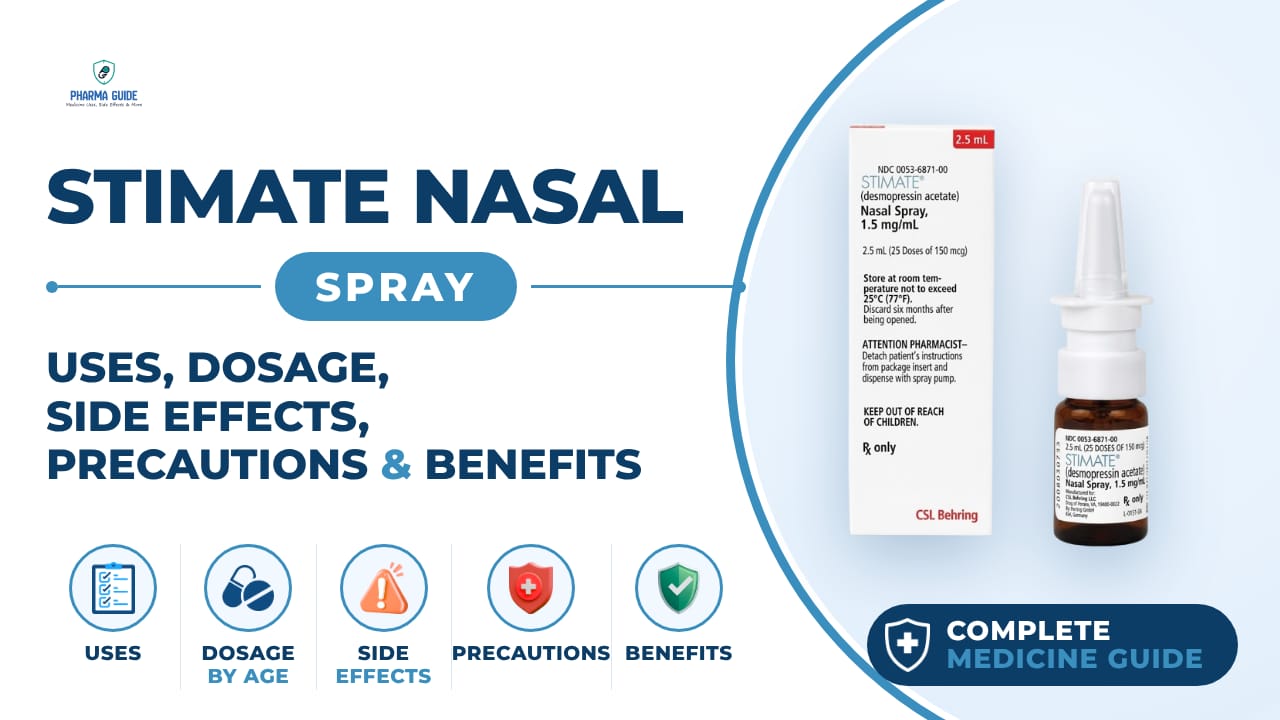
Stimate Nasal Spray: Uses, Dosage, Side Effects, Precautions and Alternates
| Generic name | desmopressin acetate |
|---|---|
| Drug class | Antidiuretic hormone (vasopressin analog) |
| Forms | Nasal spray |
Quick overview
Stimate Nasal Spray contains desmopressin acetate, a man-made version of the natural hormone vasopressin. It is sprayed into the nose to help control certain types of bleeding, including hemophilia A and mild to moderate Type I von Willebrand disease. It works by increasing clotting factor VIII levels in the blood. It is available only as a nasal spray and should be used exactly as prescribed.
What is Stimate Nasal Spray
Stimate Nasal Spray is a man-made version of a natural hormone called vasopressin. It is given as a spray into the nose to help control certain types of bleeding.
Stimate Nasal Spray uses
- Hemophilia A in eligible patients.
- Mild to moderate Type I von Willebrand disease.
- Bleeding associated with certain injuries.
- Prevention of bleeding during selected procedures.
- Control of bleeding after surgery.
Benefits of Stimate Nasal Spray
- Helps control bleeding.
- Supports blood clot formation.
- Helps reduce bleeding after injuries.
- Helps manage bleeding during surgery.
- May reduce bleeding from mucous membranes.
How Stimate Nasal Spray works
Desmopressin acetate increases the levels of clotting factor VIII in the blood in people with hemophilia A and von Willebrand's disease Type I.
Stimate Nasal Spray dosage
Use this medicine only in the nose; do not spray it in the eyes. Use exactly as your healthcare provider tells you to use it, and do not use it more often than prescribed. An adult should watch a child use the spray to make sure the correct dose is given.
If using before surgery, use it 2 hours before the scheduled procedure. Prime the spray pump before using it for the first time, and re-prime if it has not been used for more than 3 days.
Limit your fluid intake starting 1 hour before using the spray and continuing until at least 24 hours after using it. Keep track of how many sprays you have used, and throw away the bottle after the labeled number of sprays even if some liquid remains. Do not transfer any leftover medicine into another bottle.
| Age group | Dose |
|---|---|
| Under 18 years | Not recommended |
| 18–64 years | 150–300 mcg, once/day |
| 65+ years | 150–300 mcg, once/day |
Available forms and strengths
Nasal spray.
Side effects of Stimate Nasal Spray
Common
- Facial flushing
- Nasal congestion
- Runny nose
- Nosebleed
- Sore throat
- Cough
- Upper respiratory infections
- Headache
- Eye redness
- Fast heart rate
- Nausea
- Stomach pain
Serious
- Signs of low sodium in the blood (hyponatremia): headache, nausea, vomiting, weight gain, restlessness, tiredness, loss of appetite, irritability, muscle weakness, muscle spasms or cramps, hallucinations, confusion, decreased consciousness
- Severe hyponatremia symptoms: seizures, coma, or stopped breathing
- Changes in blood pressure (too high or too low), sometimes with a faster heart rate
- Nasal scarring or swelling that affects how well the medicine works
- Serious allergic reactions, including anaphylaxis: rash, hives, itching, swelling of the face, lips, tongue, or throat, trouble breathing, fast heartbeat, dizziness from low blood pressure
Warnings and precautions
- This medicine is for use in the nose only.
- This medicine can cause low sodium levels in the blood (hyponatremia), which can be life-threatening if not treated. You must limit how much fluid you drink while using it.
- Children and elderly patients have a higher risk of water intoxication and low sodium levels and must carefully follow fluid intake limits.
- This medicine should not be used in people with Type IIB von Willebrand's disease because it may cause platelets to clump together, raising the risk of blood clots.
- Changes inside the nose, such as scarring or swelling, can affect how well the medicine is absorbed and how well it works.
- Serious allergic reactions, including life-threatening anaphylaxis, have occurred with this medicine.
- It is not known if this medicine will harm an unborn baby. Tell your healthcare provider if you are pregnant or planning to become pregnant.
- It is not known if this medicine passes into breast milk in amounts that matter. Talk with your healthcare provider about whether to use this medicine while breastfeeding.
- People with kidney problems may be more prone to low sodium levels and should use this medicine with caution; elderly patients with kidney impairment need careful monitoring.
- Monitor blood sodium levels as advised for liver-related concerns.
- Inform the doctor about kidney or heart problems.
- Check product availability and current safety guidance, as Stimate has had market recalls and availability restrictions.
Storage
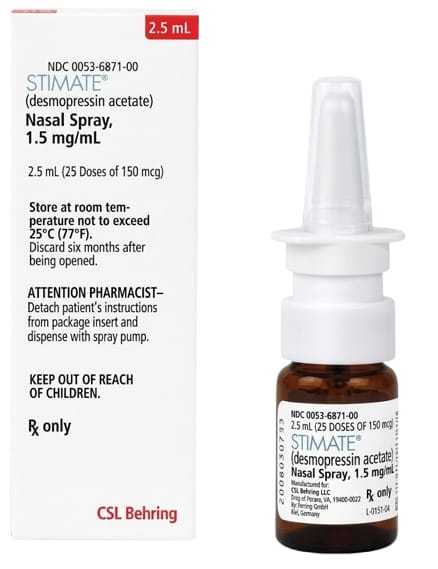
- Store the bottle at room temperature, not higher than 77°F (25°C).
- Store the bottle standing upright.
- Throw away the bottle 6 months after it is first opened, after the labeled number of sprays, or by the expiration date, whichever comes first.
- Keep out of the reach of children.
When to see a doctor
- Call your healthcare provider right away if you have headache, nausea, vomiting, weight gain, restlessness, tiredness, loss of appetite, irritability, muscle weakness, muscle spasms or cramps, hallucinations, or confusion, as these may be signs of low blood sodium.
- Get emergency medical help right away if you have symptoms of a severe allergic reaction, such as itching over large areas of skin, swelling of the lips, tongue, face, or hands, trouble swallowing, wheezing, shortness of breath, chest tightness, fast heartbeat, or dizziness.
- Call your healthcare provider right away if your bleeding is not controlled while using this medicine.
- If you use too much of this medicine, call your healthcare provider or seek help from a poison control center right away.
Alternatives
- Vonvendi
- Humate-P
- DDAVP Injection
Watch the video
FAQs
What is Stimate Nasal Spray used for?
It is used to help control certain types of bleeding, including hemophilia A in eligible patients and mild to moderate Type I von Willebrand disease, as well as bleeding from injuries or surgery.
How does Stimate Nasal Spray work?
Desmopressin acetate increases the levels of clotting factor VIII in the blood in people with hemophilia A and Type I von Willebrand disease, helping control bleeding.
How should Stimate Nasal Spray be used?
It should be sprayed only into the nose, exactly as prescribed, with the pump primed before first use and re-primed if unused for more than 3 days. Fluid intake must be limited starting 1 hour before use until at least 24 hours after.
What are the serious side effects of Stimate Nasal Spray?
Serious effects include low sodium in the blood (hyponatremia) with symptoms like headache, nausea, confusion, or muscle weakness, severe cases with seizures or coma, blood pressure changes, nasal scarring, and serious allergic reactions including anaphylaxis.
Who should not use Stimate Nasal Spray?
It should not be used in people with Type IIB von Willebrand's disease because it may cause platelets to clump together, raising the risk of blood clots.
General information, not medical advice
Your prescriber and the leaflet in your pack know your situation. This page does not.
- Follow your prescriber and the leaflet
- Don't start, stop, or change a dose on your own
- Doses and warnings differ by country and product
Sources
Video
Related medicines

Injectafer Injection: Uses, Dosage, Side Effects, Precautions and Alternates
Iron products
Injectafer (ferric carboxymaltose) treats iron deficiency anemia and heart failure-related iron deficiency via IV. Learn uses, dosage, side effects, and

Gliclazide Tablet: Uses, Dosage, Side Effects, Precautions and Alternates
Sulfonylurea (hypoglycemic/antidiabetic agent)
Gliclazide Tablet is a sulfonylurea for type 2 diabetes that boosts insulin release. Learn about dosage, side effects, warnings, and precautions.