
Safety
General information, not medical advice
Your prescriber and the leaflet in your pack know your situation. This page does not.
- Follow your prescriber and the leaflet
- Don't start, stop, or change a dose on your own
- Doses and warnings differ by country and product
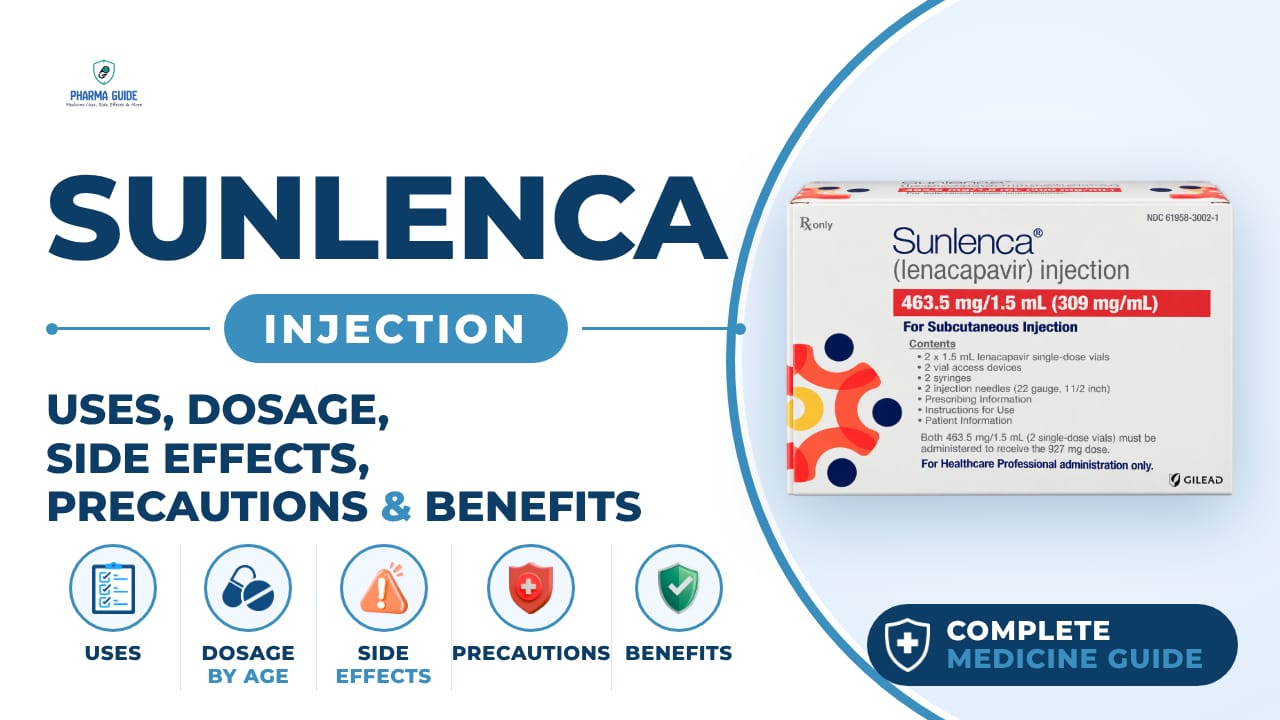
Sunlenca Injection: Uses, Dosage, Side Effects, Precautions and Alternates
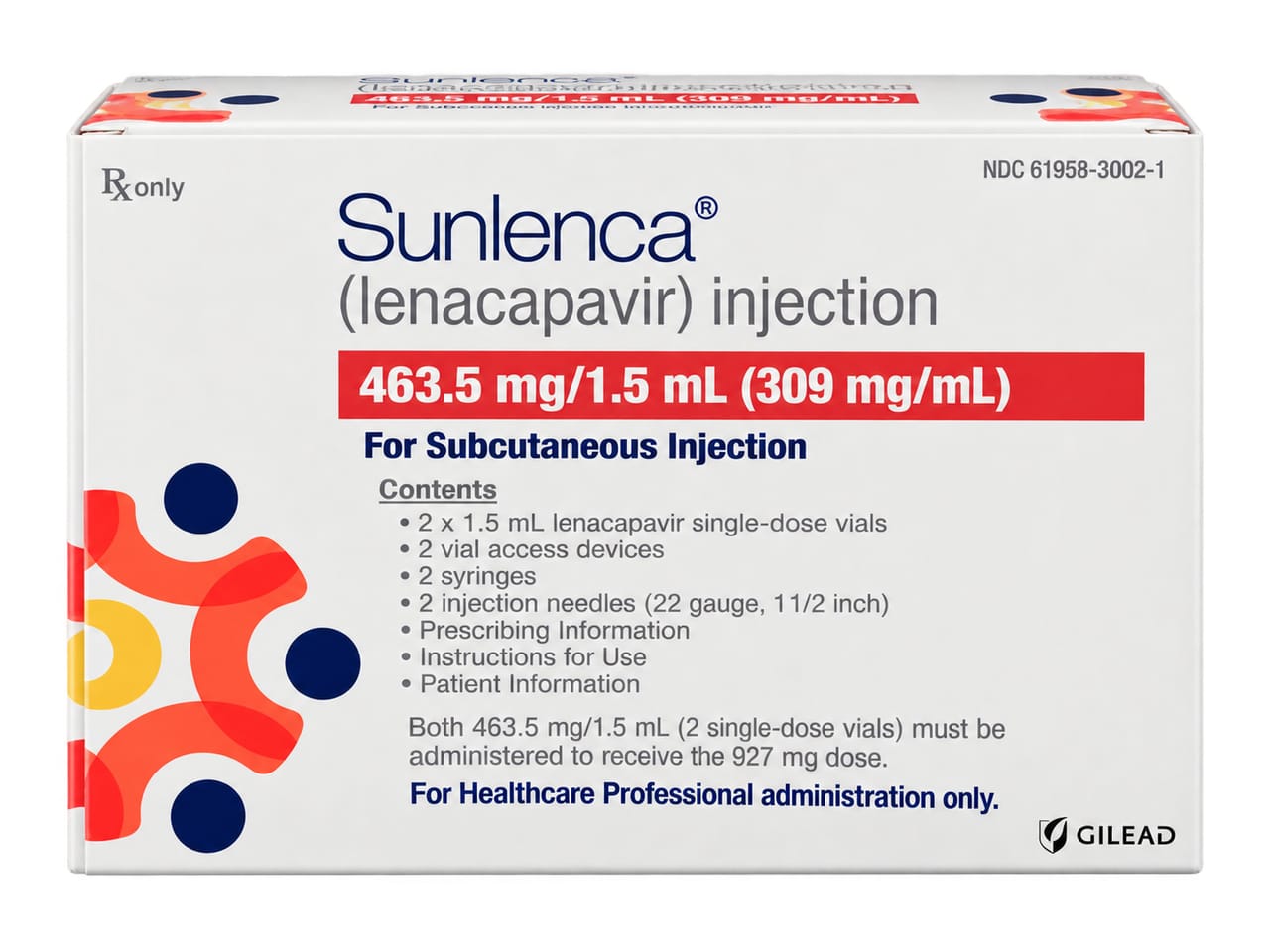
| Generic name | lenacapavir |
|---|---|
| Drug class | capsid inhibitor |
| Forms | injection, tablets |
Quick overview
Sunlenca Injection (lenacapavir) is a capsid inhibitor used with other HIV-1 medicines to treat HIV-1 infection in adults who have taken HIV-1 medicines before, whose virus resists many treatments, and whose current regimen is failing. It is given as an injection under the skin every 6 months after a short starting course of tablets. Sunlenca does not cure HIV-1 or AIDS and must be used together with other prescribed HIV medicines.
What is Sunlenca Injection
Sunlenca is a prescription medicine used with other HIV-1 medicines to treat HIV-1 infection in adults who have received HIV-1 medicines in the past, whose virus is resistant to many HIV-1 medicines, and whose current medicines are failing. Sunlenca does not cure HIV-1 or AIDS.
Sunlenca Injection uses
- Treats HIV-1 infection in adults with multi-drug resistant HIV-1 whose current treatment regimen is failing, used together with other antiretroviral drugs.
- Used in adults who have tried many HIV medicines before but are having trouble with their current treatment because it is not working, causes side effects, or is not safe for them.
- Sunlenca tablets are also used in adults when starting treatment with the prescription HIV-1 medicine called Bixlenvo.
Benefits of Sunlenca Injection
- Given as an injection under the skin every 6 months after a short starting course of tablets, instead of needing daily medicine.
- Belongs to a first-in-class group of drugs that attacks the HIV-1 capsid at multiple stages of the virus's lifecycle, so it may work against HIV that is resistant to other drugs.
- Helps lower viral loads in people who have run out of effective HIV treatment options due to resistance, side effects, or safety issues.
- By lowering the amount of virus in the body, it helps protect and support the immune system.
How Sunlenca Injection works
Sunlenca works by attaching to and blocking the HIV-1 capsid, the protein shell that protects the virus's genetic material. This stops the virus from entering cells, making copies of itself, and spreading, which helps slow the infection, including strains resistant to other HIV drugs.
Sunlenca Injection dosage
Take the tablets by mouth, with or without food. Keep taking all your other HIV-1 medicines as prescribed by your doctor along with Sunlenca. The injections are given under the skin of your stomach area by a healthcare provider, not by you.
Starting treatment involves a short course of tablets before or around the time of your first injection, following one of two schedules your provider will choose. If you are taking Bixlenvo tablets together with Sunlenca tablets to start treatment, take them on the same days as directed; do not take the two days' doses of Sunlenca on the same day if you miss a dose.
After starting treatment, injections are given every 6 months from the date of your last injection. It is important to keep all your appointments for your injections; if you will miss an injection appointment by more than two weeks, contact your healthcare provider right away to discuss options, which may include taking tablets temporarily until injections resume.
Do not stop treatment or other HIV medicines without telling your healthcare provider, since this can let the virus increase and become harder to treat.
Use exactly as prescribed by your doctor or pharmacist.
Available forms and strengths
- Injection
- Tablets
Side effects of Sunlenca Injection
Common
- Injection site reactions (up to 65% of patients), including swelling, pain, redness, small lumps or nodules, skin hardening, itching, or minor bruising/masses
- Nausea
- Headaches, fatigue, diarrhea, or mild upper respiratory symptoms
Serious
- Immune Reconstitution Syndrome - new inflammatory symptoms as the immune system starts fighting hidden, pre-existing infections
- Severe or improperly administered injection site reactions, including tissue death (necrosis) and ulcers; hardened skin or lumps that may take longer to heal and may not heal completely on their own
- Severe allergic reactions, including breathing problems or wheezing, racing heart, fever, swollen lymph nodes, swelling of the face/lips/mouth/tongue/throat, trouble swallowing, hives, nausea or vomiting, dizziness or fainting, stomach cramps, and joint pain
Warnings and precautions
- Do not take Sunlenca if you are also taking certain medicines called strong CYP3A inducers, such as carbamazepine, rifampin, or St. John's wort. Ask your healthcare provider if you are unsure whether a medicine you take falls into this group.
- Sunlenca stays in your body for a long time and can affect how certain other medicines work for up to 9 months after your last injection.
- Sticking to the twice-yearly injection schedule is very important. Missing or stopping injections without switching to another suppressive treatment can allow the virus to come back and become resistant to treatment.
- Sunlenca does not cure HIV-1 or AIDS, and must be used together with other prescribed HIV medicines.
- It is not known if Sunlenca can harm an unborn baby. Tell your healthcare provider if you are pregnant, plan to become pregnant, or become pregnant while taking Sunlenca. There is a pregnancy registry that collects information about the health of mothers and babies exposed to Sunlenca.
- Do not breastfeed if you take Sunlenca, partly because of the risk of passing HIV-1 to your baby. A small amount of the medicine passes into breast milk. Talk with your healthcare provider about the best way to feed your baby during treatment.
- Kidney: No routine renal dose adjustment is generally specified.
- Liver: Significant hepatic impairment requires specialist assessment.
- Alcohol: There are no known interactions between Sunlenca and alcohol.
- Driving: Usually does not directly impair driving, but avoid driving if dizziness or weakness occurs.
Storage
- Store at room temperature between 68°F to 77°F (20°C to 25°C).
- The bottle contains a desiccant packet to help keep your medicine dry (protect it from moisture). Keep the desiccant packet in the bottle. Do not eat the desiccant packet.
- Keep the tablets in their original blister pack.
- Keep all medicines out of the reach of children and pets.
When to see a doctor
- Tell your healthcare provider right away if you notice any new symptoms after starting Sunlenca, as this could be a sign of your immune system reacting to a hidden infection.
- Stop using Sunlenca and get help right away if you have signs of a serious allergic reaction, such as breathing problems or wheezing, a racing heart, fever, swollen lymph nodes, swelling of the face, lips, mouth, tongue or throat, trouble swallowing, hives, nausea or vomiting, dizziness or fainting, stomach cramps, or joint pain.
- Tell your healthcare provider right away if you have any injection site reactions such as pain, itching, swelling, redness, skin hardening, or a lump near the injection site.
- If you miss or expect to miss your injection appointment by more than two weeks, contact your healthcare provider right away to discuss your treatment options.
- If you stop receiving Sunlenca or stop taking your other HIV medicines, tell your healthcare provider right away, since you will need other medicines to keep the virus controlled.
- If you take too many tablets, contact your healthcare provider or go to the nearest hospital emergency room right away.
Alternatives
- Darunavir-based regimens
- Enfuvirtide
- Ibalizumab
- Fostemsavir
Watch the video
FAQs
How often is Sunlenca Injection given?
After a short starting course of tablets, Sunlenca injections are given under the skin of the stomach area by a healthcare provider every 6 months from the date of your last injection.
What is Sunlenca Injection used for?
Sunlenca is used with other HIV-1 medicines to treat HIV-1 infection in adults who have taken HIV-1 medicines before, whose virus resists many treatments, and whose current regimen is failing. It does not cure HIV-1 or AIDS.
What are the common side effects of Sunlenca Injection?
Common side effects include injection site reactions (occurring in up to 65% of patients) such as swelling, pain, redness, lumps, skin hardening, or itching, as well as nausea, headaches, fatigue, diarrhea, or mild upper respiratory symptoms.
What happens if I miss a Sunlenca injection appointment?
If you will miss an injection appointment by more than two weeks, contact your healthcare provider right away to discuss options, which may include taking tablets temporarily until injections resume.
Can I take other medicines with Sunlenca Injection?
You should not take Sunlenca with strong CYP3A inducers such as carbamazepine, rifampin, or St. John's wort. Sunlenca also stays in your body for a long time and can affect how certain other medicines work for up to 9 months after your last injection.
General information, not medical advice
Your prescriber and the leaflet in your pack know your situation. This page does not.
- Follow your prescriber and the leaflet
- Don't start, stop, or change a dose on your own
- Doses and warnings differ by country and product
Sources
Video
Related medicines

Injectafer Injection: Uses, Dosage, Side Effects, Precautions and Alternates
Iron products
Injectafer (ferric carboxymaltose) treats iron deficiency anemia and heart failure-related iron deficiency via IV. Learn uses, dosage, side effects, and

Gliclazide Tablet: Uses, Dosage, Side Effects, Precautions and Alternates
Sulfonylurea (hypoglycemic/antidiabetic agent)
Gliclazide Tablet is a sulfonylurea for type 2 diabetes that boosts insulin release. Learn about dosage, side effects, warnings, and precautions.