
Safety
General information, not medical advice
Your prescriber and the leaflet in your pack know your situation. This page does not.
- Follow your prescriber and the leaflet
- Don't start, stop, or change a dose on your own
- Doses and warnings differ by country and product
Syndopa Tablet: Uses, Dosage, Side Effects, Precautions and Alternates
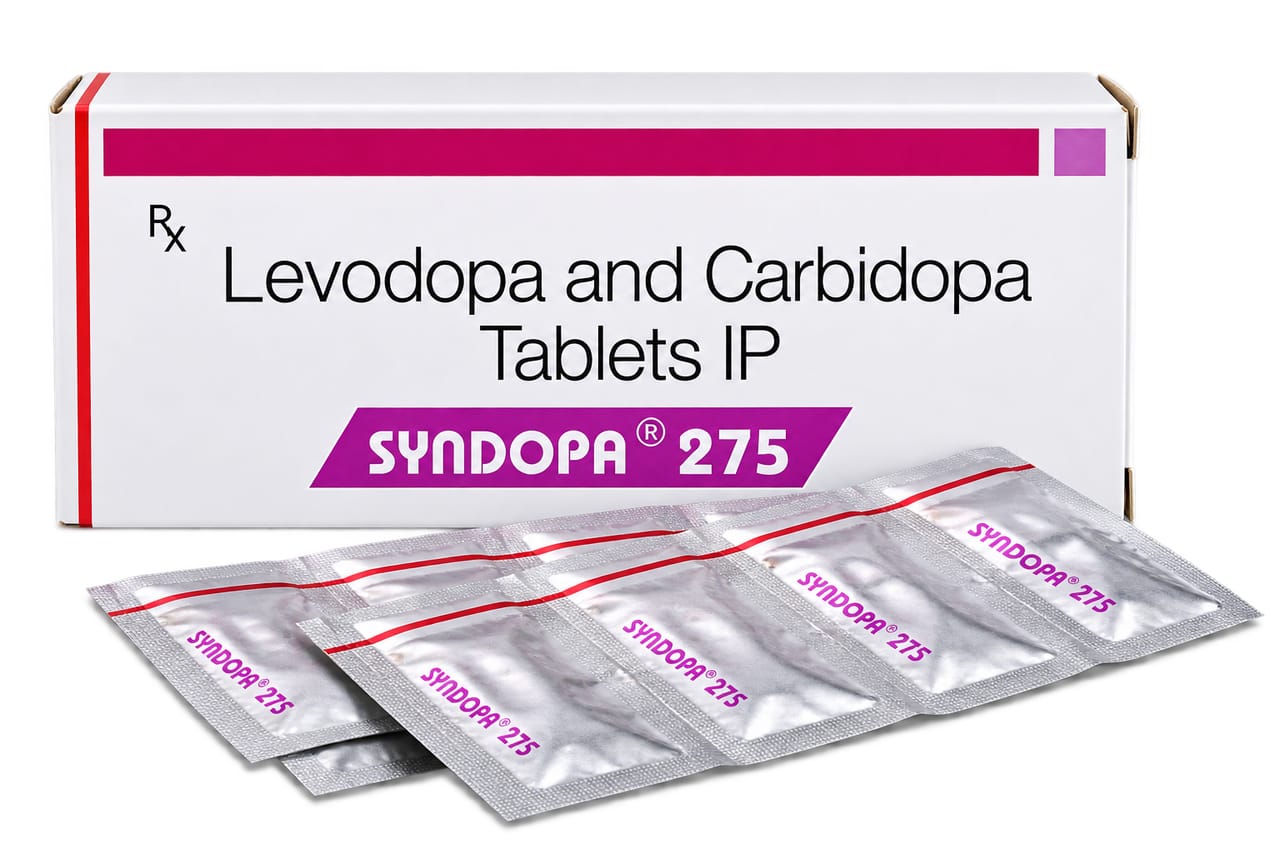
| Generic name | Levodopa + Carbidopa |
|---|---|
| Drug class | Antiparkinson Agents |
| Forms | Tablet |
Quick overview
Syndopa Tablet combines levodopa and carbidopa, two medicines that work together to manage Parkinson's disease and similar movement disorders. It helps restore the balance of dopamine, a brain chemical that controls muscle movement and coordination. This prescription medicine is taken as directed by a doctor, with dosage adjusted based on age and individual response.
What is Syndopa Tablet
Syndopa Tablet is a prescription medicine that combines levodopa and carbidopa to treat Parkinson's disease and similar movement disorders. It helps restore the balance of a brain chemical called dopamine, which controls muscle movement and coordination.
Syndopa Tablet uses
- Manages symptoms of Parkinson's disease such as muscle stiffness, tremors, shaking, and slow or difficult movements
- Treats movement difficulties that look like Parkinson's disease but are caused by other conditions, such as carbon monoxide or manganese poisoning
Benefits of Syndopa Tablet
- Parkinson's Symptom Control: Helps improve movement problems associated with Parkinson's disease.
- Movement Support: May reduce slowness of movement and muscle stiffness.
- Tremor Support: Can help reduce Parkinson's-related tremors.
- Mobility Improvement: May improve ability to perform everyday movements.
- Dopamine Replacement: Levodopa is converted into dopamine in the brain, while carbidopa helps more levodopa reach the brain.
How Syndopa Tablet works
Syndopa Tablet contains two ingredients that work together. Levodopa is converted into dopamine, a brain chemical needed for smooth muscle control, which is low in people with Parkinson's disease. Carbidopa protects levodopa from being broken down in the blood before it reaches the brain, so more of the medicine can work where it's needed while also reducing side effects like nausea and vomiting.
Syndopa Tablet dosage
Syndopa Tablet can be taken with or without food, as advised by your doctor. Take it at the same time every day to help keep symptoms controlled. Swallow the tablet whole with a glass of water. Do not chew, crush, or break the tablet.
Try to eat high-protein foods like meat, fish, dairy, and eggs at other times of the day rather than right when you take your dose, since protein can reduce how well the medicine is absorbed. Rise slowly from sitting or lying down to avoid sudden dizziness.
This medicine is not recommended for children unless specifically advised by a doctor. Older adults may need a lower dose because of age-related body changes.
| Age group | Dose |
|---|---|
| Under 18 Years | Not routinely recommended; use only under specialist supervision |
| 18–64 Years | 100/25 mg or 250/25 mg, taken in divided doses as prescribed |
| Older Adults (65+ Years) | 100/25 mg initially, with gradual adjustment by a specialist |
Available forms and strengths
- Tablet
Side effects of Syndopa Tablet
Common
- Nausea and vomiting
- Dizziness and drowsiness
- Dry mouth
- Loss of appetite
- Constipation
- Low blood pressure on standing up
- Confusion or mood changes
- Involuntary muscle movements (dyskinesia)
- Headache
- Fatigue
- Dark urine
- Unusual dreams
Serious
- Seeing or hearing things that are not there (hallucinations)
- Severe mood changes
- Unusual, uncontrollable urges (such as gambling, spending, or compulsive eating)
- Fainting
- Irregular heartbeat
- Severe involuntary muscle spasms
- Sudden sleep episodes
Warnings and precautions
- Syndopa Tablet is given to pregnant women only if the doctor believes the benefits outweigh the risks, as safety has not been fully established.
- The medicine passes into breast milk and its effect on the baby is not known, so it should only be used while breastfeeding if your doctor feels the benefits outweigh the risks.
- Use with caution if you have kidney problems or liver problems, as your doctor may need to adjust your dose. Avoid alcohol while taking this medicine, as it can increase drowsiness, dizziness, and difficulty concentrating.
- This medicine may cause drowsiness or sudden sleepiness, so avoid driving or operating machinery if you feel drowsy.
- Do not stop taking this medicine suddenly, as this can cause a dangerous, life-threatening reaction with high fever, severe muscle stiffness, and confusion. Always talk to your doctor before stopping or reducing your dose.
- Do not drive, operate machinery, or do hazardous tasks if you suddenly feel sleepy or very dizzy while on this medicine.
- Tell family or caregivers to watch for unusual behavior changes, such as new or increased urges to gamble, spend money, or eat compulsively, and report these to the doctor right away.
- Check your blood pressure regularly, since this medicine can cause sudden drops in blood pressure when you change position.
- Do not take this medicine if you have untreated narrow-angle glaucoma, as it can dangerously raise the pressure inside your eyes.
- Do not take this medicine if you have taken certain older depression medicines (MAO inhibitors) within the last 14 days, as this combination can cause a dangerous rise in blood pressure.
Storage
- Store Syndopa Plus Tablet at room temperature, ideally between 20°C and 25°C (68°F to 77°F).
- Keep the container tightly closed to protect the medicine from light, moisture, and extreme heat.
- Store Syndopa 110 Tablet at room temperature.
- Keep the medicine away from moisture and heat sources.
- Keep out of reach of children.
- Use the product before its expiry date.
When to see a doctor
- Get emergency medical help right away if you take too much of this medicine, since an overdose can cause severe involuntary muscle spasms, a fast or irregular heartbeat, confusion, or severe dizziness.
- Contact your doctor right away if you see or hear things that are not there, have severe mood changes, or develop unusual, uncontrollable urges.
- If side effects do not improve or become serious, speak to your doctor right away.
Alternatives
- Levodopa + Benserazide
- Pramipexole
- Ropinirole
- Entacapone + Levodopa + Carbidopa
Watch the video
FAQs
What is Syndopa Tablet used for?
Syndopa Tablet is used to manage symptoms of Parkinson's disease such as muscle stiffness, tremors, shaking, and slow or difficult movements. It also treats movement difficulties resembling Parkinson's disease caused by other conditions like carbon monoxide or manganese poisoning.
How does Syndopa Tablet work?
Syndopa Tablet contains levodopa, which is converted into dopamine in the brain to improve muscle control, and carbidopa, which protects levodopa from breaking down before it reaches the brain, allowing more of the medicine to work while reducing side effects like nausea and vomiting.
Can I take Syndopa Tablet with food?
Syndopa Tablet can be taken with or without food as advised by your doctor. However, high-protein foods like meat, fish, dairy, and eggs should be eaten at other times of the day, since protein can reduce how well the medicine is absorbed.
What are the common side effects of Syndopa Tablet?
Common side effects include nausea and vomiting, dizziness and drowsiness, dry mouth, loss of appetite, constipation, low blood pressure on standing up, confusion or mood changes, involuntary muscle movements, headache, fatigue, dark urine, and unusual dreams.
Can I stop taking Syndopa Tablet suddenly?
No, you should not stop taking this medicine suddenly, as this can cause a dangerous, life-threatening reaction with high fever, severe muscle stiffness, and confusion. Always talk to your doctor before stopping or reducing your dose.
General information, not medical advice
Your prescriber and the leaflet in your pack know your situation. This page does not.
- Follow your prescriber and the leaflet
- Don't start, stop, or change a dose on your own
- Doses and warnings differ by country and product
Sources
- U.S. Food and Drug Administration (FDA). 017555S069Lbl [FDA Prescribing Information]. Silver Spring, MD: FDA; 2024.
- Drugs.com Clinical Review Team. Carbidopa And Levodopa Clinical Drug Monograph. Auckland, NZ: Drugs.com; 2026.
- National Health Service (NHS). Parkinsons Disease - NHS Medicines Reference Guide. London, UK: NHS; 2025.
- Sinemet 12.5 mg/50 mg Tablets - Summary of Product Characteristics (SmPC) - (emc). Medicines.org.uk. 2022.
- Sinemet 12.5 mg/50 mg Tablets - Patient Information Leaflet (PIL) - (emc). Medicines.org.uk. 2022.
- Merck Sharp & Dohme B.V. Electronic Medicines Compendium (EMC). Revised in February 2021.
- CDSCO. Cdscoonline.gov.in. 2022.
- MedlinePlus. Levodopa and Carbidopa.
- Briggs, G. G., & Freeman, R. K. (2015). A reference guide to fetal and neonatal risk: Drugs in Pregnancy and Lactation (10th ed.). Philadelphia: Lippincott Williams & Wilkins.
- Nomoto, M., Nagai, M., Ando, R., Kagamiishi, Y., Yano, K., Saito, S., & Takeda, A. (2018). Pharmacokinetics and safety/efficacy of levodopa pro-drug ONO-2160/carbidopa for Parkinson's disease.
- SINEMET (CARBIDOPA-LEVODOPA) TABLETS (NDA 17-555/S-069). FDA.
Video
Related medicines

Injectafer Injection: Uses, Dosage, Side Effects, Precautions and Alternates
Iron products
Injectafer (ferric carboxymaltose) treats iron deficiency anemia and heart failure-related iron deficiency via IV. Learn uses, dosage, side effects, and

Gliclazide Tablet: Uses, Dosage, Side Effects, Precautions and Alternates
Sulfonylurea (hypoglycemic/antidiabetic agent)
Gliclazide Tablet is a sulfonylurea for type 2 diabetes that boosts insulin release. Learn about dosage, side effects, warnings, and precautions.