
Safety
General information, not medical advice
Your prescriber and the leaflet in your pack know your situation. This page does not.
- Follow your prescriber and the leaflet
- Don't start, stop, or change a dose on your own
- Doses and warnings differ by country and product
Teflaro Injection: Uses, Dosage, Side Effects, Precautions and Alternates

| Generic name | ceftaroline fosamil |
|---|---|
| Drug class | cephalosporin antibiotic |
| Forms | Injection (powder for solution, for intravenous use) |
Quick overview
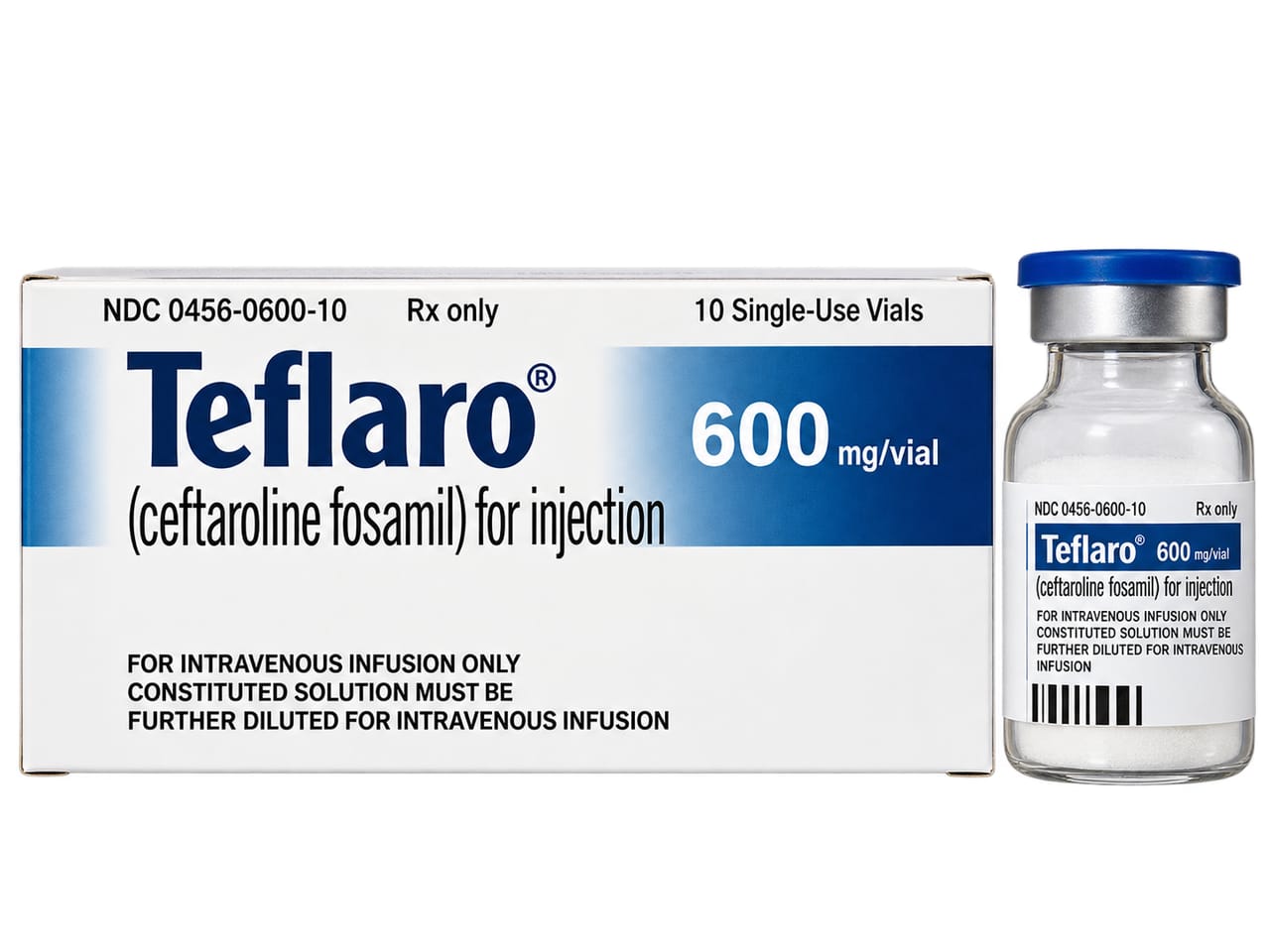
Teflaro Injection (ceftaroline fosamil) is a cephalosporin antibiotic given intravenously by a healthcare provider. It is used to treat acute bacterial skin and skin structure infections and community-acquired bacterial pneumonia caused by susceptible bacteria. It works by stopping certain bacteria from building their protective cell wall. Dosing is adjusted for patients with kidney problems.
What is Teflaro Injection
Teflaro is an intravenous (IV) antibiotic given by a healthcare provider. It belongs to the cephalosporin class of antibiotics and is used to treat certain bacterial infections of the skin and lungs.
Teflaro Injection uses
- Treatment of acute bacterial skin and skin structure infections (ABSSSI) caused by susceptible bacteria
- Treatment of community-acquired bacterial pneumonia (CABP) caused by susceptible bacteria
Benefits of Teflaro Injection
- Kills many types of bacteria that cause skin infections and pneumonia, including some resistant strains like MRSA
- Active against certain MRSA strains
- Covers several Gram-positive and Gram-negative bacteria
- Can be used in both pediatric and adult patients
How Teflaro Injection works
Teflaro works by stopping certain bacteria from being able to build their protective cell wall, which kills the bacteria.
Teflaro Injection dosage
Teflaro is given as an IV infusion into a vein, usually taking at least 1 hour to complete. A healthcare provider gives the first dose and may teach you how to give it yourself at home. The medicine must be mixed with a liquid (diluent) before use and should not be mixed with other antibiotics in the same injection. The medicine should look clear or yellow; do not use it if it looks cloudy, has changed color, or has particles in it.
Use the medicine for the full prescribed number of days, even if you start feeling better quickly. If a dose is missed, take it as soon as possible, but skip it if it is almost time for the next dose — do not give two doses at once. Teflaro does not treat viral infections such as colds or the flu. Dosing is adjusted for patients with kidney problems.
| Age group | Dose |
|---|---|
| Birth to <2 months | 6 mg/kg IV every 8 hours |
| 2 months to <2 years | 8 mg/kg IV every 8 hours |
| 2–17 years, ≤33 kg | 12 mg/kg IV every 8 hours |
Available forms and strengths
- Injection (powder for solution, for intravenous use)
Side effects of Teflaro Injection
Common
- Nausea
- Vomiting
- Diarrhea
- Constipation
- Rash
- Fever
Serious
- Severe allergic reaction (hives, difficulty breathing, swelling of face, lips, tongue, or throat)
- Antibiotic-associated diarrhea, including watery or bloody diarrhea, which can be a sign of a serious intestinal infection (C. difficile)
- Blood disorders such as agranulocytosis, aplastic anemia, hemolytic anemia, low platelets, or low white blood cell counts
- Liver damage
- Kidney damage
- Brain or central nervous system problems, including confusion, drowsiness, or slowed thinking
- Seizures
- Low potassium levels
Warnings and precautions
- Serious and sometimes fatal allergic reactions can occur with Teflaro and similar antibiotics. Tell your doctor about any previous allergic reactions to cephalosporins, penicillins, or related antibiotics before starting treatment.
- Teflaro can cause diarrhea linked to a serious gut infection called C. difficile, which can occur even months after finishing treatment.
- If you develop anemia during or after treatment, your doctor may need to check for a drug-related blood problem and may stop the medicine.
- Teflaro should only be used for infections that are confirmed or strongly suspected to be bacterial, to help prevent bacteria from becoming resistant to antibiotics.
- Cephalosporin antibiotics like Teflaro have been linked to nervous system problems such as confusion and seizures, especially in people with kidney problems who did not get the right dose adjustment.
- It is not known if or how Teflaro could affect pregnancy or harm an unborn baby. Tell your doctor if you are or plan to become pregnant.
- It is not known if Teflaro passes into breast milk. Tell your doctor if you are breastfeeding or plan to breastfeed.
- People with kidney disease, including those on dialysis, need a different dose of Teflaro. Tell your doctor if you have kidney problems.
- No routine hepatic dose adjustment is generally required.
- It isn't known if alcohol affects Teflaro, but heavy drinking can weaken your immune system and make it harder for your body to fight infection.
- Teflaro usually does not directly impair driving, but dizziness can occur.
Storage
- Store unmixed vials of Teflaro powder at room temperature, away from moisture and heat
- After mixing with a diluent, the solution may be stored for up to 6 hours at room temperature, or up to 24 hours in a refrigerator
- Do not freeze
- Use a needle and syringe only once, then place them in a puncture-proof sharps container and dispose of it according to local laws, keeping it away from children and pets
- Unreconstituted vials should be stored at controlled room temperature (25°C/77°F, with excursions permitted to 15-30°C/59-86°F)
When to see a doctor
- Get emergency help right away if you have signs of a serious allergic reaction, such as hives, trouble breathing, or swelling of your face, lips, tongue, or throat.
- Call your doctor right away if you have severe stomach pain, or watery or bloody diarrhea, even if it happens months after your last dose.
- Call your doctor right away if you notice little or no urination, which could be a sign of kidney problems.
- Call your doctor right away if you have a seizure.
- Call your doctor right away if you feel drowsy, tired, confused, or have trouble thinking clearly.
- Call your doctor right away if you notice signs of low potassium, such as leg cramps, constipation, irregular heartbeat, fluttering in your chest, or muscle weakness.
- Call your doctor right away if you have signs of low blood cell counts, such as sudden weakness, fever, chills, mouth or skin sores, easy bruising, unusual bleeding, pale skin, or feeling light-headed or short of breath.
Alternatives
- Vancomycin
- Linezolid
- Daptomycin
Watch the video
FAQs
What is Teflaro Injection used for?
Teflaro is used to treat acute bacterial skin and skin structure infections (ABSSSI) and community-acquired bacterial pneumonia (CABP) caused by susceptible bacteria.
How does Teflaro Injection work?
Teflaro works by stopping certain bacteria from being able to build their protective cell wall, which kills the bacteria.
How is Teflaro given?
Teflaro is given as an IV infusion into a vein, usually taking at least 1 hour to complete. A healthcare provider gives the first dose and may teach you how to give it yourself at home.
What are the serious side effects of Teflaro?
Serious side effects include severe allergic reactions, antibiotic-associated diarrhea (including C. difficile infection), blood disorders, liver or kidney damage, central nervous system problems like confusion or seizures, and low potassium levels.
Does Teflaro require dose adjustment for kidney problems?
Yes, people with kidney disease, including those on dialysis, need a different dose of Teflaro.
General information, not medical advice
Your prescriber and the leaflet in your pack know your situation. This page does not.
- Follow your prescriber and the leaflet
- Don't start, stop, or change a dose on your own
- Doses and warnings differ by country and product
Sources
Video
Related medicines

Duricef Capsule: Uses, Dosage, Side Effects, Precautions and Alternates
Cephalosporin antibiotic
Duricef Capsule (cefadroxil) treats UTIs, skin infections, and strep throat. Learn uses, dosage, side effects, warnings, and precautions before taking it.

Ancef Injection: Uses, Dosage, Side Effects, Precautions and Alternates
cephalosporin antibiotic
Ancef Injection (cefazolin) is a cephalosporin antibiotic used to treat infections and prevent surgical infections. Learn uses, dosage, and side effects.