
Safety
General information, not medical advice
Your prescriber and the leaflet in your pack know your situation. This page does not.
- Follow your prescriber and the leaflet
- Don't start, stop, or change a dose on your own
- Doses and warnings differ by country and product
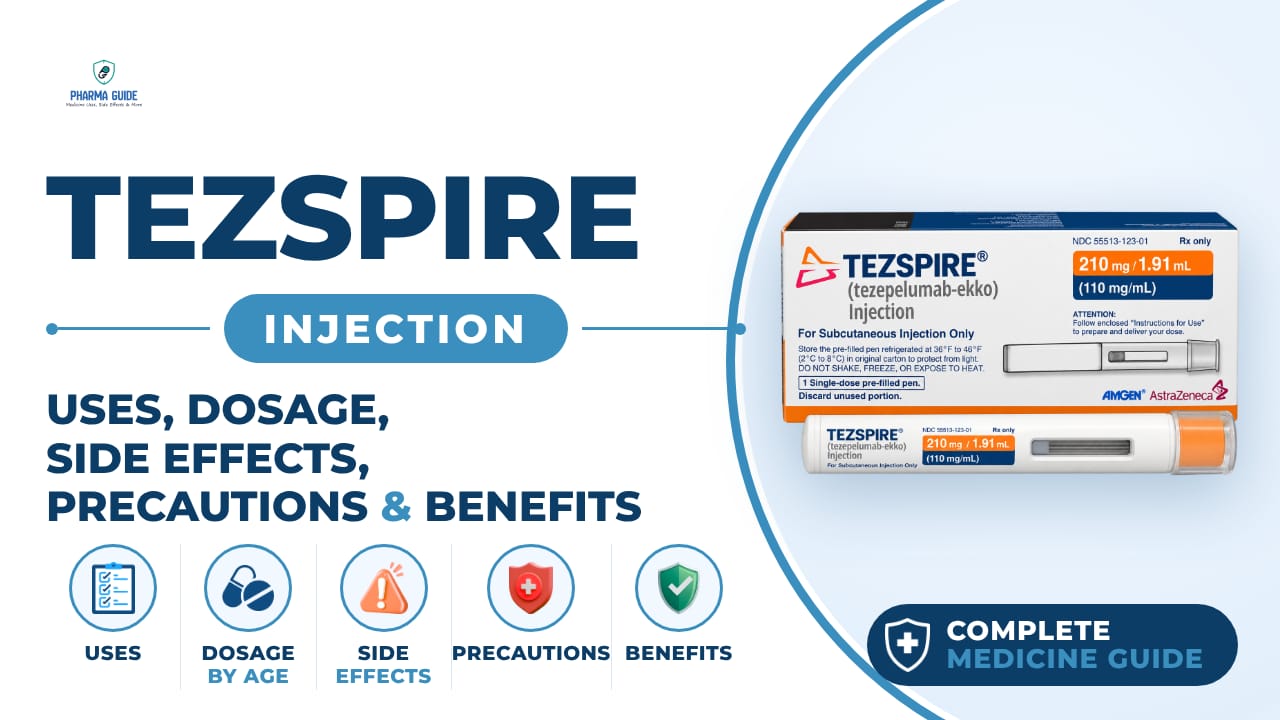
Tezspire Injection: Uses, Dosage, Side Effects, Precautions and Alternates
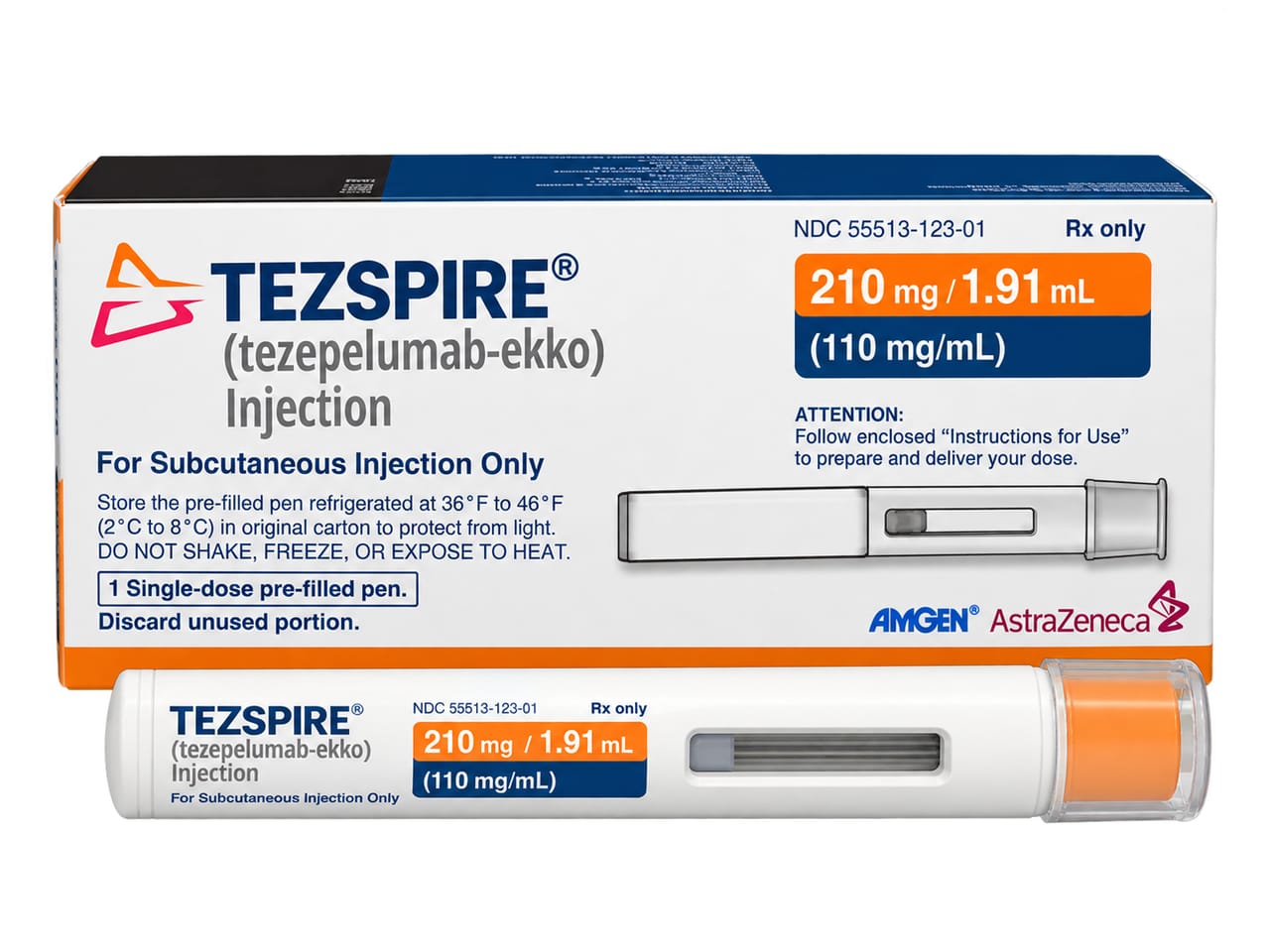
| Generic name | tezepelumab-ekko |
|---|---|
| Drug class | Selective immunosuppressants (thymic stromal lymphopoietin (TSLP) blocker, human monoclonal antibody) |
| Forms | Injection solution in a single-dose glass vial, Injection solution in a single-dose pre-filled syringe, Injection solution in a single-dose pre-filled pen |
Quick overview
Tezspire Injection (tezepelumab-ekko) is a prescription injection used alongside other medicines to help control severe asthma in people 12 years and older and severe chronic rhinosinusitis with nasal polyps (CRSwNP) in adults. It works by blocking a protein called TSLP that contributes to inflammation. It is given as an injection under the skin once every 4 weeks and is not a rescue medicine for sudden breathing problems.
What is Tezspire Injection
Tezspire is a prescription injection medicine used alongside other asthma medicines to help control severe asthma in people 12 years and older whose asthma is not well controlled with their current medicines. It is also used with other medicines to help control severe chronic rhinosinusitis with nasal polyps (CRSwNP) in adults. It is not a rescue medicine for sudden breathing problems. Its generic name is tezepelumab-ekko, and it belongs to the drug class of selective immunosuppressants known as TSLP blockers, a type of human monoclonal antibody.
Tezspire Injection uses
- Add-on maintenance treatment of severe asthma in adults and children 12 years and older whose asthma is not controlled with current asthma medicine
- Add-on maintenance treatment of severe chronic rhinosinusitis with nasal polyps (CRSwNP) in adults 18 years and older whose condition is not controlled with corticosteroids and/or surgery
Benefits of Tezspire Injection
- May help prevent severe asthma attacks (exacerbations)
- Can improve breathing
- May reduce asthma symptoms
- May reduce the size of nasal polyps and improve symptoms like congestion and loss of smell
- May reduce the need for oral corticosteroids and surgery in CRSwNP
How Tezspire Injection works
Tezspire blocks a protein in the body called TSLP, which plays a role in causing the inflammation and symptoms of asthma and nasal polyps. By blocking TSLP, the medicine helps reduce swelling and irritation in the airways and nose.
Tezspire Injection dosage
Tezspire is given as an injection just under the skin (subcutaneously) once every 4 weeks. The vial and pre-filled syringe are meant to be given by a healthcare provider, while the pre-filled pen may be given by the patient or a caregiver after proper training.
Before injecting, let the medicine warm up to room temperature for about 60 minutes; do not warm it any other way such as in a microwave or hot water. Do not shake the medicine. Check the liquid before use; it should be clear and colorless to light yellow, and should not be used if cloudy, discolored, or containing particles.
Inject into the thigh or abdomen if self-injecting (not the arm); a caregiver may also inject into the upper arm. Rotate injection sites with each dose and avoid the area around the navel, scars, or damaged, tender, bruised, or hardened skin. Do not stop or change corticosteroid or other asthma medicines unless told to by a healthcare provider.
If a dose is missed, inject as soon as possible and then continue on the usual schedule; if the next dose is already due, take it as planned.
| Age group | Dose |
|---|---|
| Under 12 years | Safety and effectiveness have not been established |
| 12–17 years | 210 mg subcutaneously once every 4 weeks |
| 18–64 years | 210 mg subcutaneously once every 4 weeks |
Available forms and strengths
- Injection solution in a single-dose glass vial
- Injection solution in a single-dose pre-filled syringe
- Injection solution in a single-dose pre-filled pen
Side effects of Tezspire Injection
Common
- Sore throat (pharyngitis)
- Joint pain (arthralgia)
- Back pain
- Injection site reaction (redness, swelling, pain)
- Rash
Serious
- Severe allergic reactions (anaphylaxis), including rash, hives, breathing problems, swelling of face, tongue or mouth, fainting, dizziness, feeling lightheaded, or red, itchy, swollen, or inflamed eyes
Warnings and precautions
- Tezspire can cause allergic reactions such as rash and eye irritation (allergic conjunctivitis). These can happen within hours of the injection, or sometimes days later.
- Tezspire is not meant to treat sudden asthma attacks or worsening breathing problems. Tell your healthcare provider if your asthma remains uncontrolled or gets worse after starting treatment.
- Do not suddenly stop or lower the dose of corticosteroid medicines after starting Tezspire. Any reduction must be done gradually and only under a doctor's supervision, because stopping too fast can cause withdrawal symptoms or unmask other health problems.
- If you have a parasitic (helminth/worm) infection, it should be treated before starting Tezspire. If you get such an infection while on treatment and it doesn't respond to standard treatment, your doctor may pause Tezspire until it clears up.
- Avoid live vaccines while taking Tezspire, since using them together hasn't been studied.
- There is no information on whether Tezspire is safe to use during pregnancy. It's not known if it could harm an unborn baby, so it should only be used if a healthcare provider says it's necessary.
- It isn't known whether Tezspire passes into breast milk. Talk to a healthcare provider about the best way to feed a baby while using this medicine.
- No routine renal dose adjustment is specified, and no routine hepatic dose adjustment is specified. No specific direct interaction with alcohol is established. Tezspire is generally not expected to impair driving, but avoid driving if dizziness or other symptoms occur.
Storage
- Store refrigerated between 36°F to 46°F (2°C to 8°C) in the original carton to protect from light
- May be kept at room temperature between 68°F to 77°F (20°C to 25°C) for a maximum of 30 days
- Do not put back in the refrigerator once it has reached room temperature
- Discard if not used within 30 days of reaching room temperature
- Do not freeze, shake, or expose to heat
- Do not use if the security seal on the carton has been broken, if dropped or damaged, or if the expiration date has passed
- Dispose of used syringes or pens in a sharps disposal container right away; do not throw away in household trash
- Keep out of the sight and reach of children
When to see a doctor
- Get emergency medical care or call your healthcare provider right away if you have signs of a severe allergic reaction, such as rash, hives, trouble breathing, or red, itchy, swollen, or inflamed eyes.
- Tell your healthcare provider if your asthma does not improve or gets worse after starting Tezspire.
- Seek immediate medical help for signs of anaphylaxis, such as swelling of the face, tongue, or mouth, trouble breathing, fainting, dizziness, or feeling lightheaded, which can occur within hours or days of the injection.
Alternatives
- Dupixent (dupilumab)
- Nucala (mepolizumab)
- Fasenra (benralizumab)
Watch the video
FAQs
What is Tezspire Injection used for?
Tezspire is used alongside other medicines to help control severe asthma in people 12 years and older and severe chronic rhinosinusitis with nasal polyps (CRSwNP) in adults whose conditions are not well controlled with current treatment.
How is Tezspire Injection given?
Tezspire is given as an injection under the skin (subcutaneously) once every 4 weeks, into the thigh or abdomen if self-injecting, or the upper arm if given by a caregiver.
What is the dosage of Tezspire for asthma?
For both 12–17 years and 18–64 years age groups, the dose is 210 mg subcutaneously once every 4 weeks. Safety and effectiveness have not been established for children under 12.
What are the common side effects of Tezspire?
Common side effects include sore throat, joint pain, back pain, injection site reactions, and rash.
Can Tezspire be used for sudden asthma attacks?
No, Tezspire is not a rescue medicine for sudden breathing problems or asthma attacks.
General information, not medical advice
Your prescriber and the leaflet in your pack know your situation. This page does not.
- Follow your prescriber and the leaflet
- Don't start, stop, or change a dose on your own
- Doses and warnings differ by country and product
Sources
Video
Related medicines

Injectafer Injection: Uses, Dosage, Side Effects, Precautions and Alternates
Iron products
Injectafer (ferric carboxymaltose) treats iron deficiency anemia and heart failure-related iron deficiency via IV. Learn uses, dosage, side effects, and

Gliclazide Tablet: Uses, Dosage, Side Effects, Precautions and Alternates
Sulfonylurea (hypoglycemic/antidiabetic agent)
Gliclazide Tablet is a sulfonylurea for type 2 diabetes that boosts insulin release. Learn about dosage, side effects, warnings, and precautions.