
Safety
General information, not medical advice
Your prescriber and the leaflet in your pack know your situation. This page does not.
- Follow your prescriber and the leaflet
- Don't start, stop, or change a dose on your own
- Doses and warnings differ by country and product
Tirbanibulin Ointment: Uses, Dosage, Side Effects, Precautions and Alternates
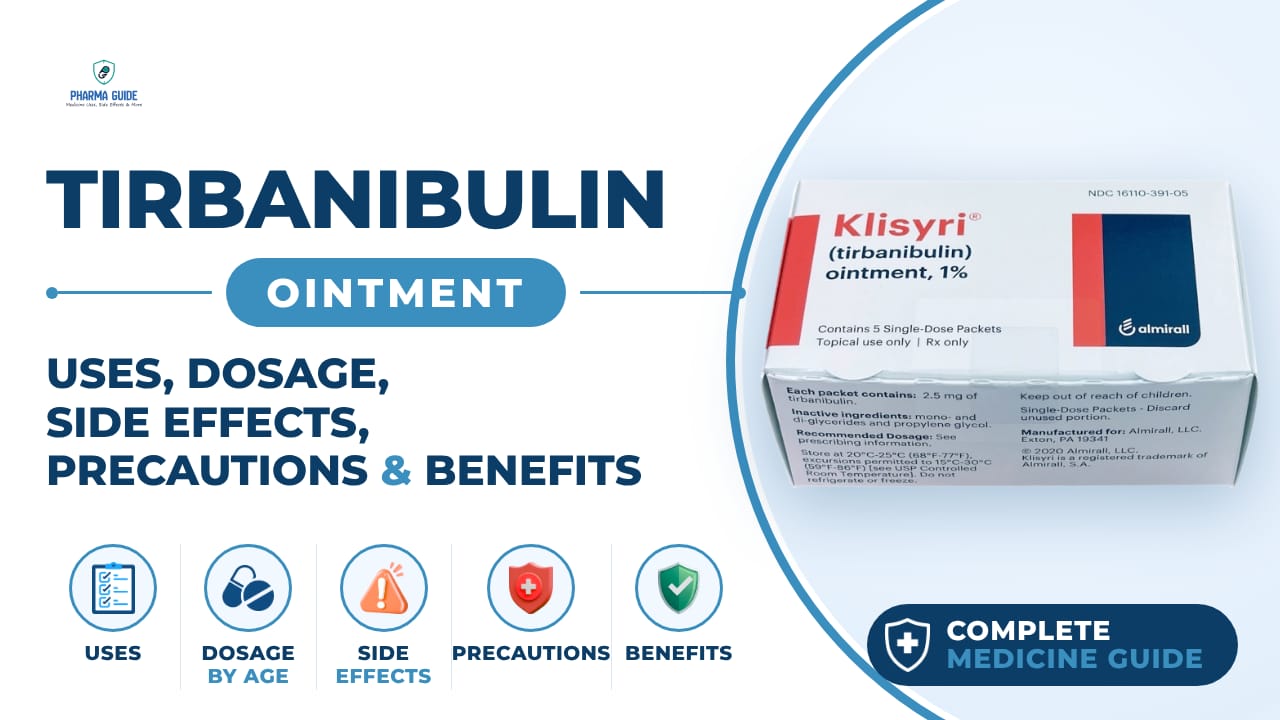
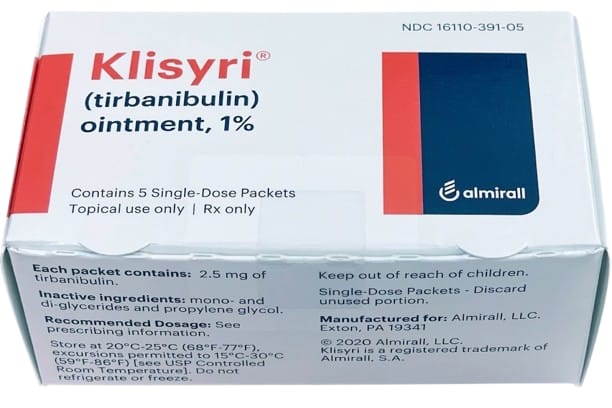
| Generic name | Tirbanibulin |
|---|---|
| Drug class | Microtubule inhibitor |
| Forms | Ointment (1%) in single-dose packets |
Quick overview
Tirbanibulin Ointment (Klisyri) is a prescription topical medicine in the microtubule inhibitor class, used to treat actinic keratosis—rough, scaly patches caused by sun damage—on the face or scalp. It is generically known as tirbanibulin and is applied once daily for just 5 consecutive days. In clinical trials, a greater proportion of patients achieved complete clearance of lesions with tirbanibulin compared to an inactive vehicle ointment.
What is Tirbanibulin Ointment
Klisyri is a prescription ointment put on the skin to treat actinic keratosis, which is a rough, scaly skin patch caused by sun damage, on the face or scalp.
Tirbanibulin Ointment uses
- Actinic keratosis on the face
- Actinic keratosis on the scalp
- Sun-damaged skin with precancerous lesions
Benefits of Tirbanibulin Ointment
- A greater proportion of patients achieved complete clearance of actinic keratosis lesions with tirbanibulin compared to the inactive vehicle ointment in clinical trials
- Short treatment course of only 5 consecutive days of once-daily application
How Tirbanibulin Ointment works
Tirbanibulin blocks the formation of microtubules (tiny structures cells need to divide), which stops abnormal skin cells from growing and causes them to die. It may also work by blocking a signaling pathway called Src tyrosine kinase.
Tirbanibulin Ointment dosage
For use on the skin only; do not use in the eyes or by mouth. Apply once a day for 5 days in a row using one single-dose packet each time, covering only the treatment area on the face or scalp. Do not apply to other areas of the body.
Do not use more ointment than needed to cover the treatment area, and do not use it more often or longer than directed, since this can raise the risk of severe skin reactions. Do not cover the treated area with a bandage or dressing after applying.
Wash your hands right away with soap and water after applying to avoid getting the medicine in your eyes. Avoid getting the ointment in, around, or near the eyes, mouth, or lips.
Avoid washing or touching the treated area for about 8 hours after application; after that, the area may be washed with a mild soap and water. Avoid transferring the medicine to other areas of your skin or to another person. Throw away each packet after a single use, even if some ointment remains.
Safety and effectiveness have not been established in people under 18 years of age. No overall differences in safety or effectiveness were seen between older and younger adults in studies, though some older individuals may be more sensitive.
| Age group | Dose |
|---|---|
| Under 18 years | Not recommended |
| 18–64 years | 1% ointment, once/day for 5 days |
| 65+ years | 1% ointment, once/day for 5 days |
Available forms and strengths
- Ointment (1%) in single-dose packets
Side effects of Tirbanibulin Ointment
Common
- Itching at the application site
- Pain, tenderness, stinging, or burning at the application site
- Redness (erythema)
- Flaking or scaling
- Crusting
- Swelling
Serious
- Severe local skin reactions such as blistering, pus-filled bumps, erosion, or ulceration of the treated skin
- Eye irritation if the medicine accidentally gets into the eyes
Warnings and precautions
- Do not use this ointment until your skin has fully healed from any other treatment, procedure, or surgery for actinic keratosis.
- This medicine may cause eye irritation if it gets into the eyes. Avoid letting the ointment get into or near the eyes or the skin around the eyes.
- Local skin reactions can occur in the treated area, including severe reactions like blistering, pus-filled bumps, and skin breakdown.
- Using too much ointment, using it too often, or using it for too long can raise the chance of a severe skin reaction or other side effects.
- Do not put a dressing or bandage over the treated area after applying the ointment, as this can cause skin irritation.
- It is not known if this medicine can harm an unborn baby, since there is no human data available. Animal studies at much higher doses than used in people showed harm to the fetus.
- It is not known if this medicine passes into breast milk or affects a breastfed baby. Talk to your healthcare provider about the best way to feed your baby during treatment.
- No routine kidney-specific dosage adjustment is established. No routine liver-specific dosage adjustment is established. No significant direct interaction with alcohol is established. Tirbanibulin is not expected to impair driving.
Storage
- Store at room temperature between 68°F to 77°F (20°C to 25°C)
- Do not refrigerate or freeze
- Safely throw away used packets in household trash
- Keep out of the reach of children
When to see a doctor
- If the medicine accidentally gets into your eyes, rinse them with water right away and get medical care as soon as possible.
- Call your healthcare provider if you develop skin reactions that become more severe, or if you notice blisters, peeling, pus, ulcers, or breakdown of the skin in the treated area.
Alternatives
- Imiquimod
- Fluorouracil topical
- Diclofenac topical
- Cryotherapy
Watch the video
FAQs
What is Tirbanibulin Ointment used for?
It is used to treat actinic keratosis, a rough, scaly skin patch caused by sun damage, on the face or scalp.
How long do you use Tirbanibulin Ointment?
It is applied once daily for 5 consecutive days using one single-dose packet each time, covering only the treatment area on the face or scalp.
What are the common side effects of Tirbanibulin Ointment?
Common side effects include itching, pain, tenderness, stinging or burning, redness, flaking or scaling, crusting, and swelling at the application site.
Can Tirbanibulin Ointment be used near the eyes?
No, it should not be applied in, around, or near the eyes, mouth, or lips, as it can cause eye irritation if it gets into the eyes.
Should the treated area be covered after applying Tirbanibulin Ointment?
No, you should not cover the treated area with a bandage or dressing after applying, as this can cause skin irritation.
General information, not medical advice
Your prescriber and the leaflet in your pack know your situation. This page does not.
- Follow your prescriber and the leaflet
- Don't start, stop, or change a dose on your own
- Doses and warnings differ by country and product
Sources
Video
Related medicines

Injectafer Injection: Uses, Dosage, Side Effects, Precautions and Alternates
Iron products
Injectafer (ferric carboxymaltose) treats iron deficiency anemia and heart failure-related iron deficiency via IV. Learn uses, dosage, side effects, and

Gliclazide Tablet: Uses, Dosage, Side Effects, Precautions and Alternates
Sulfonylurea (hypoglycemic/antidiabetic agent)
Gliclazide Tablet is a sulfonylurea for type 2 diabetes that boosts insulin release. Learn about dosage, side effects, warnings, and precautions.