
Safety
General information, not medical advice
Your prescriber and the leaflet in your pack know your situation. This page does not.
- Follow your prescriber and the leaflet
- Don't start, stop, or change a dose on your own
- Doses and warnings differ by country and product
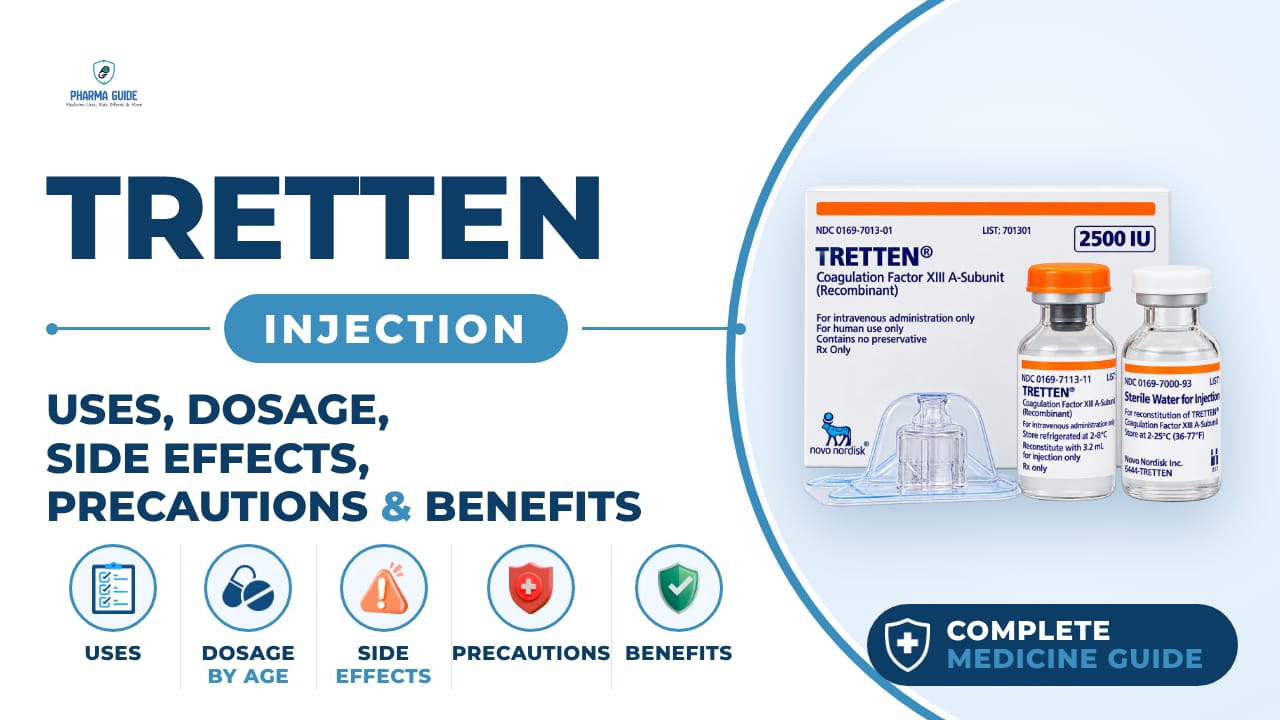
Tretten Injection: Uses, Dosage, Side Effects, Precautions and Alternates
| Generic name | Coagulation Factor XIII A-Subunit (Recombinant) |
|---|---|
| Drug class | Miscellaneous coagulation modifiers |
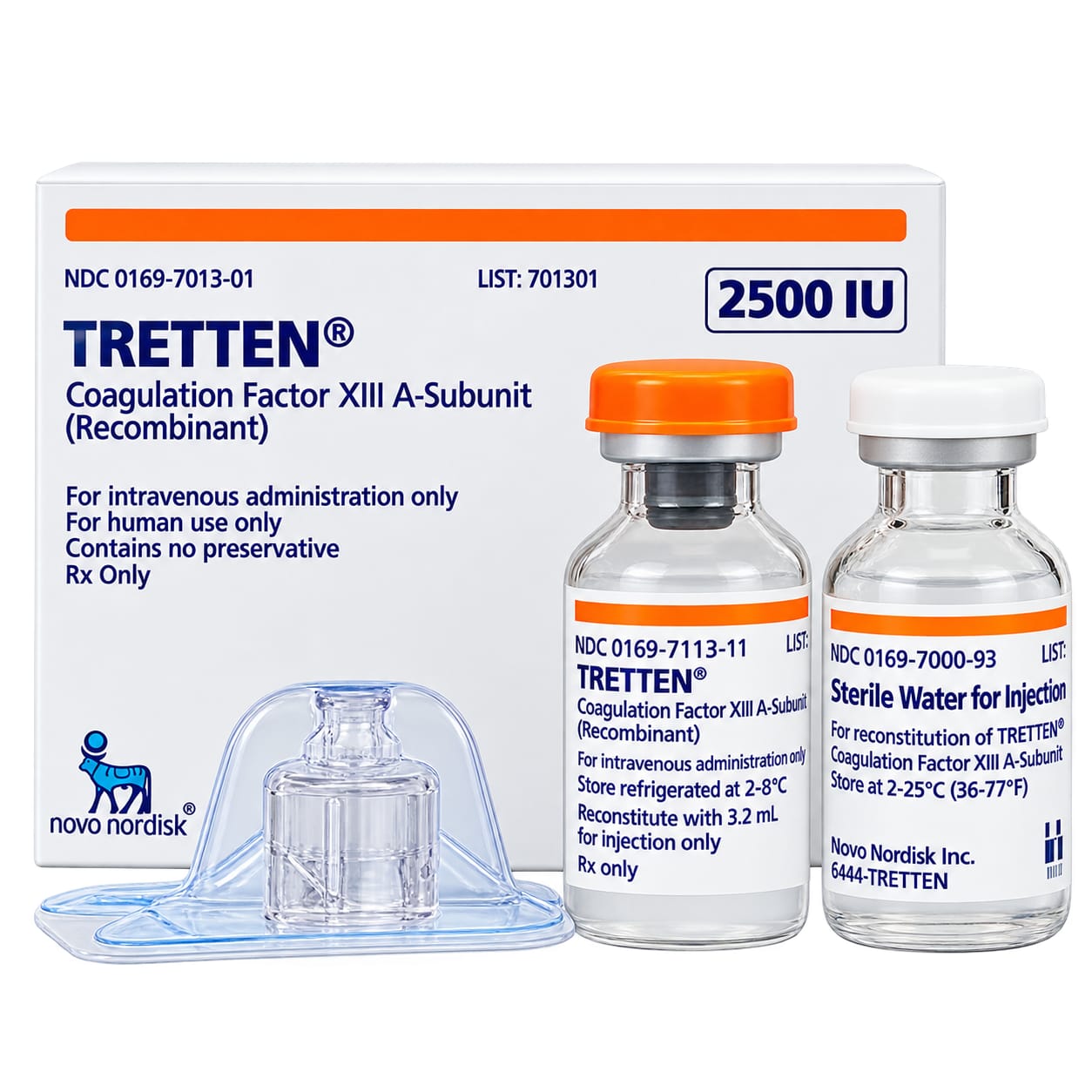
| Forms | Intravenous injection (powder for reconstitution with sterile water) |
Quick overview
Tretten Injection (Coagulation Factor XIII A-Subunit, Recombinant) is a man-made injectable medicine used to prevent bleeding in adults and children with congenital factor XIII A-subunit deficiency. It contains no animal or human materials and is not intended for congenital factor XIII B-subunit deficiency. It is given once a month by intravenous injection, with the dose based on body weight.
What is Tretten Injection
Tretten is an injectable medicine used to prevent bleeding in adults and children who have congenital factor XIII (FXIII) A-subunit deficiency. It is man-made and does not contain animal or human materials. It is not for use in patients with congenital factor XIII B-subunit deficiency.
Tretten Injection uses
- Prevents bleeding in patients with congenital factor XIII A-subunit deficiency.
- Helps reduce recurrent spontaneous bleeding.
- Maintains factor XIII activity in patients with inherited deficiency.
- Supports normal fibrin clot stabilization.
Benefits of Tretten Injection
- Replaces missing or deficient factor XIII A-subunit activity.
- Helps strengthen and stabilize fibrin blood clots.
- Reduces the frequency of bleeding episodes in responsive patients.
- Provides prolonged protection through monthly administration.
How Tretten Injection works
Tretten works by maintaining the body's factor XIII activity levels, which helps make blood clots stronger and less likely to break down.
Tretten Injection dosage
Tretten is given as an injection into a vein (intravenous injection) once a month. Your dose depends on your body weight, so use the dose your healthcare provider has prescribed for you based on your weight. Before injecting, it must be dissolved (reconstituted) using the sterile water provided in the package. If needed for a small dose, it may be diluted with sodium chloride solution. Do not inject faster than the rate your provider recommends per minute. Throw away any medicine left in the vial after you inject your dose because it may become unsterile.
| Age group | Dose |
|---|---|
| Under 1 year | Reference dose: 35 IU/kg intravenously every 28 days, with specialist monitoring |
| 1–17 years | 35 IU/kg intravenously every 28 days; no routine pediatric age-based adjustment |
| 18–74 years | Standard dose: 35 IU/kg intravenously every 28 days |
| 75 years and older | Reference dose: 35 IU/kg every 28 days; individualized specialist assessment required |
Available forms and strengths
- Intravenous injection (powder for reconstitution with sterile water)
Side effects of Tretten Injection
Common
- Headache
- Pain in the extremities (arms or legs)
- Injection site pain, redness, or irritation
- Increased fibrin D-dimer levels (shown in blood tests)
- Bruising or minor nosebleeds
Serious
- Severe allergic reaction (anaphylaxis): hives, itching, swelling of the face or lips, dizziness, difficulty breathing, rash, redness of the skin, fainting
- Blood clots (thrombosis): pain, swelling, warmth, redness, or a lump in the legs or arms, chest pain, or sudden severe headache and/or loss of consciousness or function
- Development of antibodies against the medication, leading to an inadequate response or breakthrough bleeding
- Unexpected bleeding
Warnings and precautions
- Do not use Tretten if you have ever had an allergic reaction, including a severe whole-body reaction (anaphylaxis), to Tretten or any of its ingredients.
- Do not use Tretten together with recombinant factor VIIa, as this can increase the risk of blood clots.
- Tell your healthcare provider if you have a history of blood clots.
- Tretten is not for use in patients with congenital factor XIII B-subunit deficiency, since it only replaces the A-subunit.
- Do not use Tretten for any condition it was not prescribed for, and do not share it with others even if they have similar symptoms.
- It is not known if Tretten can harm you or your unborn baby. Tell your healthcare provider if you are pregnant, think you may be pregnant, or are planning to become pregnant.
- It is not known if Tretten passes into breast milk.
- Kidney: No established renal-specific dosage adjustment is available. Patients with significant kidney disease require individualized medical assessment.
- Liver: No standardized hepatic dose adjustment is established. Patients with liver disease require evaluation because liver disorders may independently affect blood clotting.
- Alcohol: No major direct interaction has been established. Excessive alcohol consumption may worsen underlying medical conditions affecting clotting or liver function.
- Driving: Tretten is not generally associated with substantial sedation. Avoid driving or operating machinery if dizziness or other impairing symptoms occur.
Storage
- Keep in a refrigerator at 36°F to 46°F (2°C to 8°C) and in the original package to protect it from light
- Do not freeze
- Use immediately after it is dissolved (reconstituted) using the sterile water provided in the package
- If you cannot inject it immediately, either leave it at room temperature not above 25°C (77°F) or put it in the refrigerator at 36°F to 46°F (2°C to 8°C) for no more than 3 hours
- After more than 3 hours, do not use it—throw it away
- Does not contain a preservative
- Do not store in the syringe or place in the freezer
When to see a doctor
- Get medical help right away if you have signs of an allergic reaction such as shortness of breath, rash, itching, skin redness, or fainting/dizziness.
- Get medical help right away if you have signs of a blood clot, such as pain, swelling, warmth, redness, or a lump in your legs or arms, chest pain, or a sudden severe headache and/or loss of consciousness or function.
- Get medical help right away if you have any unexpected bleeding.
Alternatives
- Plasma-derived factor XIII replacement products
- Fibrogammin
- Corifact
Watch the video
FAQs
What is Tretten Injection used for?
Tretten is used to prevent bleeding in adults and children with congenital factor XIII A-subunit deficiency. It is not intended for congenital factor XIII B-subunit deficiency.
How is Tretten Injection given?
Tretten is given as an intravenous injection once a month, with the dose based on body weight. It must be dissolved with the sterile water provided before injecting.
What is the standard dose of Tretten Injection?
The standard dose is 35 IU/kg given intravenously every 28 days, with individualized assessment for very young or elderly patients.
What are the common side effects of Tretten Injection?
Common side effects include headache, pain in the arms or legs, injection site pain or redness, increased fibrin D-dimer levels, and bruising or minor nosebleeds.
How should Tretten Injection be stored?
Tretten should be kept refrigerated at 36°F to 46°F in its original package, not frozen, and used immediately after reconstitution or within 3 hours if kept at room temperature or refrigerated.
General information, not medical advice
Your prescriber and the leaflet in your pack know your situation. This page does not.
- Follow your prescriber and the leaflet
- Don't start, stop, or change a dose on your own
- Doses and warnings differ by country and product
Sources
Video
Related medicines

Injectafer Injection: Uses, Dosage, Side Effects, Precautions and Alternates
Iron products
Injectafer (ferric carboxymaltose) treats iron deficiency anemia and heart failure-related iron deficiency via IV. Learn uses, dosage, side effects, and

Gliclazide Tablet: Uses, Dosage, Side Effects, Precautions and Alternates
Sulfonylurea (hypoglycemic/antidiabetic agent)
Gliclazide Tablet is a sulfonylurea for type 2 diabetes that boosts insulin release. Learn about dosage, side effects, warnings, and precautions.