
Safety
General information, not medical advice
Your prescriber and the leaflet in your pack know your situation. This page does not.
- Follow your prescriber and the leaflet
- Don't start, stop, or change a dose on your own
- Doses and warnings differ by country and product
Trikafta Tablet: Uses, Dosage, Side Effects, Precautions and Alternates
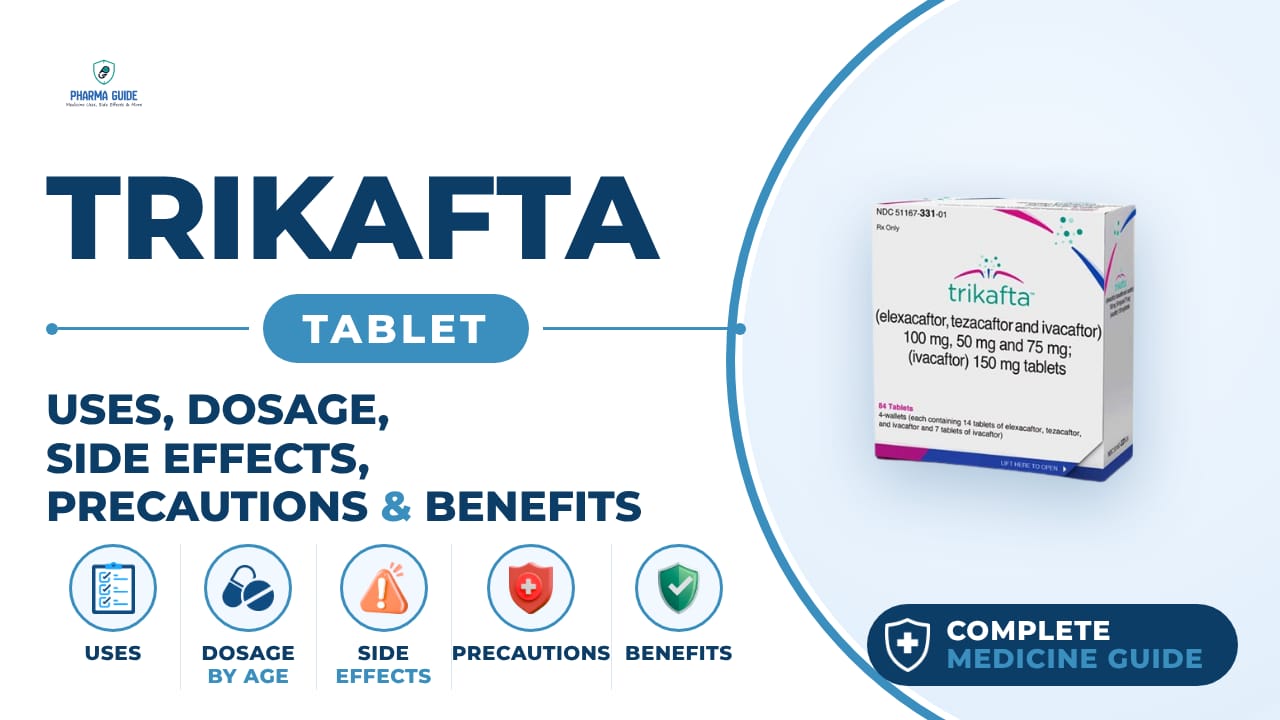
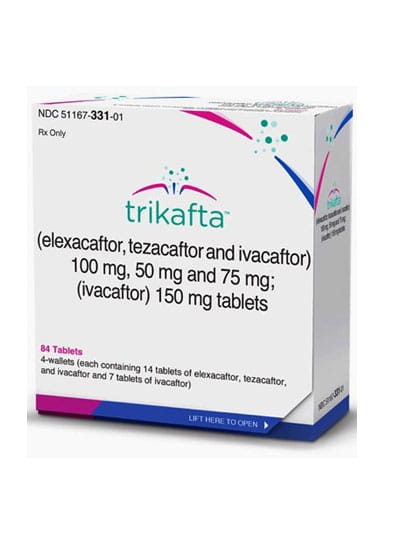
| Generic name | elexacaftor / tezacaftor / ivacaftor, and ivacaftor |
|---|---|
| Drug class | CFTR combination (Cystic Fibrosis Transmembrane Conductance Regulator corrector and potentiator) |
| Forms | Tablet |
Quick overview
Trikafta Tablet is a combination prescription medicine containing elexacaftor, tezacaftor, and ivacaftor, plus ivacaftor, belonging to the CFTR corrector and potentiator combination class. It is used to treat cystic fibrosis in people aged 2 years and older who have at least one F508del mutation in the CFTR gene, or another CFTR mutation known to respond to Trikafta. It works by helping the faulty CFTR protein reach the cell surface and function better, which can improve lung function and reduce flare-ups. It is taken by mouth as a morning and evening dose with fat-containing food.
What is Trikafta Tablet
Trikafta is a combination prescription medicine made up of three active ingredients: elexacaftor, tezacaftor, and ivacaftor. It targets the underlying cause of cystic fibrosis by helping the faulty CFTR protein work better.
Trikafta Tablet uses
- Treatment of cystic fibrosis (CF) in people aged 2 years and older who have at least one F508del mutation in the CFTR gene
- Treatment of CF in people with another CFTR gene mutation that is responsive to Trikafta based on clinical and/or lab data
Benefits of Trikafta Tablet
- Improves lung function (percent predicted FEV1)
- Reduces sweat chloride levels, showing the CFTR protein is working better
- Reduces the number of pulmonary (lung) flare-ups
- Improves CF-related quality of life scores, including breathing symptoms
- Can improve body mass index (BMI) and weight
How Trikafta Tablet works
Trikafta contains two 'correctors' (elexacaftor and tezacaftor) that help increase the amount of CFTR protein that reaches the surface of the cell, and one 'potentiator' (ivacaftor) that helps the CFTR protein at the cell surface work better at moving chloride. Together this increases CFTR activity, which helps reduce mucus buildup and improve CF symptoms.
Trikafta Tablet dosage
Take exactly as your healthcare provider tells you, even if you feel well. Take by mouth only. Trikafta has a morning dose and an evening dose taken about 12 hours apart, and each dose has different ingredients. Always take with food that contains fat, such as butter, oils, eggs, peanut butter, cheese, nuts, whole milk, or meats. Swallow tablets whole; do not chew, break, or dissolve them.
For granules, mix the entire packet with a small amount of soft food or liquid at or below room temperature, and eat or drink it all within one hour of mixing. A fat-containing meal or snack should be eaten just before or after taking the granules. Do not take the morning and evening doses at the same time. Avoid food or drinks containing grapefruit while taking this medicine.
If you miss a dose by 6 hours or less, take it as soon as possible with fat-containing food and continue your normal schedule. If more than 6 hours have passed since a missed morning dose, take the missed dose and skip the evening dose that day. If more than 6 hours have passed since a missed evening dose, skip it and take your next morning dose as usual. Children should be supervised after taking a dose until you see whether it affects their alertness or coordination.
| Age group | Dose |
|---|---|
| Under 18 years | Not recommended |
| 18–64 years | 150 mg, twice/day |
| 65+ years | 150 mg, twice/day |
Available forms and strengths
- Tablet
Side effects of Trikafta Tablet
Common
- Headache
- Upper respiratory tract infection (common cold), including stuffy or runny nose
- Stomach (abdominal) pain
- Diarrhea
- Rash
- Increase in liver enzymes on blood tests
- Increase in a blood enzyme called creatine phosphokinase
- Flu (influenza)
- Inflamed sinuses (sinusitis)
- Increase in blood bilirubin
- Constipation
Serious
- Serious and potentially fatal liver injury, including liver failure that may require a liver transplant
- Serious allergic reactions (anaphylaxis), including rash, hives, swelling of face/lips/tongue, tightness of chest or throat, difficulty breathing or swallowing, dizziness
- Increased pressure around the brain (intracranial hypertension), with symptoms like unusual headache, blurred or double vision, or vision loss
- Serious mental health problems such as anxiety, depression, suicidal thoughts and behaviors, and trouble sleeping
- Cataracts (clouding of the eye lens) in children and adolescents
Warnings and precautions
- Trikafta can cause serious and potentially fatal liver damage, including liver failure leading to transplant or death, even in people without prior liver disease. Liver blood tests are required before starting and regularly during treatment.
- Avoid taking strong medicines that induce CYP3A (like rifampin, phenobarbital, carbamazepine, phenytoin, or St. John's wort) together with Trikafta, as they can make Trikafta less effective.
- Taking Trikafta with certain antifungal or antibiotic medicines that strongly or moderately affect CYP3A enzymes can raise levels of Trikafta in the body, so the dose needs to be reduced if these are used together.
- Avoid grapefruit and grapefruit juice while taking this medicine, as it can increase the levels of the medicine in your body.
- Clouding of the eye lens (cataracts) has been seen in some children and teens taking ivacaftor-containing medicines. Eye exams are recommended before and during treatment in pediatric patients.
- A rash can occur, especially in females, and particularly in those taking hormonal birth control. Your doctor may consider stopping both medicines if a rash develops.
- Serious allergic reactions, including anaphylaxis and angioedema, have been reported after this medicine was approved and is on the market.
- Increased pressure around the brain and serious mental health problems, including suicidal thoughts, have been reported with this medicine.
- It is not known if Trikafta will harm an unborn baby. You and your healthcare provider should decide together whether you should take it during pregnancy.
- It is not known whether Trikafta passes into breast milk. You and your healthcare provider should decide together whether you should take it while breastfeeding.
- Caution is needed in patients with severe kidney impairment or end-stage kidney disease; no dose change is needed for mild or moderate kidney problems.
- Trikafta should not be used in people with severe liver impairment, and is not recommended for people with moderate liver impairment unless clearly needed, with a reduced dose and close monitoring. No dose change is needed for mild liver impairment.
- Dizziness has been reported with this medicine, which could affect your ability to drive or operate machinery. Use caution and avoid driving or using machines until you know how the medicine affects you.
Storage
- Store at or below 30°C (store at room temperature, 68°F–77°F / 20°C–25°C, per other source)
- Keep each tablet in its blister strip and granules in their packet until ready to take
- Keep out of reach and sight of children
- Do not use after the expiry date on the package
When to see a doctor
- Stop taking Trikafta and call your healthcare provider right away if you notice signs of liver problems, such as pain or discomfort in the upper right stomach area, yellowing of skin or eyes, loss of appetite, nausea or vomiting, dark urine, pale stools, or itchy skin.
- Get emergency help right away if you have signs of a serious allergic reaction, such as rash or hives, tightness in the chest or throat, difficulty breathing or swallowing, swelling of the face, lips, or tongue, or feeling light-headed or dizzy.
- Call your healthcare provider right away if you get an unusual headache, blurred vision, double vision, or vision loss, which could be a sign of increased pressure around the brain.
- Contact your healthcare provider right away if you experience new or worsening mental health symptoms such as anxiety, depression, suicidal thoughts, or trouble sleeping.
- If you think you or someone you are caring for has taken too much Trikafta, contact a healthcare provider, hospital emergency department, or your local poison control center right away, even if there are no symptoms.
Alternatives
- Kalydeco
- Symdeko
- Orkambi
- Alyftrek
- Other genotype-appropriate CFTR modulator therapy
Watch the video
FAQs
What is Trikafta Tablet used for?
Trikafta is used to treat cystic fibrosis in people aged 2 years and older who have at least one F508del mutation in the CFTR gene, or another CFTR mutation known to respond to Trikafta.
How should Trikafta Tablet be taken?
Trikafta is taken by mouth with a morning dose and an evening dose about 12 hours apart, each with different ingredients. It should always be taken with fat-containing food, and tablets should be swallowed whole without chewing, breaking, or dissolving them.
What are the serious side effects of Trikafta Tablet?
Serious side effects include potentially fatal liver injury, serious allergic reactions like anaphylaxis, increased pressure around the brain, serious mental health problems including suicidal thoughts, and cataracts in children and adolescents.
What should be avoided while taking Trikafta Tablet?
Avoid grapefruit and grapefruit juice, as well as strong CYP3A inducers like rifampin, phenobarbital, carbamazepine, phenytoin, or St. John's wort, since these can affect how Trikafta works in the body.
What are the alternatives to Trikafta Tablet?
Alternatives include Kalydeco, Symdeko, Orkambi, Alyftrek, and other genotype-appropriate CFTR modulator therapies.
General information, not medical advice
Your prescriber and the leaflet in your pack know your situation. This page does not.
- Follow your prescriber and the leaflet
- Don't start, stop, or change a dose on your own
- Doses and warnings differ by country and product
Sources
Video
Related medicines

Injectafer Injection: Uses, Dosage, Side Effects, Precautions and Alternates
Iron products
Injectafer (ferric carboxymaltose) treats iron deficiency anemia and heart failure-related iron deficiency via IV. Learn uses, dosage, side effects, and

Gliclazide Tablet: Uses, Dosage, Side Effects, Precautions and Alternates
Sulfonylurea (hypoglycemic/antidiabetic agent)
Gliclazide Tablet is a sulfonylurea for type 2 diabetes that boosts insulin release. Learn about dosage, side effects, warnings, and precautions.