
Safety
General information, not medical advice
Your prescriber and the leaflet in your pack know your situation. This page does not.
- Follow your prescriber and the leaflet
- Don't start, stop, or change a dose on your own
- Doses and warnings differ by country and product
Tysabri Injection: Uses, Dosage, Side Effects, Precautions and Alternates
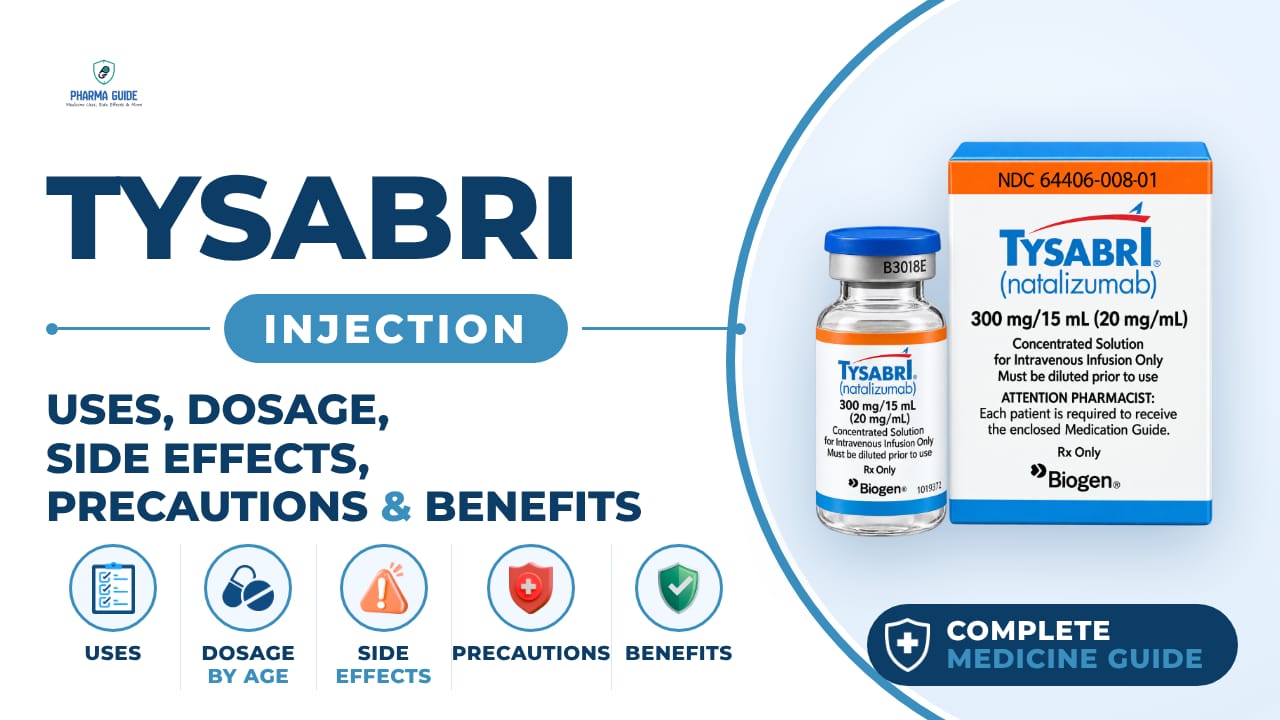
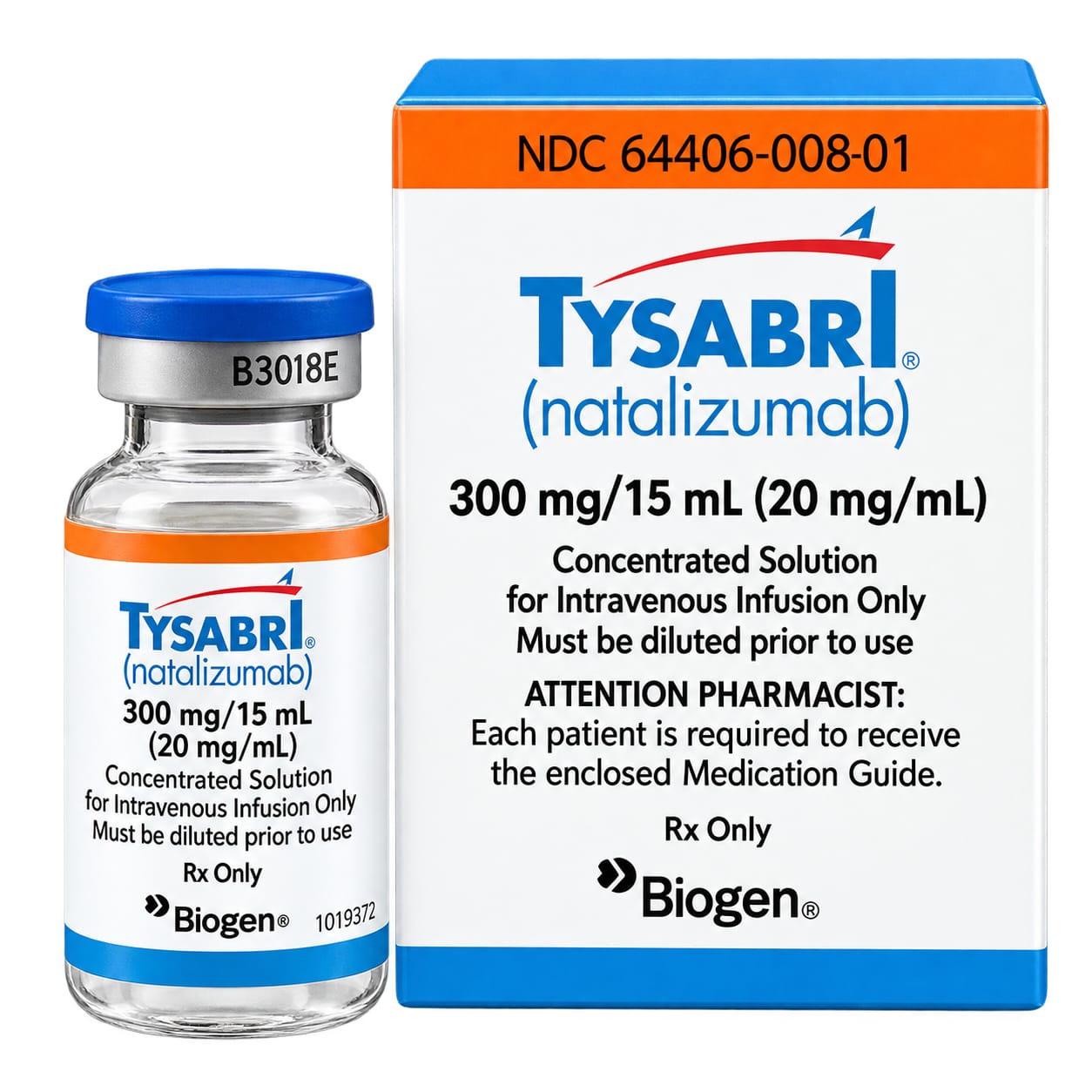
| Generic name | natalizumab |
|---|---|
| Drug class | Selective immunosuppressant (integrin receptor antagonist) |
| Forms | Injection for intravenous use (IV infusion), Single-dose vial |
Quick overview
Tysabri Injection (natalizumab) is a prescription selective immunosuppressant given as an IV infusion. It is used to treat relapsing forms of multiple sclerosis and moderate to severe Crohn's disease in adults who haven't responded well to other treatments. It works by blocking immune cells from crossing into the brain or gut, which lowers inflammation. Tysabri is given once every 4 weeks by a healthcare provider and carries important safety warnings that require close monitoring.
What is Tysabri Injection
Tysabri is a prescription medicine given as an IV infusion. It is used to treat multiple sclerosis and Crohn's disease in adults. It belongs to a drug class called selective immunosuppressants, specifically an integrin receptor antagonist.
Tysabri Injection uses
- Relapsing forms of multiple sclerosis (MS), including clinically isolated syndrome, relapsing-remitting disease, and active secondary progressive disease
- Moderate to severe Crohn's disease in adults who have not been helped enough by, or cannot use, usual Crohn's disease medicines and TNF inhibitors
Benefits of Tysabri Injection
- Can help reduce relapses in multiple sclerosis
- An option for Crohn's disease when other treatments haven't worked well
- Helps reduce MS relapses
- Can reduce new inflammatory brain lesions
- May slow disability progression
How Tysabri Injection works
Tysabri attaches to a protein called integrin on the surface of immune cells. This protein normally acts like a hook that lets immune cells grip onto blood vessel walls and move into the brain or gut, causing inflammation. By blocking this hook, Tysabri stops immune cells from crossing into these tissues, which lowers inflammation that drives MS and Crohn's disease.
Tysabri Injection dosage
Tysabri is given through a needle placed in a vein (IV infusion) by a healthcare provider, once every 4 weeks. Each infusion lasts about 1 hour. You may need to stay at the infusion center for about another hour afterward so your care team can watch for allergic reactions. Before each dose, you will be asked questions to make sure Tysabri is still right for you.
This medicine is only approved for use in adults; it is not known if it is safe and effective in children under 18. Write down your infusion dates on a calendar to help you stay on schedule, and call your care team if you need to reschedule. Do not stop taking Tysabri without talking to your prescriber first, since stopping can cause more MS relapses or worsen Crohn's disease symptoms.
| Age group | Dose |
|---|---|
| Under 18 years | Safety and effectiveness have not been established for routine use |
| 18–64 years | 300 mg IV infusion once every 4 weeks |
Available forms and strengths
- Injection for intravenous use (IV infusion)
- Single-dose vial
Side effects of Tysabri Injection
Common
- Headache
- Fatigue or feeling tired
- Urinary tract infection
- Joint pain
- Lung infection
- Depression
- Pain in arm or leg
- Diarrhea
- Vaginitis
- Rash or skin irritation
- Nose and throat infections
- Nausea
- Stomach area pain or discomfort
- Weight loss
- Weight gain
Serious
- Progressive multifocal leukoencephalopathy (a rare, serious brain infection)
- Herpes infections, including encephalitis, meningitis, and eye infections that can cause blindness
- Liver damage
- Allergic reactions, including serious allergic reactions and infusion reactions
- Other serious infections, including fungal infections
- Low platelet counts (bleeding or bruising problems)
- Depression
Warnings and precautions
- Tysabri carries a boxed warning for a rare but serious brain infection called progressive multifocal leukoencephalopathy (PML), which usually leads to death or severe disability. There is no known treatment, prevention, or cure for PML.
- Your risk of PML may be higher if you have been infected with the JC virus, have taken Tysabri for a long time (especially more than 2 years), or have previously taken medicines that weaken your immune system. Risk is greatest if all three factors apply.
- Because of the PML risk, Tysabri is only available through a restricted program called the TOUCH Prescribing Program. You, your doctor, and the infusion center must all be enrolled before you can receive the medicine.
- Do not receive Tysabri if you currently have or have had PML, or if you are allergic to natalizumab or any ingredient in Tysabri.
- Tysabri can weaken the immune system, raising the risk of serious infections. This risk is higher if you also take other medicines that weaken the immune system.
- It is not known if Tysabri is safe during pregnancy. If taken during pregnancy, it may cause low platelets and low red blood cells in the newborn baby. Talk with your doctor if you are pregnant or planning to become pregnant.
- Tysabri can pass into breast milk. It is not known if this can harm a breastfed baby. Talk to your doctor about the best way to feed your baby while receiving Tysabri.
- No routine dose adjustment is generally required solely for kidney impairment.
- Tysabri can cause liver damage, which can be serious. Watch for yellowing of the skin or eyes, nausea, vomiting, dark urine, or feeling tired or weak, and call your doctor right away if these occur.
- There is no known interaction between alcohol and Tysabri, but that does not necessarily mean it's safe to drink. Talk with your doctor or pharmacist for guidance.
- Dizziness, fatigue, or neurologic symptoms may make driving unsafe.
When to see a doctor
- Call your doctor right away if you have any new or worsening problems with thinking, eyesight, strength, balance, weakness on one side of the body, or using your arms and legs — these can be signs of PML. Keep watching for these symptoms for at least 6 months after stopping Tysabri.
- Call your doctor right away if you have sudden fever, severe headache, or feel confused, as these can be signs of a serious brain or spinal cord infection.
- Call your doctor right away if you have changes in vision, eye redness, or eye pain, which could signal a serious herpes eye infection.
- Call your doctor right away if you have symptoms of liver damage, such as yellowing of the skin or eyes, nausea, vomiting, dark urine, or feeling very tired or weak.
- Tell your doctor right away if you have any symptoms of an allergic reaction, such as hives, itching, trouble breathing, chest pain, dizziness, wheezing, chills, rash, nausea, flushing, or low blood pressure, even if it happens after your infusion.
- Call your doctor if you notice easy bruising, heavier than normal periods, bleeding from gums or nose that won't stop quickly, small red or purple spots on the skin, or a cut that is hard to stop bleeding — these may be signs of low platelet counts.
Alternatives
- Ocrevus (ocrelizumab)
- Kesimpta (ofatumumab)
- Gilenya (fingolimod)
Watch the video
FAQs
What is Tysabri Injection used for?
Tysabri treats relapsing forms of multiple sclerosis and moderate to severe Crohn's disease in adults who haven't responded well to other treatments.
How is Tysabri Injection given?
Tysabri is given as an IV infusion by a healthcare provider once every 4 weeks. Each infusion lasts about 1 hour, followed by about an hour of monitoring for allergic reactions.
What is the most serious risk of Tysabri Injection?
Tysabri carries a boxed warning for progressive multifocal leukoencephalopathy (PML), a rare but serious brain infection that usually leads to death or severe disability. Because of this risk, it is only available through the restricted TOUCH Prescribing Program.
What are common side effects of Tysabri Injection?
Common side effects include headache, fatigue, urinary tract infection, joint pain, lung infection, depression, diarrhea, nausea, and weight changes.
Can I stop taking Tysabri Injection suddenly?
No, you should not stop Tysabri without talking to your prescriber first, since stopping can cause more MS relapses or worsen Crohn's disease symptoms.
General information, not medical advice
Your prescriber and the leaflet in your pack know your situation. This page does not.
- Follow your prescriber and the leaflet
- Don't start, stop, or change a dose on your own
- Doses and warnings differ by country and product
Sources
Video
Related medicines

Injectafer Injection: Uses, Dosage, Side Effects, Precautions and Alternates
Iron products
Injectafer (ferric carboxymaltose) treats iron deficiency anemia and heart failure-related iron deficiency via IV. Learn uses, dosage, side effects, and

Gliclazide Tablet: Uses, Dosage, Side Effects, Precautions and Alternates
Sulfonylurea (hypoglycemic/antidiabetic agent)
Gliclazide Tablet is a sulfonylurea for type 2 diabetes that boosts insulin release. Learn about dosage, side effects, warnings, and precautions.