
Safety
General information, not medical advice
Your prescriber and the leaflet in your pack know your situation. This page does not.
- Follow your prescriber and the leaflet
- Don't start, stop, or change a dose on your own
- Doses and warnings differ by country and product
Unasyn Injection: Uses, Dosage, Side Effects, Precautions and Alternates
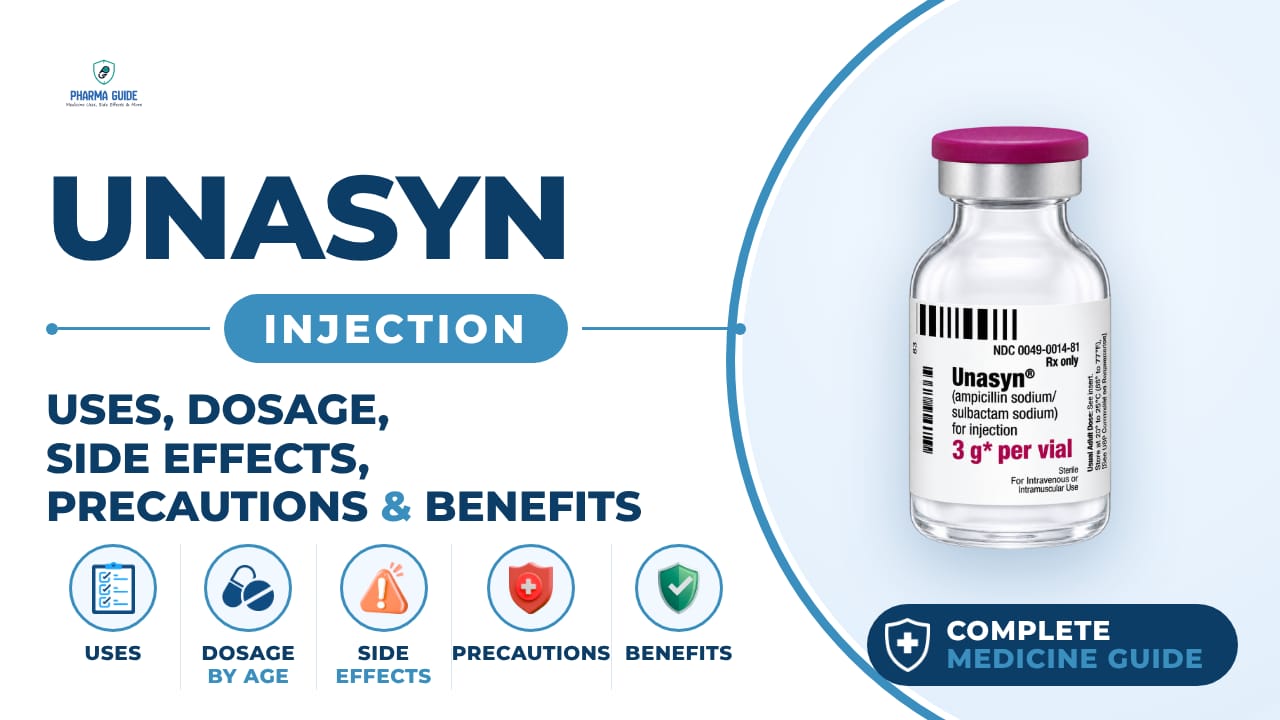
| Generic name | ampicillin and sulbactam |
|---|---|
| Drug class | Penicillins / beta-lactamase inhibitors |
| Forms | Injection (powder for solution, given into a vein or muscle) |
Quick overview
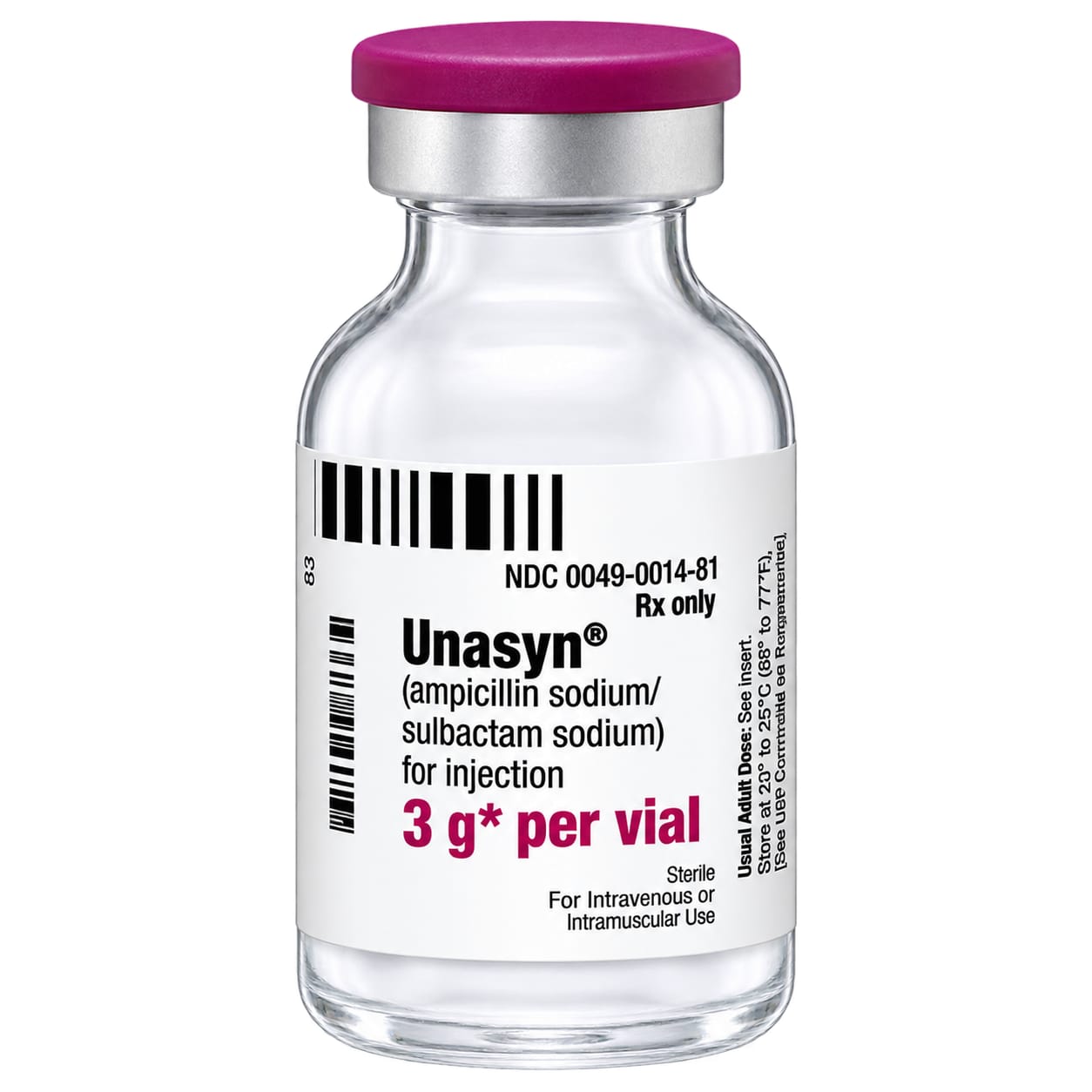
Unasyn Injection is a combination antibiotic containing ampicillin and sulbactam, used to treat skin and skin structure infections, intra-abdominal infections, and gynecological infections caused by certain bacteria. It is given as a shot into a muscle or as an infusion into a vein. Sulbactam helps ampicillin work against more types of bacteria by blocking an enzyme that would otherwise destroy it.
What is Unasyn Injection
Unasyn is a combination antibiotic medicine that fights bacteria. It combines ampicillin, a penicillin antibiotic, with sulbactam, which helps the antibiotic work against more types of bacteria.
Unasyn Injection uses
- Treats skin and skin structure infections caused by certain bacteria
- Treats intra-abdominal infections caused by certain bacteria
- Treats gynecological infections caused by certain bacteria
- May be used for other infections not listed in this guide, as decided by a doctor
Benefits of Unasyn Injection
- Combines an antibiotic with a beta-lactamase inhibitor
- Provides broad antibacterial coverage
- Can treat mixed bacterial infections
- Available for IV or IM administration
How Unasyn Injection works
Ampicillin kills bacteria by stopping them from building their cell walls. Some bacteria make an enzyme that destroys ampicillin, but the sulbactam in Unasyn blocks that enzyme, which allows the ampicillin to keep working against more types of bacteria.
Unasyn Injection dosage
Follow all directions on your prescription label and read all medication guides or instruction sheets, and use the medicine exactly as directed. This medicine is given as a shot into a muscle or as an infusion into a vein; a healthcare provider gives the first dose and may teach you how to give it yourself.
The medicine must be mixed with a liquid before use, and you need to understand how to properly mix and store it if you are giving it to yourself at home. After mixing, the medicine must be used within a certain number of hours depending on how it is stored (at room temperature or in the refrigerator). Prepare an injection only when you are ready to give it, and do not use it if it has changed color or has particles in it.
Use this medicine for the full length of time your doctor prescribes, even if you start feeling better quickly, because skipping doses can lead to an infection that resists treatment. This medicine will not treat viral infections such as the flu or a common cold. You may need frequent blood tests to check how well your liver is working.
If you miss a dose, use it as soon as you can, but skip it if it is almost time for your next dose; do not use two doses at one time.
| Age group | Dose |
|---|---|
| 1–11 years, <40 kg | 300 mg/kg/day IV, divided into equal doses every 6 hours |
| 12–17 years, <40 kg | 300 mg/kg/day IV, divided every 6 hours |
| Pediatric patients ≥40 kg | Adult dosing: 1,500–3,000 mg every 6 hours |
Available forms and strengths
- Injection (powder for solution, given into a vein or muscle)
Side effects of Unasyn Injection
Common
- Diarrhea
- Rash
- Swollen, black, or hairy tongue
- Vaginal itching or discharge
- Pain, swelling, or irritation where the medicine was injected
- Fever
- Sore throat
- Headache
- Body aches
- Nausea
- Vomiting
- Stomach pain
- Bloating
- Gas
- Itching
- Thrush (white patches inside the mouth or throat)
Serious
- Signs of an allergic reaction such as hives, difficulty breathing, or swelling of the face or throat
- Severe skin reaction with fever, sore throat, burning eyes, skin pain, or a red or purple skin rash with blistering and peeling
- Severe stomach pain or watery or bloody diarrhea, even months after the last dose
- Heart problems such as fast heartbeats, chest pain or pressure, pain spreading to the jaw or shoulder, nausea, or sweating
- Liver problems such as nausea, upper stomach pain, itching, tiredness, loss of appetite, dark urine, clay-colored stools, or yellowing of the skin or eyes
- Signs of a new infection such as fever, headache, tiredness, ear pain or drainage, eye pain or redness, cough, skin rash, sores or pimples with pus, joint pain, ongoing neck or back pain, diarrhea, or pain or burning when urinating
- Sudden vision loss, blurred vision, tunnel vision, eye pain or swelling, or seeing halos around lights
- Fast, irregular, or pounding heartbeats, fluttering in the chest, shortness of breath, sudden dizziness, lightheadedness, or passing out
- Severe headache, confusion, slurred speech, arm or leg weakness, trouble walking, loss of coordination, feeling unsteady, very stiff muscles, high fever, profuse sweating, or tremors
- Seizures (convulsions)
Warnings and precautions
- Do not use this medicine if you have ever had a severe allergic reaction to any penicillin or cephalosporin antibiotic, or if you have had liver problems while using this medicine before.
- Serious and sometimes fatal allergic reactions have happened with penicillin medicines, especially in people who have had allergic reactions before.
- This medicine can cause severe skin reactions that need urgent medical attention, and it should be stopped if a rash gets worse.
- This medicine can cause diarrhea linked to a serious bowel infection called C. difficile, which can occur even two months or more after finishing treatment.
- People with mononucleosis should not take ampicillin-type antibiotics because they are very likely to develop a skin rash.
- This medicine only treats bacterial infections, not viral infections like the common cold, and skipping doses can make bacteria harder to treat in the future.
- Tell your doctor if you are pregnant. This medicine should be used during pregnancy only if it is clearly needed, since there are no adequate studies in pregnant women.
- Tell your doctor if you are breastfeeding. Small amounts of the medicine pass into breast milk, so caution is needed.
- Tell your doctor if you have kidney disease. People with reduced kidney function may need a lower dose given less often.
- Do not use this medicine if you have had liver problems while using it before. Tell your doctor about any liver disease, since liver function may need to be checked regularly.
- No major direct interaction with alcohol is established, though avoiding alcohol during a serious infection is sensible.
- This medicine usually does not impair driving, but avoid driving if dizziness or weakness occurs.
Storage
- Store unmixed Unasyn at room temperature away from moisture and heat
- Use a needle and syringe only once and then place them in a puncture-proof sharps container
- Follow state or local laws about how to dispose of the sharps container, and keep it out of the reach of children and pets
When to see a doctor
- Get emergency medical help right away if you have signs of an allergic reaction such as hives, trouble breathing, or swelling of the face or throat, or a severe skin reaction with fever, sore throat, burning eyes, or a painful rash with blistering and peeling.
- Call your doctor right away if you have severe stomach pain, watery or bloody diarrhea, thrush, signs of heart problems, signs of liver problems, or signs of a new infection.
- If you get watery or bloody diarrhea, contact your doctor before taking any anti-diarrhea medicine, and seek care as soon as possible even if it starts weeks after finishing treatment.
- Seek emergency medical attention if you think you have used too much of this medicine, since an overdose may cause seizures.
Alternatives
- Ceftriaxone
- Cefepime
- Ertapenem
Watch the video
FAQs
What is Unasyn Injection used for?
Unasyn Injection is used to treat skin and skin structure infections, intra-abdominal infections, and gynecological infections caused by certain bacteria. It may also be used for other infections as decided by a doctor.
How does Unasyn Injection work?
Ampicillin in Unasyn kills bacteria by stopping them from building their cell walls. Sulbactam blocks an enzyme that some bacteria make to destroy ampicillin, allowing it to work against more types of bacteria.
How is Unasyn Injection given?
Unasyn is given as a shot into a muscle or as an infusion into a vein. A healthcare provider gives the first dose and may teach you how to give it yourself. The medicine must be mixed with a liquid before use.
What are the common side effects of Unasyn Injection?
Common side effects include diarrhea, rash, swollen or black or hairy tongue, vaginal itching or discharge, pain or swelling at the injection site, fever, sore throat, headache, nausea, vomiting, stomach pain, bloating, gas, and thrush.
Who should not use Unasyn Injection?
People who have had a severe allergic reaction to any penicillin or cephalosporin antibiotic, or who have had liver problems while using this medicine before, should not use it. People with mononucleosis should also avoid ampicillin-type antibiotics.
General information, not medical advice
Your prescriber and the leaflet in your pack know your situation. This page does not.
- Follow your prescriber and the leaflet
- Don't start, stop, or change a dose on your own
- Doses and warnings differ by country and product
Sources
Video
Related medicines
Augmentin Syrup: Uses, Dosage, Side Effects, Precautions and Alternates
Penicillins / beta-lactamase inhibitors
Augmentin Syrup combines amoxicillin and clavulanic acid to treat bacterial infections. Learn about dosage, side effects, and precautions before use.

Injectafer Injection: Uses, Dosage, Side Effects, Precautions and Alternates
Iron products
Injectafer (ferric carboxymaltose) treats iron deficiency anemia and heart failure-related iron deficiency via IV. Learn uses, dosage, side effects, and