
Safety
General information, not medical advice
Your prescriber and the leaflet in your pack know your situation. This page does not.
- Follow your prescriber and the leaflet
- Don't start, stop, or change a dose on your own
- Doses and warnings differ by country and product
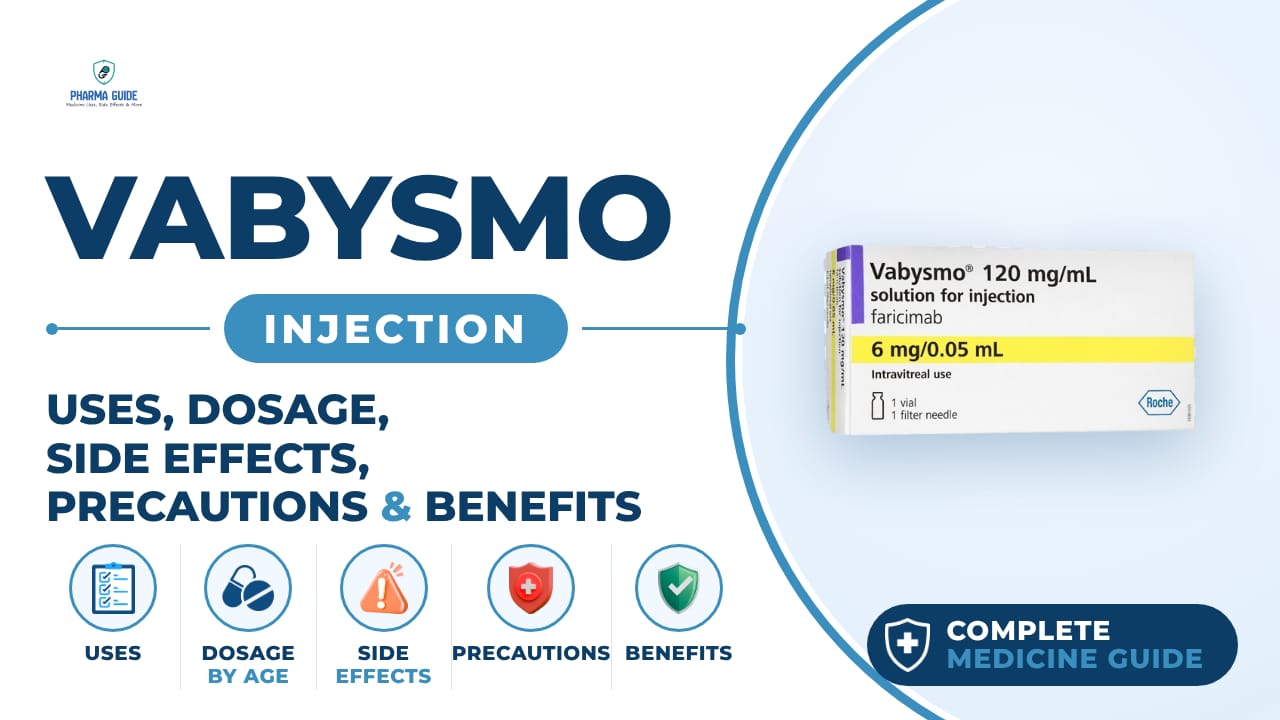
Vabysmo Injection: Uses, Dosage, Side Effects, Precautions and Alternates
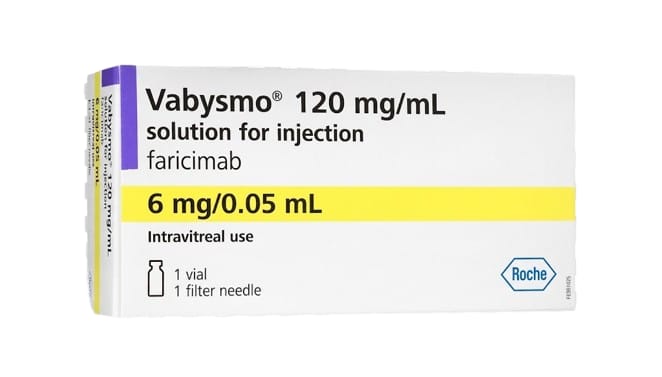
| Generic name | faricimab-svoa |
|---|---|
| Drug class | Anti-angiogenic ophthalmic agents |
| Forms | Intravitreal injection (single-dose vial) |
Quick overview
Vabysmo Injection (faricimab-svoa) is a prescription eye injection belonging to the anti-angiogenic ophthalmic agents class. It is used in adults to treat wet age-related macular degeneration, diabetic macular edema, and macular edema following retinal vein occlusion. It works by blocking VEGF and Ang-2 proteins to reduce abnormal blood vessel growth and fluid leakage in the eye. It is given by a healthcare professional as an injection into the eye on a schedule determined by your doctor.
What is Vabysmo Injection
Vabysmo is a prescription eye injection used to treat certain eye diseases that cause vision loss in adults, including wet age-related macular degeneration, diabetic macular edema, and macular edema following retinal vein occlusion.
Vabysmo Injection uses
- Neovascular (wet) age-related macular degeneration (nAMD)
- Visual impairment due to diabetic macular edema (DME)
- Visual impairment due to macular edema following retinal vein occlusion (branch RVO or central RVO)
Benefits of Vabysmo Injection
- Helps improve and maintain vision
- May help slow damage to the retina and preserve vision
- Clinical trials showed vision gains comparable to aflibercept at one month and through follow-up visits
How Vabysmo Injection works
Vabysmo blocks two proteins called VEGF and Ang-2 that cause abnormal blood vessel growth and leakage in the eye. By blocking these proteins, it helps reduce swelling and fluid leakage, which can help protect and improve vision.
Vabysmo Injection dosage
Vabysmo is given as an injection into the eye by a trained healthcare professional, so you do not take it yourself. Your eye will be numbed with an anesthetic before the injection, so it is usually painless. A separate syringe is used for each eye if both eyes need treatment. Your eye pressure will be checked right after the injection.
You may have blurred vision for a short time after the injection and after the related eye exam, so you should not drive or use machinery until your vision clears. Treatment is usually given on a regular schedule at first, and your doctor may space out the injections over time depending on how your eye responds. If you miss a scheduled injection appointment, contact your doctor for instructions as soon as possible.
| Age group | Dose |
|---|---|
| Under 18 years | Not recommended |
| 18–60 years | 6 mg, once/day |
| 60+ years | 6 mg, once/day |
Available forms and strengths
- Intravitreal injection (single-dose vial)
Side effects of Vabysmo Injection
Common
- Blurred vision
- Eye pain or redness
- Seeing halos around lights
- Bleeding in the white part of the eye
- Cataract
- Vitreous detachment
- Increased eye pressure
- Vitreous floaters
- Retinal pigment epithelial tear (nAMD only)
Serious
- Signs of eye infection such as swelling, severe discomfort, crusting, or drainage
- Severe eye redness or pain
- Eyes becoming more sensitive to light
- Changes in vision
- Endophthalmitis (serious eye infection)
- Retinal detachment or retinal tear
- Severe inflammation of blood vessels in the retina (retinal vasculitis)
- Blood clots that could lead to heart attack or stroke
- Signs of an allergic reaction such as hives, difficulty breathing, or swelling of the face, lips, tongue, or throat
Warnings and precautions
- Do not receive this medicine if you have an infection in or around the eye, if your eye is red, swollen, or painful, or if you are allergic to the active ingredient or any other ingredient.
- Eye infections or retinal detachment can occur after eye injections like this one. Contact your healthcare provider right away if you have increasing eye pain, vision loss, sensitivity to light, or redness in the white of the eye.
- Temporary increases in eye pressure have been reported shortly after the injection.
- There is a risk of serious, sometimes fatal, blood clots such as heart attacks or strokes associated with this type of medicine.
- This medicine should not be given at the same time as other anti-VEGF medicines in the same eye.
- Tell your doctor if you are pregnant or planning to become pregnant, since there is a potential risk to an unborn baby. Effective birth control should be used during treatment and for at least 3 months after the last dose.
- Ask your doctor if it is safe to breastfeed during treatment, since it is not known if the medicine passes into breast milk.
- No dose adjustment is needed for patients with kidney problems. No dose adjustment is needed for patients with liver problems.
- Vision may be temporarily impaired after the injection or related eye exam, so you should not drive or use machinery until your vision has recovered enough.
Storage
- Store in the refrigerator between 2°C to 8°C (36°F to 46°F).
- Do not freeze, do not shake, and keep the vial in the original carton to protect it from light.
- Before use, the unopened glass vial of Vabysmo may be kept at room temperature, 20°C to 25°C (68°F to 77°F), for up to 24 hours.
- Once drawn up, the injection must be given immediately.
When to see a doctor
- Contact your doctor immediately if you notice signs of possible infection or inflammation, such as eye pain, increased redness, blurred or decreased vision, more floaters in your vision, or increased sensitivity to light.
- Seek help right away for a sudden decrease or change in vision.
- Get emergency medical help if you have signs of an allergic reaction, such as hives, difficulty breathing, or swelling of your face, lips, tongue, or throat.
Alternatives
- Avastin (Bevacizumab)
- Lucentis (Ranibizumab)
- Eylea (Aflibercept)
Watch the video
FAQs
What is Vabysmo Injection used for?
Vabysmo is used in adults to treat wet age-related macular degeneration, diabetic macular edema, and macular edema following retinal vein occlusion.
How does Vabysmo Injection work?
Vabysmo blocks two proteins called VEGF and Ang-2 that cause abnormal blood vessel growth and leakage in the eye, helping reduce swelling and fluid leakage to protect and improve vision.
How is Vabysmo given?
Vabysmo is given as an injection into the eye by a trained healthcare professional after the eye is numbed with an anesthetic. A separate syringe is used for each eye if both need treatment, and eye pressure is checked right after the injection.
What are the common side effects of Vabysmo Injection?
Common side effects include blurred vision, eye pain or redness, seeing halos around lights, bleeding in the white part of the eye, cataract, vitreous detachment, increased eye pressure, and vitreous floaters.
Can I drive after getting a Vabysmo injection?
No, you may have blurred vision for a short time after the injection and the related eye exam, so you should not drive or use machinery until your vision clears.
General information, not medical advice
Your prescriber and the leaflet in your pack know your situation. This page does not.
- Follow your prescriber and the leaflet
- Don't start, stop, or change a dose on your own
- Doses and warnings differ by country and product
Sources
Video
Related medicines

Injectafer Injection: Uses, Dosage, Side Effects, Precautions and Alternates
Iron products
Injectafer (ferric carboxymaltose) treats iron deficiency anemia and heart failure-related iron deficiency via IV. Learn uses, dosage, side effects, and

Gliclazide Tablet: Uses, Dosage, Side Effects, Precautions and Alternates
Sulfonylurea (hypoglycemic/antidiabetic agent)
Gliclazide Tablet is a sulfonylurea for type 2 diabetes that boosts insulin release. Learn about dosage, side effects, warnings, and precautions.