
Safety
General information, not medical advice
Your prescriber and the leaflet in your pack know your situation. This page does not.
- Follow your prescriber and the leaflet
- Don't start, stop, or change a dose on your own
- Doses and warnings differ by country and product
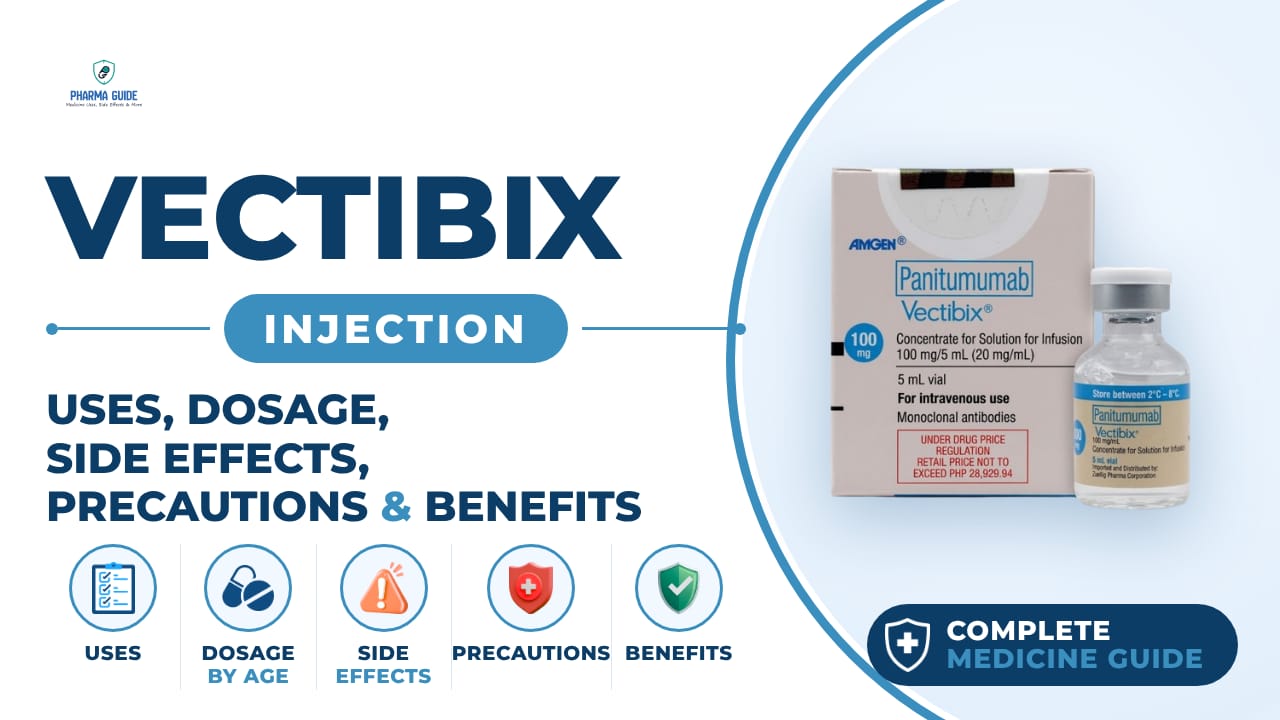
Vectibix Injection: Uses, Dosage, Side Effects, Precautions and Alternates
| Generic name | panitumumab |
|---|---|
| Drug class | Epidermal growth factor receptor (EGFR) antagonist (a type of monoclonal antibody) |
| Forms | Injection |
Quick overview
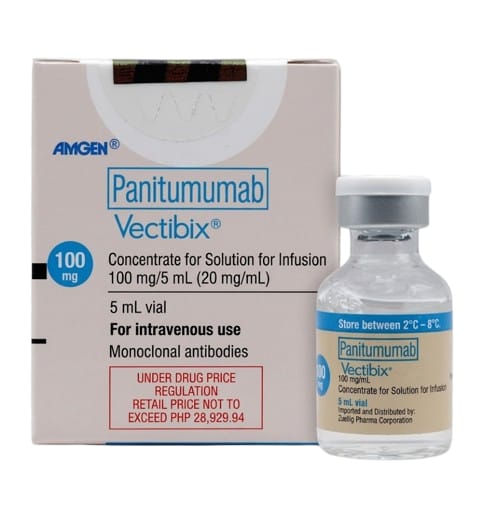
Vectibix Injection contains panitumumab, an epidermal growth factor receptor (EGFR) antagonist that belongs to the monoclonal antibody class of medicines. It is given by infusion into a vein to treat a specific type of advanced bowel cancer, either together with chemotherapy or combined with sotorasib, depending on the tumor type. Vectibix works by blocking growth signals that cancer cells use to grow and divide. It is administered by a doctor or nurse in a healthcare facility and requires close monitoring for skin, lung, and other serious reactions.
What is Vectibix Injection
Vectibix is a cancer medicine that contains panitumumab, a man-made antibody. It is given by infusion into a vein to treat a specific type of advanced bowel cancer.
Vectibix Injection uses
- Treatment of adult patients with wild-type RAS metastatic colorectal cancer (mCRC), used together with FOLFOX chemotherapy as first-line treatment
- Treatment of wild-type RAS mCRC on its own (monotherapy) after prior chemotherapy with a fluoropyrimidine, oxaliplatin, and irinotecan has stopped working
- Treatment of KRAS G12C-mutated mCRC, used together with sotorasib, in patients who have already had chemotherapy with a fluoropyrimidine, oxaliplatin, and irinotecan
Benefits of Vectibix Injection
- Can help slow down disease progression in wild-type RAS metastatic colorectal cancer when combined with chemotherapy
- May improve response rates compared to chemotherapy alone in wild-type RAS mCRC
- Combined with sotorasib, showed improved progression-free survival compared to standard chemotherapy options in KRAS G12C-mutated mCRC
How Vectibix Injection works
Vectibix blocks a protein called EGFR that is found on the surface of some cancer cells. Normally, growth signals attach to EGFR and tell the cancer cell to grow and divide. Panitumumab attaches to EGFR instead, blocking these growth signals and helping stop the cancer cell from growing.
Vectibix Injection dosage
Vectibix is given as an infusion into a vein using an infusion pump, by a doctor or nurse in a healthcare facility. It must not be given as a quick injection (push or bolus) into the vein. It is usually given once every two weeks, typically infused over about 60 minutes. If the first infusion is well tolerated, later infusions may be given a bit faster; larger doses are infused over a longer time. The IV line is flushed with saline before and after the infusion so Vectibix does not mix with other medicines.
When used with sotorasib, the first dose of sotorasib should be taken before the first Vectibix infusion, and Vectibix should be stopped if sotorasib is stopped or paused. Doctors may recommend using moisturizer, sunscreen, and topical steroid cream on the face, hands, feet, neck, back, and chest before and during treatment to help prevent skin reactions. Limit sun exposure, and wear sunscreen and a hat while being treated with this medicine.
| Age group | Dose |
|---|---|
| Under 18 years | Safety and effectiveness have not been established |
| 18–64 years | 6 mg/kg IV every 14 days |
| 65–74 years | 6 mg/kg IV every 14 days |
Available forms and strengths
- Injection
Side effects of Vectibix Injection
Common
- Skin rash with variable presentations (acne-like rash, redness, dryness, peeling, skin fissures)
- Paronychia (nail bed infections/inflammation)
- Fatigue or weakness
- Nausea and vomiting
- Diarrhea
- Mouth sores (stomatitis) and inflammation of mucous membranes
- Loss of appetite
- Low magnesium and low potassium levels in the blood
- Itching (pruritus)
- Constipation
- Abdominal pain
- Weight loss
- Growth of eyelashes
- Cough and shortness of breath
Serious
- Severe skin reactions with pain, disfigurement, ulceration, or loss of outer layers of skin
- Life-threatening or fatal infections (sepsis, necrotizing fasciitis, abscesses) following severe skin reactions
- Severe or fatal infusion reactions (fever, chills, difficulty breathing, bronchospasm, low blood pressure)
- Severe diarrhea and dehydration leading to acute kidney failure
- Interstitial lung disease or pulmonary fibrosis, which can be fatal
- Serious eye problems including keratitis, ulcerative keratitis, or corneal perforation
- Severe electrolyte imbalances (very low magnesium, calcium, or potassium)
- Stevens-Johnson syndrome or toxic epidermal necrolysis (severe blistering skin reactions)
- Blood clots including pulmonary embolism (especially when combined with bevacizumab)
- Harm to an unborn baby if used during pregnancy
Warnings and precautions
- Serious skin and soft tissue reactions can occur, affecting most patients, and may be severe. Patients should be watched for signs of infection related to skin reactions, as life-threatening and fatal infections have occurred.
- This medicine is not meant for patients with RAS-mutant metastatic colorectal cancer (except when combined with sotorasib for KRAS G12C-mutated tumors) because it may not help and could cause harm, including a greater risk of death, in these patients.
- This medicine must not be used together with bevacizumab-containing chemotherapy, as this combination increased deaths and serious side effects without added benefit.
- This medicine must not be used in patients who have a history of or current interstitial lung disease (lung inflammation) or pulmonary fibrosis (lung scarring).
- Serious and sometimes fatal infusion reactions can occur during or after treatment, including trouble breathing, low blood pressure, and severe allergic reactions.
- This medicine can cause low levels of magnesium, calcium, and potassium in the blood, sometimes severe, which require monitoring before, during, and after treatment.
- Severe diarrhea and dehydration can lead to kidney failure.
- Serious eye problems, including corneal ulcers or perforation, have occurred and may require stopping treatment.
- This medicine can harm an unborn baby. Women who could become pregnant should use effective birth control during treatment and for at least 2 months after the last dose. Tell your doctor right away if you are or might be pregnant.
- Women should not breastfeed during treatment with this medicine and for 2 months after the last dose, because of the risk of serious side effects in a nursing infant.
- This medicine has not been specifically studied in people with kidney problems. Severe diarrhea and dehydration during treatment can also lead to kidney failure.
- This medicine has not been specifically studied in people with liver problems.
- Discuss alcohol use with the oncology team, particularly during combination chemotherapy.
- This medicine may have a minor effect on your ability to drive or use machines. If side effects affect your vision or your ability to concentrate and react, do not drive or use machines until these effects go away.
Storage
- Store vials in the original carton under refrigeration at 2° to 8°C (36° to 46°F) until time of use
- Protect from direct sunlight
- Do not freeze or shake
- Discard any unused portion remaining in the vial
When to see a doctor
- Get medical help right away if you notice new or worsening skin reactions, blistering of the skin, mouth, eyes, or genitals, or any signs of infection such as fever, chills, or increased redness or swelling.
- Contact your doctor immediately if you have symptoms during or after an infusion such as fever, chills, shortness of breath, throat tightness, or a drop in blood pressure.
- Tell your doctor right away if you have severe diarrhea or signs of dehydration, since this can lead to kidney problems.
- Tell your doctor if you have new or worsening breathing problems, a cough that doesn't go away, or wheezing, as this could be a sign of serious lung disease.
- Seek prompt medical attention for any eye symptoms such as redness, pain, increased tearing, blurred vision, or sensitivity to light.
- Seek immediate medical attention if you have symptoms of a severe allergic reaction such as difficulty breathing, chest tightness, a choking feeling, dizziness, or fainting, even if it happens more than a day after your infusion.
Alternatives
- Cetuximab
- Bevacizumab
- FOLFOX-based chemotherapy
Watch the video
FAQs
What is Vectibix Injection used for?
Vectibix is used to treat wild-type RAS metastatic colorectal cancer, either combined with FOLFOX chemotherapy as first-line treatment or alone after prior chemotherapy has failed. It is also used with sotorasib for KRAS G12C-mutated metastatic colorectal cancer in patients who have already had prior chemotherapy.
How is Vectibix Injection given?
Vectibix is given as an infusion into a vein using an infusion pump by a doctor or nurse in a healthcare facility, usually once every two weeks over about 60 minutes. It must not be given as a quick push or bolus injection.
What are the serious side effects of Vectibix Injection?
Serious side effects include severe skin reactions that can lead to life-threatening infections, severe or fatal infusion reactions, severe diarrhea and dehydration leading to kidney failure, interstitial lung disease, serious eye problems, severe electrolyte imbalances, and blood clots, especially when combined with bevacizumab.
Can Vectibix be used with bevacizumab?
No, Vectibix must not be used together with bevacizumab-containing chemotherapy, as this combination increased deaths and serious side effects without added benefit.
Is Vectibix safe to use during pregnancy or breastfeeding?
Vectibix can harm an unborn baby, so women who could become pregnant should use effective birth control during treatment and for at least 2 months after the last dose. Women should not breastfeed during treatment and for 2 months after the last dose.
General information, not medical advice
Your prescriber and the leaflet in your pack know your situation. This page does not.
- Follow your prescriber and the leaflet
- Don't start, stop, or change a dose on your own
- Doses and warnings differ by country and product
Sources
Video
Related medicines

Injectafer Injection: Uses, Dosage, Side Effects, Precautions and Alternates
Iron products
Injectafer (ferric carboxymaltose) treats iron deficiency anemia and heart failure-related iron deficiency via IV. Learn uses, dosage, side effects, and

Gliclazide Tablet: Uses, Dosage, Side Effects, Precautions and Alternates
Sulfonylurea (hypoglycemic/antidiabetic agent)
Gliclazide Tablet is a sulfonylurea for type 2 diabetes that boosts insulin release. Learn about dosage, side effects, warnings, and precautions.