
Safety
General information, not medical advice
Your prescriber and the leaflet in your pack know your situation. This page does not.
- Follow your prescriber and the leaflet
- Don't start, stop, or change a dose on your own
- Doses and warnings differ by country and product
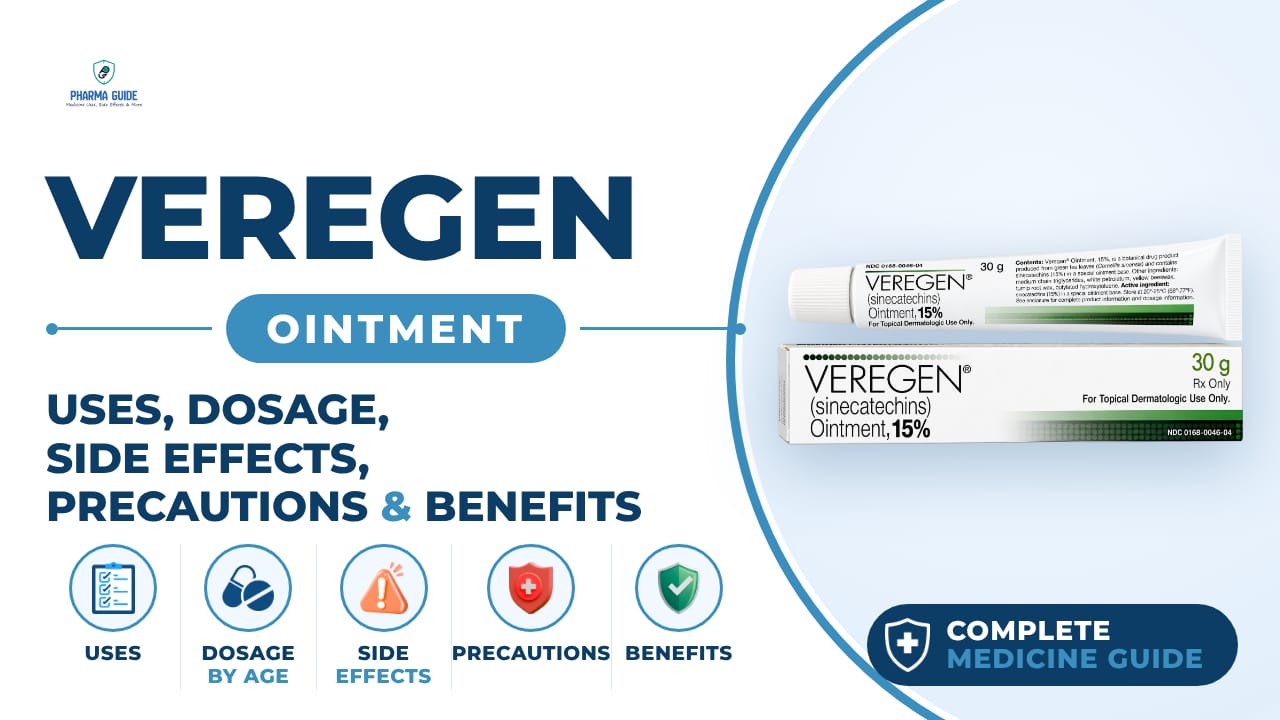
Veregen Ointment: Uses, Dosage, Side Effects, Precautions and Alternates
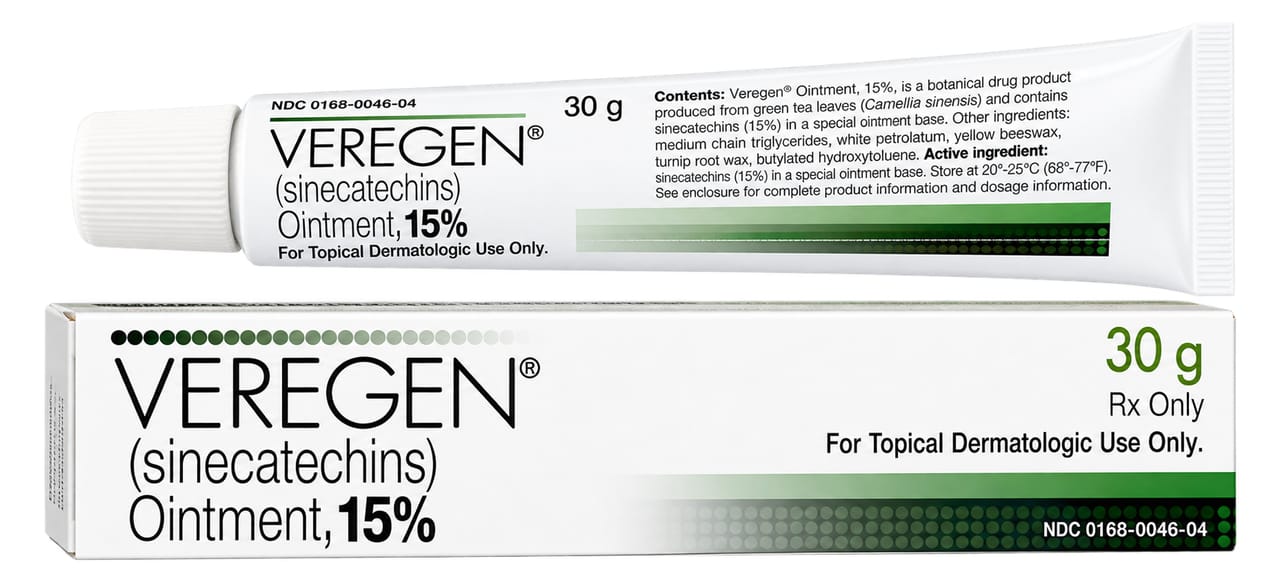
| Generic name | sinecatechins |
|---|---|
| Drug class | botanical drug product (green tea extract) |
| Forms | Ointment, 15% w/w, Ointment, 10% w/w |
Quick overview
Veregen Ointment (sinecatechins) is a prescription botanical drug product made from purified green tea leaf extract. It is applied to the skin to treat external genital and perianal warts caused by HPV in adults. The ointment is used three times a day until warts clear, for up to 16 weeks, and common skin reactions such as redness, itching, and burning may occur at the application site.
What is Veregen Ointment
Veregen is a prescription ointment made from a purified extract of green tea leaves. It is applied to the skin to treat warts on the outside of the genital and anal area in adults. Its generic name is sinecatechins, and it belongs to the botanical drug product class, derived from green tea extract.
Veregen Ointment uses
- External genital warts
- Warts around the outside of the anus
- Condylomata acuminata caused by HPV
Benefits of Veregen Ointment
- Helps remove external genital warts
- Helps reduce visible wart growth
- Supports clearance of treated warts
- Provides a topical treatment option
- May help clear warts without a surgical procedure
How Veregen Ointment works
It is not fully known how Veregen clears genital and perianal warts. In lab studies the green tea extract showed antioxidant activity, but what this means for how it works in the body is unclear.
Veregen Ointment dosage
Apply the ointment to all external genital and perianal warts three times a day. Use your finger to dab a small amount onto each wart so it is fully covered with a thin layer. Wash your hands before and after applying the ointment. You do not need to wash off the ointment before the next application; if you wash the area or bathe, apply the ointment again afterward. Do not use in the eyes, mouth, vagina, or anus.
Continue treatment until the warts clear completely, but not longer than 16 weeks. If new warts appear during treatment, they should be treated too. Uncircumcised men treating warts under the foreskin should pull back the foreskin and clean the area daily. Women using tampons should insert the tampon before applying the ointment, and avoid getting the ointment into the vagina when changing it.
Avoid sexual contact while the ointment is on the skin, or wash it off first, since it can weaken condoms and vaginal diaphragms. Do not cover the treated area with a bandage or other covering. Avoid exposing the treated area to sunlight, sunlamps, or tanning beds. Safety and effectiveness have not been studied in people under 18.
| Age group | Dose |
|---|---|
| Under 18 years | Not recommended |
| 18–64 years | Apply a thin layer, 3 times/day |
| 65+ years | Apply a thin layer, 3 times/day |
Available forms and strengths
- Ointment, 15% w/w
- Ointment, 10% w/w
Side effects of Veregen Ointment
Common
- Redness (erythema)
- Itching (pruritus)
- Burning
- Pain or discomfort
- Skin erosion or ulceration
- Swelling (edema)
- Hardening of the skin (induration)
- Small blisters (vesicular rash)
Serious
- Severe skin reactions such as intense inflammation, open sores, or swollen lymph nodes
- Phimosis (tightening of the foreskin) in uncircumcised men
- Allergic (hypersensitivity) reactions
Warnings and precautions
- Do not use this ointment to treat warts inside the urethra, vagina, cervix, rectum, or anus.
- Avoid using this ointment on open wounds.
- Keep the treated area out of sunlight, sunlamps, and tanning beds, since this has not been tested.
- Do not cover the treatment area with a bandage or wrap, as this can make the ointment work too strongly on the skin.
- This medicine can weaken condoms and vaginal diaphragms, so wash it off before sexual contact.
- People whose immune system is weakened should not use this medicine, since its safety has not been studied in this group.
- It is not known whether Veregen can harm an unborn baby. Animal studies showed effects on the developing fetus when the mother had signs of toxicity. Your doctor will decide if the benefits outweigh the risks.
- It is not known if Veregen passes into breast milk or if it could harm a nursing baby, though levels in the blood after use on the skin are expected to be low.
- Systemic absorption is very low, and no routine renal dose adjustment is established.
- Tell your doctor if you have liver problems. This medicine should not be used if your liver function is impaired.
- No major direct alcohol interaction is established.
- No studies have looked at whether this medicine affects your ability to drive or use machines, but it is unlikely to cause problems with these activities.
Storage
- Prior to dispensing to the patient, store refrigerated 2°C to 8°C (36°F to 46°F). After dispensing, store refrigerated or up to 25°C (77°F). Do not freeze.
- Make sure the cap on the tube is tightly closed.
- Safely throw away tubes that are out of date or are empty.
- Keep out of the reach of children.
When to see a doctor
- If you get a severe skin reaction, open sores, or other serious reactions where you applied the ointment, stop using it and contact your doctor right away.
- If you notice blister-like reactions, see your doctor, since this could be a sign of a herpes infection that needs to be ruled out before continuing treatment.
- Uncircumcised men should stop treatment and see a doctor if they notice early signs of tightening of the foreskin, such as sores, hardened skin, or trouble pulling back the foreskin.
- If warts do not clear up, or they come back after treatment, contact your doctor.
Alternatives
- Imiquimod
- Podofilox
- Cryotherapy
Watch the video
FAQs
What is Veregen Ointment used for?
Veregen is used to treat external genital and perianal warts (condylomata acuminata) caused by HPV in adults.
How often should Veregen Ointment be applied?
Apply a thin layer to all external genital and perianal warts three times a day, continuing until the warts clear completely, but not longer than 16 weeks.
What are the common side effects of Veregen Ointment?
Common side effects include redness, itching, burning, pain or discomfort, skin erosion or ulceration, swelling, hardening of the skin, and small blisters at the application site.
Can Veregen Ointment weaken condoms?
Yes, Veregen can weaken condoms and vaginal diaphragms, so it should be washed off before sexual contact.
Can Veregen Ointment be used inside the vagina or anus?
No, it should not be used to treat warts inside the urethra, vagina, cervix, rectum, or anus.
General information, not medical advice
Your prescriber and the leaflet in your pack know your situation. This page does not.
- Follow your prescriber and the leaflet
- Don't start, stop, or change a dose on your own
- Doses and warnings differ by country and product
Sources
Video
Related medicines

Injectafer Injection: Uses, Dosage, Side Effects, Precautions and Alternates
Iron products
Injectafer (ferric carboxymaltose) treats iron deficiency anemia and heart failure-related iron deficiency via IV. Learn uses, dosage, side effects, and

Gliclazide Tablet: Uses, Dosage, Side Effects, Precautions and Alternates
Sulfonylurea (hypoglycemic/antidiabetic agent)
Gliclazide Tablet is a sulfonylurea for type 2 diabetes that boosts insulin release. Learn about dosage, side effects, warnings, and precautions.