
Safety
General information, not medical advice
Your prescriber and the leaflet in your pack know your situation. This page does not.
- Follow your prescriber and the leaflet
- Don't start, stop, or change a dose on your own
- Doses and warnings differ by country and product
Vinorelbine Injection: Uses, Dosage, Side Effects, Precautions and Alternates
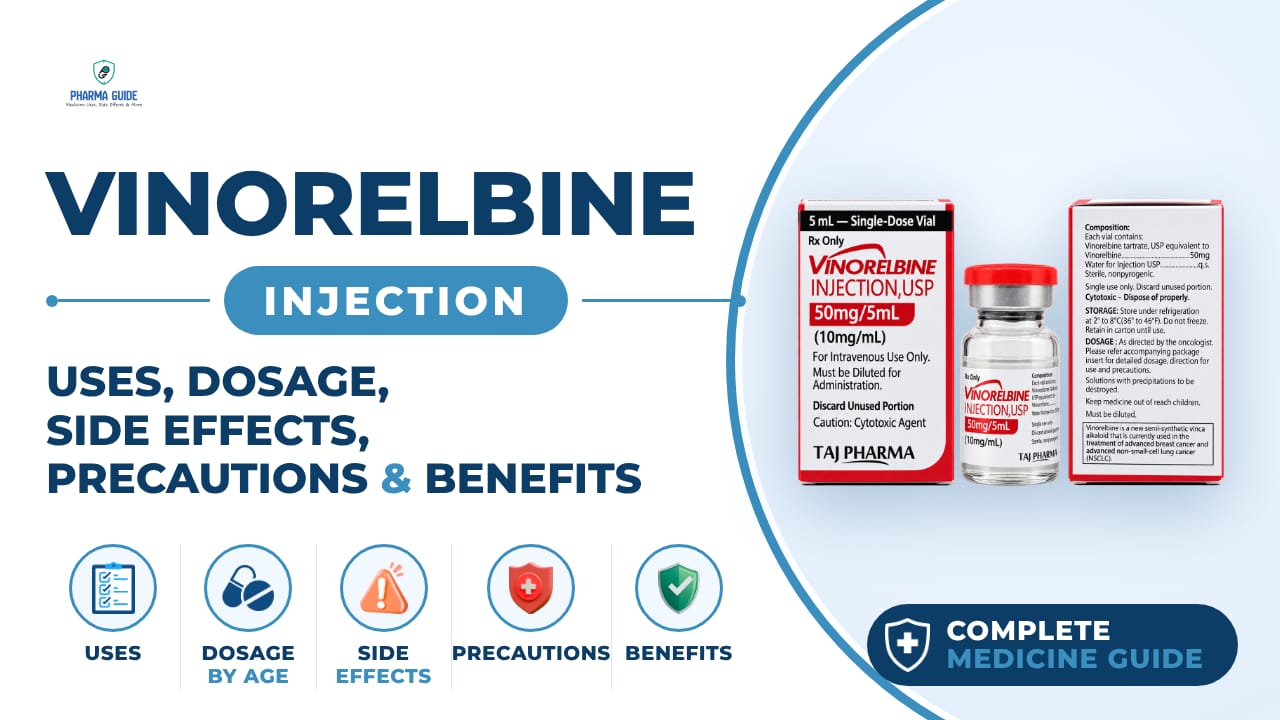
| Generic name | vinorelbine (as vinorelbine tartrate) |
|---|---|
| Drug class | Vinca alkaloid (microtubule inhibitor); antineoplastic agent |
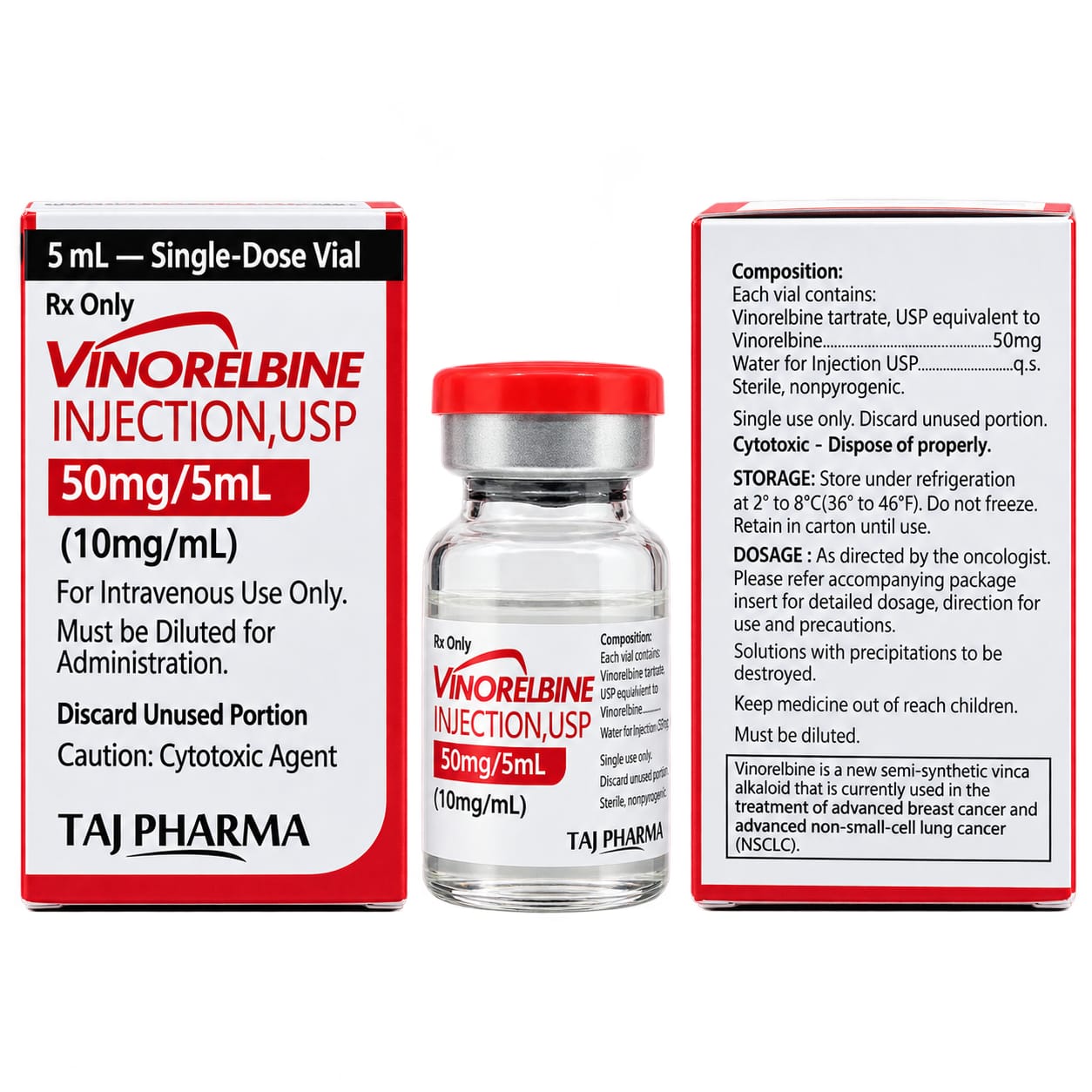
| Forms | Injection solution, 10 mg per 1 mL single-dose vial, Injection solution, 50 mg per 5 mL single-dose vial |
Quick overview
Vinorelbine Injection, generically known as vinorelbine (as vinorelbine tartrate), is a chemotherapy medicine from the vinca alkaloid class given into a vein. It is used to treat non-small cell lung cancer (NSCLC), either alone or combined with cisplatin. It works by stopping cancer cells from dividing. It is given only by a healthcare professional and requires regular blood testing to monitor safety.
What is Vinorelbine Injection
Vinorelbine Injection is a chemotherapy medicine given into a vein. It is used to treat lung cancer, usually non-small cell lung cancer, either alone or combined with another chemotherapy drug called cisplatin.
Vinorelbine Injection uses
- In combination with cisplatin for first-line treatment of locally advanced or metastatic non-small cell lung cancer (NSCLC)
- As a single agent for first-line treatment of metastatic NSCLC
- Treatment of advanced non-small cell lung cancer, as a single agent or in combination (Canadian labeling)
- Treatment of metastatic breast cancer that did not respond to standard first-line chemotherapy, or that relapsed within 6 months of anthracycline-based adjuvant therapy (Canadian labeling)
Benefits of Vinorelbine Injection
- Can slow the growth and spread of certain lung cancers by stopping cancer cells from dividing
- When combined with cisplatin, has been shown to extend survival compared to cisplatin alone in clinical studies
- Treats certain non-small-cell lung cancers (NSCLC)
- Can be used alone or with cisplatin
- Disrupts cancer-cell microtubules
- Inhibits cancer-cell division
- Provides an established chemotherapy option for advanced or metastatic NSCLC
How Vinorelbine Injection works
Vinorelbine blocks tiny structures inside cells called microtubules, which cells need to divide properly. By blocking these structures, the drug stops cancer cells from dividing, which helps slow or stop the cancer's growth.
Vinorelbine Injection dosage
Vinorelbine Injection is given only into a vein (intravenously) by a healthcare professional experienced with cancer chemotherapy drugs; it must never be given into the spinal fluid. It is administered as an injection or infusion lasting about 6 to 10 minutes, followed by flushing the IV line with fluid. It must be diluted before use; it is not given as-is. It is typically given once a week, with the exact schedule set by your care team.
Blood tests are done before each dose to check blood cell counts and liver function, and your dose may be delayed, reduced, or stopped based on the results. It is important not to miss a scheduled dose; contact your care team if you cannot keep an appointment. No dose adjustment is needed for kidney problems, but caution and dose changes are used for liver problems.
| Age group | Dose |
|---|---|
| 18–64 years, single-agent NSCLC | 30 mg/m² IV once weekly |
| 18–64 years, with cisplatin | 25–30 mg/m² IV once weekly, depending on the chemotherapy regimen |
Available forms and strengths
- Injection solution, 10 mg per 1 mL single-dose vial
- Injection solution, 50 mg per 5 mL single-dose vial
Side effects of Vinorelbine Injection
Common
- Low white blood cell count
- Low red blood cell count (anemia)
- Higher liver enzyme levels
- Nausea
- Weakness/tiredness (asthenia)
- Constipation
- Redness, pain, and warmth around the injection site
- Numbness and tingling in fingers and/or toes
- Vomiting
- Diarrhea
- Hair loss
- Pain in the vein used for the injection
- Change in taste
- Joint pain or swelling
- Hearing changes
Serious
- Severe low white blood cell counts leading to serious infection, septic shock, hospitalization, or death
- Severe constipation, bowel blockage, tissue damage, or perforation of the bowel
- Leakage of the drug into surrounding tissue (extravasation) causing severe irritation, tissue damage, or blood vessel inflammation
- Severe nerve damage causing numbness, tingling, or muscle weakness
- Serious lung problems, including inflammation (interstitial pneumonitis) or acute respiratory distress syndrome (ARDS), which can be fatal
- Liver injury, including right upper belly pain, yellowing of the skin or eyes, dark urine
- Severe allergic reaction (anaphylaxis), swelling, hives, difficulty breathing
- Serious bleeding or unusual bruising
- Harm to an unborn baby (can cause birth defects or pregnancy loss)
Warnings and precautions
- This medicine can cause severe lowering of blood cell counts, which can lead to serious infections, septic shock, and even death. Doctors will check blood counts before each dose and may lower the dose or delay treatment if counts are too low.
- Serious liver problems can occur; liver function will be checked before and during treatment.
- Severe constipation and bowel blockage, including tissue death and tears in the bowel, can occur. A bowel care plan to prevent constipation is recommended.
- If the medicine leaks out of the vein into surrounding tissue, it can cause serious tissue damage. Treatment must be stopped right away if this happens.
- Severe nerve damage affecting sensation and muscle strength can occur. Treatment may need to be stopped if nerve problems become more than mild.
- Serious lung problems, including respiratory failure, can occur. Treatment should be paused for unexplained shortness of breath and permanently stopped if confirmed lung inflammation or ARDS occurs.
- This medicine can cause serious harm to an unborn baby. Women should be told about this risk and use effective birth control.
- This medicine can harm an unborn baby and should not be used during pregnancy. Women who could become pregnant should use effective birth control during treatment and for 6 months after the last dose.
- Men should use condoms with partners who could become pregnant during treatment and for 3 months after the last dose.
- Women should not breastfeed during treatment and for 9 days after the last dose, because the drug may cause serious harm to a nursing baby.
- No specific dose change is needed for kidney problems based on available information.
- The liver plays an important role in breaking down this medicine, so doctors monitor liver function before and during treatment and may lower the dose if liver tests are abnormal.
- Discuss alcohol use with the oncology team, especially if liver function is abnormal.
- Fatigue, dizziness, weakness, or neuropathy may make driving unsafe.
Storage
- Store refrigerated between 2° and 8°C (36° and 46°F)
- Do not freeze
- Protect from light; keep in the original carton until time of use
- Discard unused portion
- Unopened vials are stable at 25°C (77°F) for up to 72 hours
- Store diluted solutions at 5° to 30°C (41° to 86°F) and use within 24 hours
- This medication is given in a hospital or clinic and will not be stored at home
- Keep out of the sight and reach of children
When to see a doctor
- Get help right away for a new fever or signs of infection such as chills, cough, or sore throat.
- Get help right away for severe constipation, new stomach pain, nausea, or vomiting, which could signal a bowel problem.
- Get help right away for new or worsening numbness, tingling, reduced feeling, or muscle weakness.
- Get help right away for new or worsening shortness of breath, cough, wheezing, or other new breathing problems.
- Tell your doctor right away if you think you might be pregnant or if you are planning a pregnancy.
- If you notice pain, swelling, burning, or any unusual feeling around the injection site, tell your healthcare team immediately, as this could mean the drug has leaked into surrounding tissue.
- If you think you have received too much of this medicine, contact a poison control center or emergency room right away, even without symptoms.
Alternatives
- Paclitaxel
- Docetaxel
- Gemcitabine
Watch the video
FAQs
What is Vinorelbine Injection used for?
It is used to treat non-small cell lung cancer (NSCLC), either as a single agent or combined with cisplatin, for locally advanced or metastatic disease. Canadian labeling also includes certain metastatic breast cancers.
How is Vinorelbine Injection given?
It is given only into a vein by a healthcare professional, as an injection or infusion lasting about 6 to 10 minutes, followed by flushing the IV line. It must be diluted before use and is typically given once a week.
What are the common side effects of Vinorelbine Injection?
Common side effects include low white blood cell count, anemia, higher liver enzymes, nausea, weakness, constipation, injection site reactions, numbness and tingling, vomiting, diarrhea, hair loss, and joint pain.
What are the serious risks of Vinorelbine Injection?
Serious risks include severe low white blood cell counts leading to infection or septic shock, severe constipation or bowel blockage, tissue damage if the drug leaks into surrounding tissue, severe nerve damage, serious lung problems, liver injury, and harm to an unborn baby.
Can Vinorelbine Injection be used during pregnancy?
No, it can cause serious harm to an unborn baby. Women should use effective birth control during treatment and for 6 months after the last dose, and men should use condoms for 3 months after the last dose.
General information, not medical advice
Your prescriber and the leaflet in your pack know your situation. This page does not.
- Follow your prescriber and the leaflet
- Don't start, stop, or change a dose on your own
- Doses and warnings differ by country and product
Sources
Video
Related medicines

Injectafer Injection: Uses, Dosage, Side Effects, Precautions and Alternates
Iron products
Injectafer (ferric carboxymaltose) treats iron deficiency anemia and heart failure-related iron deficiency via IV. Learn uses, dosage, side effects, and

Gliclazide Tablet: Uses, Dosage, Side Effects, Precautions and Alternates
Sulfonylurea (hypoglycemic/antidiabetic agent)
Gliclazide Tablet is a sulfonylurea for type 2 diabetes that boosts insulin release. Learn about dosage, side effects, warnings, and precautions.