
Safety
General information, not medical advice
Your prescriber and the leaflet in your pack know your situation. This page does not.
- Follow your prescriber and the leaflet
- Don't start, stop, or change a dose on your own
- Doses and warnings differ by country and product
Vitrakvi Capsule: Uses, Dosage, Side Effects, Precautions and Alternates
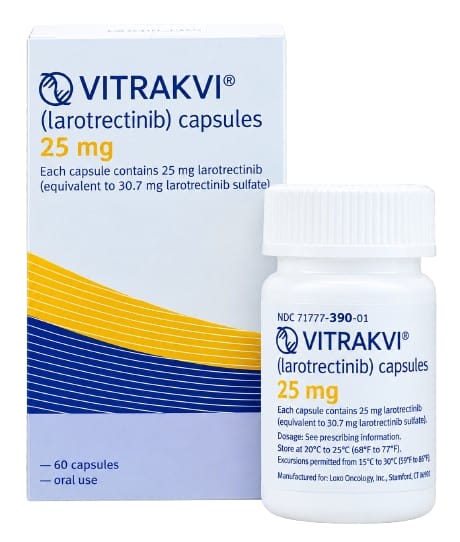
| Generic name | larotrectinib |
|---|---|
| Drug class | Tropomyosin receptor kinase (TRK) inhibitor |
| Forms | Capsules (25 mg and 100 mg), Oral solution (20 mg/mL) |
Quick overview
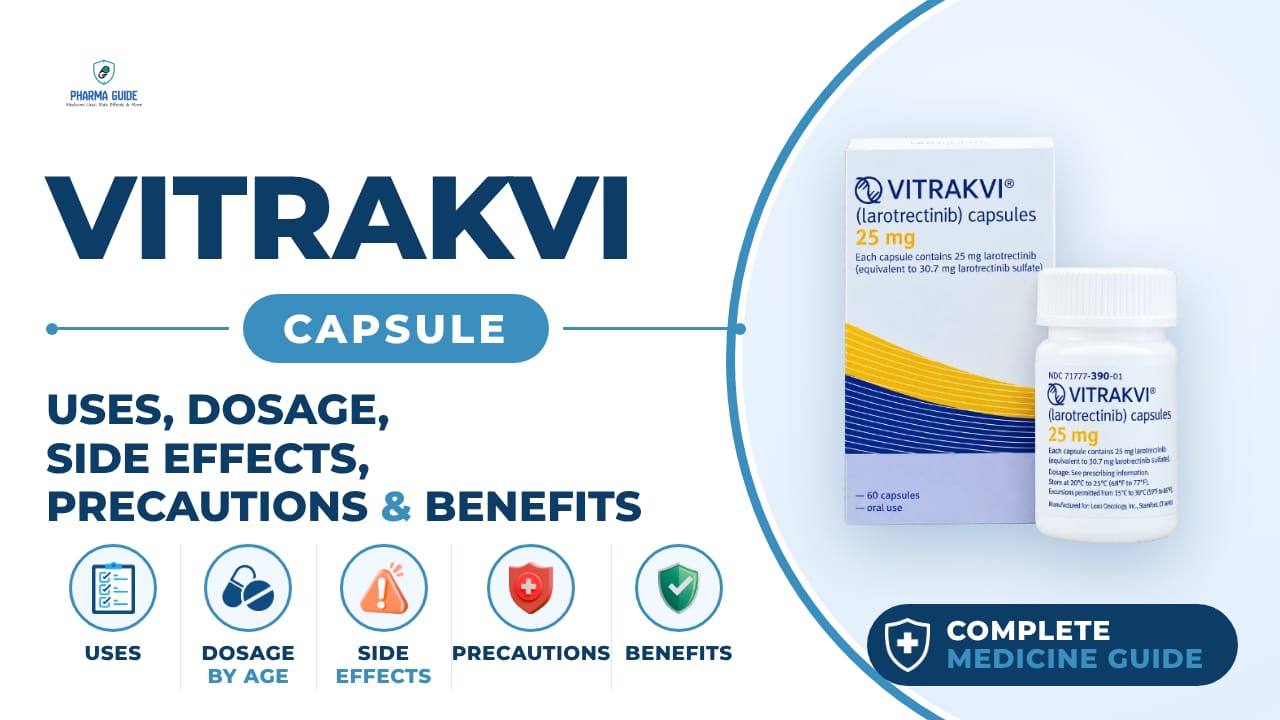
Vitrakvi Capsule (larotrectinib) is a prescription cancer medicine taken by mouth that belongs to a class of drugs called TRK inhibitors. It is not a type of chemotherapy and is used to treat adults and children with solid tumors caused by an abnormal NTRK gene fusion. It is available as capsules and as an oral liquid, and dosing is usually twice a day.
What is Vitrakvi Capsule
Vitrakvi is a prescription cancer medicine taken by mouth. It is not a type of chemotherapy. It is used to treat adults and children with solid tumors caused by an abnormal NTRK gene fusion.
Vitrakvi Capsule uses
- Treatment of adult and pediatric patients with solid tumors that have a neurotrophic receptor tyrosine kinase (NTRK) gene fusion without a known acquired resistance mutation, that are metastatic or where surgery would likely cause severe complications, and that have no satisfactory alternative treatments or that progressed after treatment
Benefits of Vitrakvi Capsule
- Taken by mouth
- Available as capsules and as a liquid for people who have trouble swallowing pills whole
- An option for cancers with the NTRK fusion mutation when other treatments haven't worked
How Vitrakvi Capsule works
Vitrakvi blocks a protein called TRK. In some cancers, an abnormal joining of genes causes TRK proteins to be made constantly, which signals cancer cells to grow. By blocking the TRK protein, Vitrakvi is thought to turn off this growth signal, though the exact way it works is not fully known.
Vitrakvi Capsule dosage
Vitrakvi is usually taken by mouth 2 times a day. It can be taken with or without food. Swallow capsules whole with water; do not chew or crush them. If using the liquid form, measure the dose carefully using the bottle adapter and oral syringes provided.
If you vomit after taking a dose, wait and take your next dose at the regular scheduled time instead of taking an extra dose. If you miss a dose, take it as soon as you remember, unless your next scheduled dose is due within 6 hours—in that case, skip the missed dose and take your next dose at the regular time.
Avoid eating grapefruit or drinking grapefruit juice, and avoid taking St. John's wort, while on this medicine. Take the medicine exactly as your healthcare provider tells you and do not change your dose or stop without their guidance.
| Age group | Dose |
|---|---|
| Under 18 years | Not recommended |
| 18–64 years | 100 mg, twice/day |
| 65+ years | 100 mg, twice/day |
Available forms and strengths
- Capsules (25 mg and 100 mg)
- Oral solution (20 mg/mL)
Side effects of Vitrakvi Capsule
Common
- High liver enzyme levels
- Muscle, bone, or joint pain
- Anemia (low red blood cell count)
- Low white blood cell count
- Feeling very tired
- Cough
- Feeling dizzy
- Constipation
- Diarrhea
- Nausea
- Vomiting
- Low calcium levels
- Fever
- Belly (abdomen) pain
- Low levels of albumin protein in the blood
- Increased alkaline phosphatase (a liver or bone enzyme)
Serious
- Nervous system problems: confusion, difficulty speaking, dizziness, coordination problems, tingling, numbness, or burning in hands and feet
- Liver problems: loss of appetite, nausea or vomiting, pain on the upper right side of the stomach, yellowing of eyes or skin, dark or brown urine
- Bone fractures: pain, changes in ability to move around, or bone abnormalities
Warnings and precautions
- Vitrakvi can cause nervous system problems such as dizziness, confusion, trouble concentrating, memory problems, mood changes, and sleep problems. These can start as early as one day after starting treatment or appear after months of use. Tell your care team right away if you notice these symptoms, and don't drive or use machinery until you know how the medicine affects you.
- Some people taking Vitrakvi have broken a bone, including in the hip or leg, during treatment. Tell your care team if you have new muscle or bone pain, a limb that looks crooked, or trouble moving a limb.
- Vitrakvi can raise liver enzyme levels, which can be a sign of liver damage, and in rare cases this can become serious. You will need blood tests to check your liver before starting treatment, every 2 weeks for the first month, and then monthly afterward.
- Avoid taking St. John's wort, and avoid eating grapefruit or drinking grapefruit juice, while taking Vitrakvi, since these can change the levels of the medicine in your blood.
- Vitrakvi may affect a woman's ability to become pregnant in the future (fertility). Talk to your healthcare provider if this is a concern for you.
- Vitrakvi can harm an unborn baby. Women who can become pregnant should not become pregnant during treatment and should use effective birth control during treatment and for at least 1 week after the final dose.
- Men with partners who can become pregnant should also use effective birth control during treatment and for 1 week after the final dose.
- Do not breastfeed during treatment with Vitrakvi and for 1 week after the final dose, because it is not known if the medicine passes into breast milk and it could harm a breastfeeding child.
- No dose adjustment is needed for people with kidney problems of any severity.
- People with moderate to severe liver problems need a lower starting dose of Vitrakvi, since the body clears the drug more slowly.
- Vitrakvi can cause dizziness and other nervous system effects. Do not drive or operate machinery until you know how this medicine affects you.
Storage
- Store capsules at room temperature between 68°F to 77°F (20°C to 25°C); temperature excursions between 59°F and 86°F are permitted
- Store the oral solution in the refrigerator between 36°F to 46°F (2°C to 8°C); do not freeze
- Throw away any unused oral solution remaining after 90 days of first opening a 100 mL bottle, or after 31 days of first opening a 50 mL bottle
- Keep VITRAKVI and all medicines out of the reach of children
When to see a doctor
- Get medical help right away if you have confusion, trouble speaking, dizziness, coordination problems, or tingling, numbness, or a burning feeling in your hands or feet.
- Tell your healthcare provider right away if you have loss of appetite, nausea or vomiting, or pain on the upper right side of your stomach — these can be signs of liver problems.
- Go to urgent care if you have a limb that looks crooked, new muscle or bone pain, or trouble moving a limb, as these can be signs of a broken bone.
- If you take too much Vitrakvi, contact your healthcare provider or go to the nearest hospital emergency room right away.
Alternatives
- Augtyro
- Xalkori
- Rozlytrek
Watch the video
FAQs
What is Vitrakvi Capsule used for?
Vitrakvi is used to treat adult and pediatric patients with solid tumors that have an NTRK gene fusion without a known acquired resistance mutation, that are metastatic or where surgery would likely cause severe complications, and that have no satisfactory alternative treatments or progressed after treatment.
How is Vitrakvi Capsule taken?
Vitrakvi is usually taken by mouth 2 times a day, with or without food. Capsules should be swallowed whole with water and not chewed or crushed. The usual dose for adults is 100 mg twice a day.
What should I avoid while taking Vitrakvi?
Avoid eating grapefruit or drinking grapefruit juice, and avoid taking St. John's wort, since these can change the levels of the medicine in your blood.
What are the serious side effects of Vitrakvi Capsule?
Serious side effects include nervous system problems like confusion, difficulty speaking, dizziness, and numbness; liver problems such as loss of appetite, nausea, and yellowing of eyes or skin; and bone fractures causing pain or trouble moving a limb.
Can Vitrakvi Capsule be used in children?
According to the dosage table, Vitrakvi is not recommended for patients under 18 years, while the article also states it treats adult and pediatric patients with NTRK gene fusion tumors.
General information, not medical advice
Your prescriber and the leaflet in your pack know your situation. This page does not.
- Follow your prescriber and the leaflet
- Don't start, stop, or change a dose on your own
- Doses and warnings differ by country and product
Sources
Video
Related medicines

Injectafer Injection: Uses, Dosage, Side Effects, Precautions and Alternates
Iron products
Injectafer (ferric carboxymaltose) treats iron deficiency anemia and heart failure-related iron deficiency via IV. Learn uses, dosage, side effects, and

Gliclazide Tablet: Uses, Dosage, Side Effects, Precautions and Alternates
Sulfonylurea (hypoglycemic/antidiabetic agent)
Gliclazide Tablet is a sulfonylurea for type 2 diabetes that boosts insulin release. Learn about dosage, side effects, warnings, and precautions.