
Safety
General information, not medical advice
Your prescriber and the leaflet in your pack know your situation. This page does not.
- Follow your prescriber and the leaflet
- Don't start, stop, or change a dose on your own
- Doses and warnings differ by country and product
Vyzulta Eye Drops: Uses, Dosage, Side Effects, Precautions and Alternates
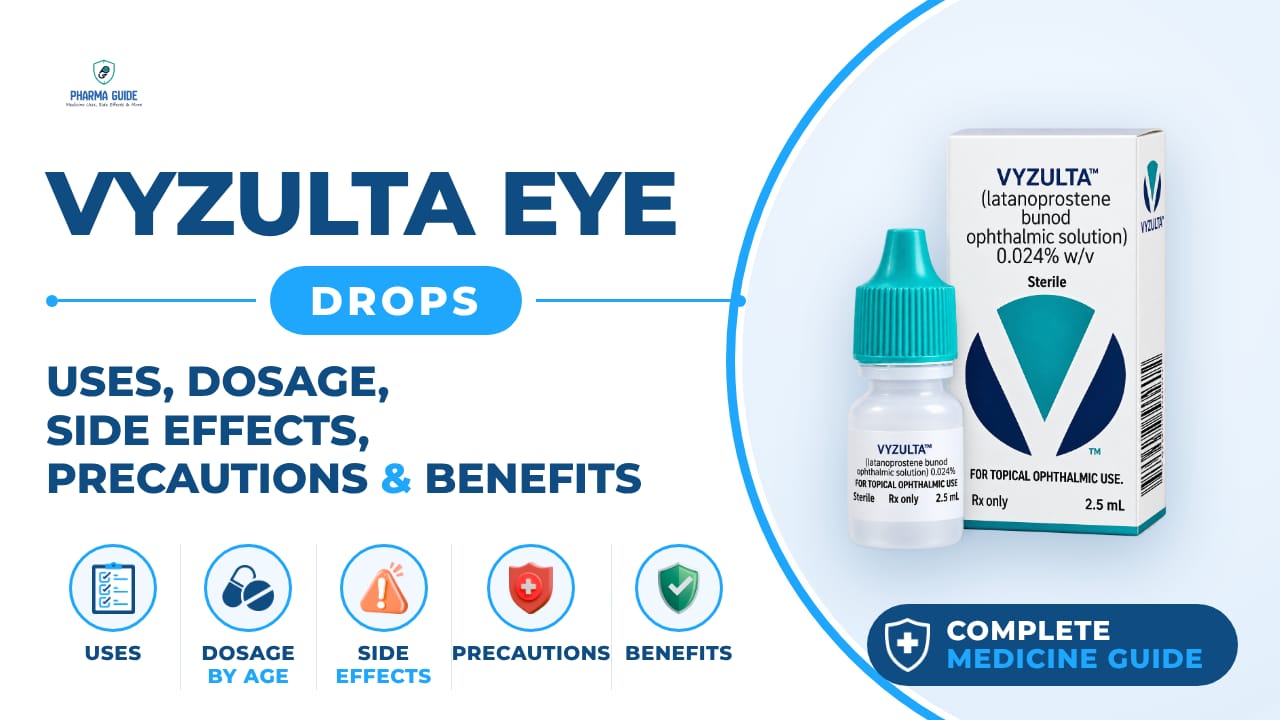
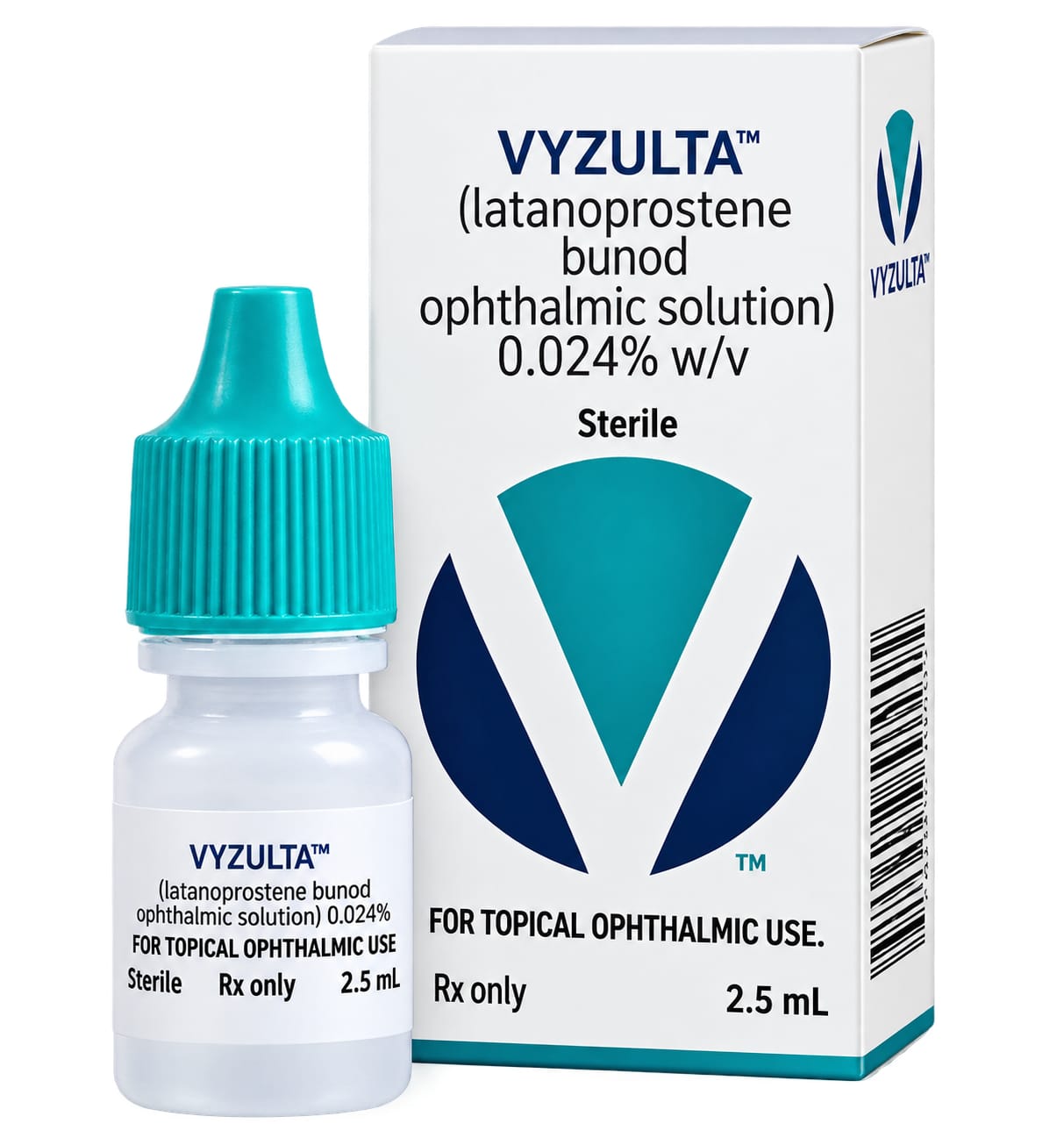
| Generic name | latanoprostene bunod |
|---|---|
| Drug class | Prostaglandin analog (ophthalmic glaucoma agent) |
| Forms | Liquid eye drop solution |
Quick overview
Vyzulta Eye Drops contain latanoprostene bunod, a prostaglandin analog used to lower high pressure inside the eye. It is prescribed for open-angle glaucoma and ocular hypertension and is used as one drop in the affected eye once daily in the evening. Vyzulta is a brand-name medicine with no generic version currently available, and it may be used alone or together with other eye pressure-lowering medicines.
What is Vyzulta Eye Drops
Vyzulta is a prescription eye drop used to treat high pressure inside the eye. It contains the active ingredient latanoprostene bunod and is a brand-name medicine with no generic version currently available.
Vyzulta Eye Drops uses
- Treats increased eye pressure caused by open-angle glaucoma
- Treats ocular hypertension (high pressure inside the eye)
Benefits of Vyzulta Eye Drops
- Lowers eye pressure to help protect the optic nerve
- Given as just one drop per day
- Can be used along with other eye pressure-lowering medicines
How Vyzulta Eye Drops works
Vyzulta lowers pressure inside the eye by helping more fluid drain out of the eye, through two different drainage pathways.
Vyzulta Eye Drops dosage
Use Vyzulta in the affected eye or eyes once a day, in the evening. Wash your hands before using the eye drops. Do not touch the tip of the dropper to your eye, hands, or any other surface, since this can contaminate it and cause an eye infection.
If you use other eye drops as well, wait at least 5 minutes between using Vyzulta and the other eye drops. If you wear contact lenses, take them out before using Vyzulta and wait at least 15 minutes afterward before putting them back in.
After placing a drop in your eye, close your eyes for a couple of minutes with your head tipped down, and gently press a finger to the inner corner of your eye to keep the drop from draining away. Do not use the eye drops if the liquid has changed color or has particles in it.
If you miss a dose, take it as soon as you remember; but if it's almost time for the next dose, skip the missed one and go back to your normal schedule — do not use two doses at once. Vyzulta is usually used as a long-term treatment for eye pressure.
| Age group | Dose |
|---|---|
| Under 16 years | Not recommended |
| 16–17 years | 1 drop in affected eye(s) once daily in the evening, only under ophthalmologist supervision |
| 18–64 years | 1 drop in affected eye(s) once daily in the evening |
| 65 years and older | 1 drop in affected eye(s) once daily in the evening |
Available forms and strengths
- Liquid eye drop solution
Side effects of Vyzulta Eye Drops
Common
- Redness in the white of the eye
- Eye irritation
- Eye pain
- Temporary pain or stinging after applying a drop
- Blurry vision
- Swelling of the eye or eyelids
- Feeling like something is in your eye
Serious
- Eyelash changes, such as increased length, thickness, or number of hairs
- Changes to the color of the eye or eyelid, which may be permanent
- Macular edema (swelling of the retina)
- Bacterial keratitis, an eye infection caused by a contaminated dropper touching the eye
- Eye inflammation, redness, severe discomfort, crusting, or drainage
- Sudden vision changes
- Signs of allergic reaction such as hives, difficulty breathing, or swelling of the face, lips, tongue, or throat
Warnings and precautions
- It isn't known whether Vyzulta is safe to use during pregnancy. Talk with your doctor if you're pregnant or planning to become pregnant before starting this medicine.
- It isn't known whether Vyzulta passes into breast milk or could affect a nursing baby. Talk with your doctor before using it while breastfeeding.
- Vyzulta can permanently increase brown pigmentation of the iris.
- Darkening of the skin around the eye may occur.
- Eyelashes may become longer, thicker, or more numerous; these changes are usually reversible after stopping treatment.
- Use with caution in patients with active eye inflammation, such as uveitis.
- Use caution in patients who are aphakic, have a torn posterior lens capsule, or have other risk factors for macular edema.
- Avoid contaminating the bottle tip by touching it to the eye, fingers, or other surfaces because contaminated drops can cause serious eye infections.
- Vyzulta is not known to interact with alcohol, but you should still tell your doctor about anything you regularly consume.
- Remove contact lenses before applying Vyzulta and wait at least 15 minutes before reinserting them.
- If using other ophthalmic medicines, separate them by at least 5 minutes.
- Tell your doctor before using Vyzulta if you have eye inflammation such as iritis or uveitis, an implanted eye lens, a pseudophakic eye lens, macular edema or risk factors for it, or if you've had an allergic reaction to Vyzulta in the past.
- Vyzulta can cause a gradual, sometimes permanent change in eye color, and can increase the growth or thickness of eyelashes, in the treated eye only.
- Do not touch the dropper tip to your eye or any surface, since a contaminated dropper can cause a serious eye infection.
- Tell your doctor right away if you have an eye injury or infection, or if you're planning to have eye surgery.
- Vyzulta is not approved for use in children younger than 16 years old.
Storage
- Store an unopened bottle in a refrigerator; do not freeze
- After opening, the bottle can be stored at room temperature away from moisture, heat, and light
- Keep the bottle tightly closed when not in use
- Throw away the medicine after 8 weeks have passed since you first opened the bottle
- Keep this and all other medicines out of the reach of children
When to see a doctor
- Get emergency medical help right away if you have signs of a serious allergic reaction, such as hives, difficulty breathing, or swelling of your face, lips, tongue, or throat.
- Stop using Vyzulta and call your doctor right away if you notice eye swelling, redness, severe discomfort, crusting or drainage, red/swollen/itchy eyelids, sudden vision changes, or severe pain, burning, stinging, or irritation after use.
- Call your doctor right away if you have serious side effects, and call emergency services if you think you're having a medical emergency.
Alternatives
- Bimatoprost (Lumigan)
- Brimonidine/timolol (Combigan)
- Brimonidine/brinzolamide (Simbrinza)
- Latanoprost (Xalatan, Iyuzeh)
- Latanoprost/netarsudil (Rocklatan)
- Netarsudil (Rhopressa)
- Brinzolamide (Azopt)
- Timolol (Timoptic)
- Travoprost (iDose TR, Travatan Z)
Watch the video
FAQs
What is Vyzulta Eye Drops used for?
Vyzulta is used to treat increased eye pressure caused by open-angle glaucoma and ocular hypertension.
How often should I use Vyzulta Eye Drops?
Vyzulta is used as one drop in the affected eye once daily in the evening.
Is there a generic version of Vyzulta?
No, Vyzulta is a brand-name medicine with no generic version currently available.
What are the serious side effects of Vyzulta?
Serious side effects include eyelash changes, permanent changes to eye or eyelid color, macular edema, bacterial keratitis, eye inflammation, sudden vision changes, and signs of an allergic reaction.
How should Vyzulta Eye Drops be stored?
Store an unopened bottle in the refrigerator without freezing; after opening, keep it at room temperature away from moisture, heat, and light, and discard it 8 weeks after first opening.
General information, not medical advice
Your prescriber and the leaflet in your pack know your situation. This page does not.
- Follow your prescriber and the leaflet
- Don't start, stop, or change a dose on your own
- Doses and warnings differ by country and product
Sources
- Healthline: https://www.healthline.com/health/drugs/vyzulta
- Drugs.com: https://www.drugs.com/mtm/vyzulta.html
- GoodRx: https://www.goodrx.com/vyzulta/what-is
- Medical News Today (via Healthline source)
- Vyzulta prescribing information (Bausch + Lomb)
Video
Related medicines

Injectafer Injection: Uses, Dosage, Side Effects, Precautions and Alternates
Iron products
Injectafer (ferric carboxymaltose) treats iron deficiency anemia and heart failure-related iron deficiency via IV. Learn uses, dosage, side effects, and

Gliclazide Tablet: Uses, Dosage, Side Effects, Precautions and Alternates
Sulfonylurea (hypoglycemic/antidiabetic agent)
Gliclazide Tablet is a sulfonylurea for type 2 diabetes that boosts insulin release. Learn about dosage, side effects, warnings, and precautions.