
Safety
General information, not medical advice
Your prescriber and the leaflet in your pack know your situation. This page does not.
- Follow your prescriber and the leaflet
- Don't start, stop, or change a dose on your own
- Doses and warnings differ by country and product
Zelboraf Tablet: Uses, Dosage, Side Effects, Precautions and Alternates
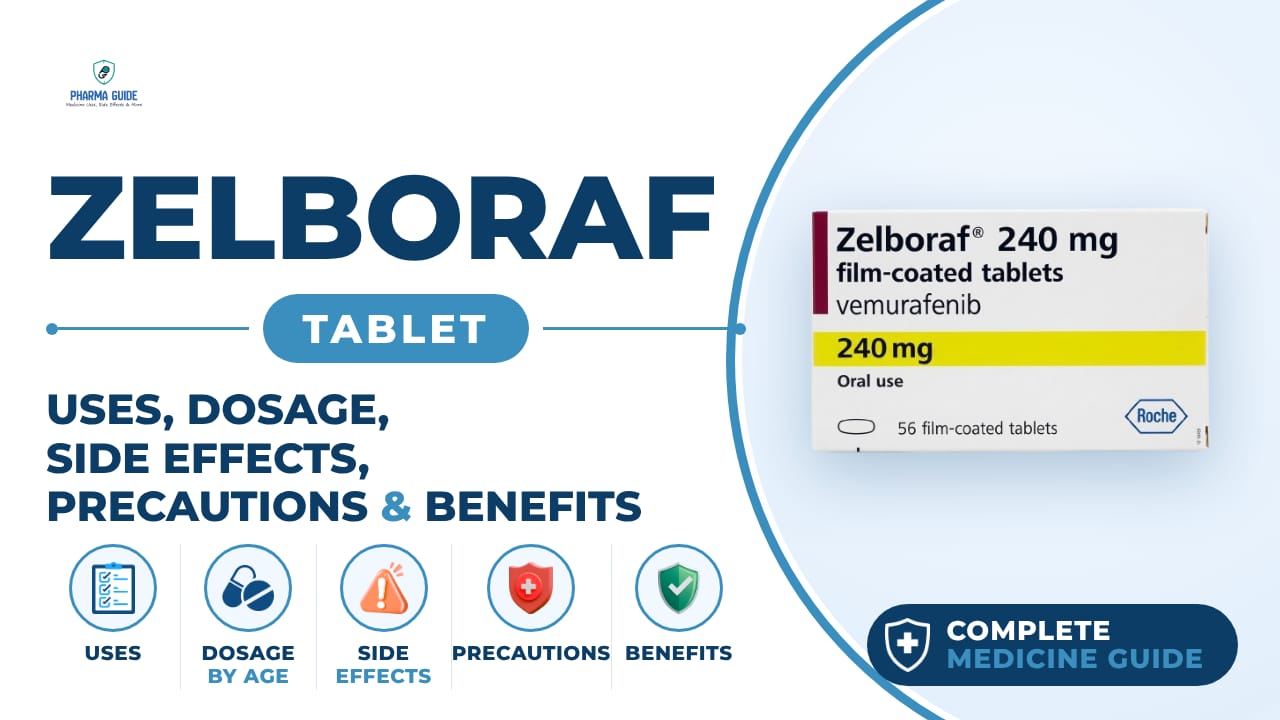
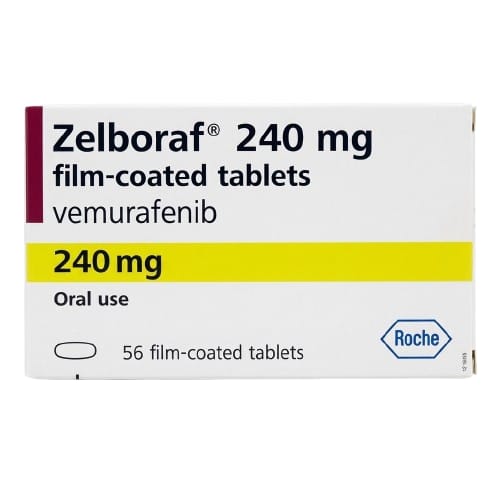
| Generic name | vemurafenib |
|---|---|
| Drug class | Kinase inhibitor (BRAF kinase inhibitor, antineoplastic) |
| Forms | Tablet (240 mg, film-coated, oral) |
Quick overview
Zelboraf Tablet (vemurafenib) is a prescription cancer medicine belonging to the kinase inhibitor class, used to treat unresectable or metastatic melanoma with a specific BRAF V600E gene mutation. It works by blocking a mutated BRAF protein that drives cancer growth. The typical dose is 960 mg twice a day for adults, and it is not recommended for those under 18 years of age.
What is Zelboraf Tablet
Zelboraf is a prescription cancer medicine containing vemurafenib. It is used to treat a type of skin cancer called melanoma that has spread or cannot be removed by surgery, in people whose tumor has a specific BRAF gene change.
Zelboraf Tablet uses
- Treatment of unresectable or metastatic melanoma with a BRAF V600E gene mutation, confirmed by an FDA-approved test
- Not indicated for melanoma with a normal (wild-type) BRAF gene
Benefits of Zelboraf Tablet
- Has been shown to improve overall survival and progression-free survival compared to dacarbazine in clinical trials
- Treats certain BRAF V600 mutation-positive melanomas
- Used for selected cases of Erdheim-Chester disease
How Zelboraf Tablet works
Zelboraf blocks a mutated form of the BRAF protein that drives cancer cell growth, which helps slow down or stop the cancer from growing and spreading.
Zelboraf Tablet dosage
Take the medicine about every 12 hours, approximately 12 hours apart. It can be taken with or without a meal according to the US label, though the Australian leaflet advises taking it on an empty stomach, at least 1 hour before or 2 hours after a meal, because food may affect how it is absorbed. Swallow the tablets whole with a glass of water; do not crush or chew them.
If you vomit after taking a dose, do not take another dose — just take your next dose at the regular scheduled time. If you miss a dose, take it as soon as you remember, unless it is within about 4 hours of your next dose, in which case skip the missed dose and continue your regular schedule. Do not double up doses to make up for a missed one.
Try to take your medicine at the same time each day to help you remember and get the best effect. Continue taking this medicine until your doctor tells you to stop. Avoid grapefruit or grapefruit juice while taking this medicine. This medicine is not recommended for use in children or adolescents under 18.
| Age group | Dose |
|---|---|
| Under 18 years | Not recommended |
| 18–64 years | 960 mg, twice/day |
| 65+ years | 960 mg, twice/day |
Available forms and strengths
- Tablet (240 mg, film-coated, oral)
Side effects of Zelboraf Tablet
Common
- Joint pain (arthralgia)
- Rash
- Hair loss (alopecia)
- Tiredness (fatigue)
- Sensitivity to sunlight/photosensitivity reaction
- Nausea
- Itching (pruritus)
- Skin papilloma/warts
- Diarrhea
- Constipation
- Vomiting
- Headache
- Changes in taste
- Decreased appetite
- Cough
- Sunburn
Serious
- New skin cancers (cutaneous squamous cell carcinoma, keratoacanthoma) and new melanoma lesions
- Non-skin squamous cell carcinoma, especially of the head and neck
- Serious allergic reactions including anaphylaxis and DRESS syndrome
- Severe skin reactions including Stevens-Johnson syndrome and toxic epidermal necrolysis
- QT prolongation (abnormal heart rhythm) which can be life-threatening
- Liver injury/hepatotoxicity
- Eye problems including uveitis, blurred vision, and light sensitivity
- Kidney failure, including acute interstitial nephritis and acute tubular necrosis
- Severe reactions in skin or organs previously treated with radiation (radiation sensitization/recall)
- Thickening of connective tissue in the hand (Dupuytren's contracture) or foot (plantar fibroma)
Warnings and precautions
- This medicine can cause new skin cancers and new melanomas. Your doctor should check your skin before starting treatment, every 2 months during treatment, and for up to 6 months after stopping.
- Serious allergic reactions, including anaphylaxis and DRESS syndrome, can happen during treatment or when restarting treatment.
- Severe skin reactions such as Stevens-Johnson syndrome and toxic epidermal necrolysis can occur and treatment should be stopped permanently if they happen.
- This medicine can cause a heart rhythm problem called QT prolongation. Your doctor will check your heart's electrical activity and blood electrolytes before and during treatment.
- Liver injury can occur, so liver function should be monitored before and during treatment.
- Skin becomes more sensitive to sunlight; avoid sun exposure and use sun protection.
- Eye problems such as uveitis can occur; report any eye symptoms immediately.
- This medicine can harm an unborn baby. Effective contraception should be used during treatment and for a period after stopping.
- Radiation treatment given before, during, or after this medicine can cause severe skin or organ reactions, sometimes fatal.
- Kidney failure can occur; kidney function should be checked before and during treatment.
- Avoid taking this medicine with certain other drugs, such as strong CYP3A4 inhibitors or inducers, without talking to your doctor, since they can change how this medicine works.
- This medicine can harm an unborn baby. Women who can become pregnant should use effective birth control during treatment and for some time after the last dose, and should tell their doctor right away if they become pregnant.
- It is not known if this medicine passes into breast milk. Breastfeeding is not recommended during treatment and for a period after the last dose.
- Tell your doctor if you have kidney problems. Your doctor will check your kidney function with blood tests before and during treatment, since this medicine can cause kidney injury.
- Tell your doctor if you have liver problems. Your doctor will check your liver function with blood tests before starting treatment and monthly during treatment.
- It isn't known for certain if alcohol affects this medicine, but heavy drinking can weaken your immune system and make it harder for your body to fight cancer.
- Be careful driving or using machinery until you know how this medicine affects you, since it can cause tiredness, dizziness, or eye problems that may affect your vision.
Storage
- Store at room temperature between 68°F and 77°F (20°C to 25°C); brief exposure to 59°F–86°F (15°C–30°C) is allowed, such as during transport
- Store in the original container with the lid tightly closed
- Keep tablets in the blister pack until it is time to take them
- Keep in a cool, dry place where the temperature stays below 30°C
- Do not store in the bathroom, near a sink, on a window sill, or in the car
- Keep out of reach of children; a locked cupboard at least 1.5 m above the ground is recommended
- Ask your pharmacist how to safely dispose of unused or expired medicine; do not dispose of via wastewater or household waste if possible, and use local medicine take-back or collection systems if available
When to see a doctor
- Stop taking this medicine and get emergency help if you have signs of a serious allergic reaction, such as swelling of the face, lips, or tongue, trouble breathing, throat tightness, or a fast heartbeat.
- Stop taking this medicine and call your doctor right away if you get a rash with blisters, skin peeling, mouth sores, fever, or swelling of the face, hands, or feet.
- Tell your doctor right away if you feel faint, lightheaded, dizzy, or notice an irregular or fast heartbeat, as this could be a sign of a serious heart rhythm problem.
- Contact your doctor right away if you notice yellowing of your skin or eyes, dark urine, nausea, vomiting, loss of appetite, or pain on the right side of your stomach — these can be signs of liver problems.
- Contact your doctor right away if you have eye pain, swelling, redness, or any vision changes.
- Check your skin regularly and tell your doctor right away about any new wart, sore that bleeds or doesn't heal, or changes in the size or color of a mole.
- Tell your doctor right away if you become pregnant or think you might be pregnant during treatment.
- Get medical help right away if you think you or someone else has taken too much of this medicine.
Alternatives
- Dabrafenib
- Encorafenib
- Trametinib
Watch the video
FAQs
What is Zelboraf Tablet used for?
Zelboraf is used to treat unresectable or metastatic melanoma with a specific BRAF V600E gene mutation, confirmed by an FDA-approved test. It is not indicated for melanoma with a normal (wild-type) BRAF gene.
How is Zelboraf Tablet taken?
The typical adult dose is 960 mg twice a day, taken about every 12 hours. Tablets should be swallowed whole with water; do not crush or chew them. It is not recommended for children or adolescents under 18.
What should I avoid while taking Zelboraf Tablet?
You should avoid grapefruit or grapefruit juice while taking this medicine. It's also important to avoid sun exposure and use sun protection, since the medicine increases skin sensitivity to sunlight.
What are the serious side effects of Zelboraf Tablet?
Serious side effects include new skin cancers and new melanoma lesions, serious allergic reactions, severe skin reactions like Stevens-Johnson syndrome, QT prolongation, liver injury, eye problems like uveitis, and kidney failure.
What happens if I miss a dose of Zelboraf Tablet?
If you miss a dose, take it as soon as you remember unless it is within about 4 hours of your next dose, in which case skip the missed dose and continue your regular schedule. Do not double up doses.
General information, not medical advice
Your prescriber and the leaflet in your pack know your situation. This page does not.
- Follow your prescriber and the leaflet
- Don't start, stop, or change a dose on your own
- Doses and warnings differ by country and product
Sources
Video
Related medicines

Injectafer Injection: Uses, Dosage, Side Effects, Precautions and Alternates
Iron products
Injectafer (ferric carboxymaltose) treats iron deficiency anemia and heart failure-related iron deficiency via IV. Learn uses, dosage, side effects, and

Gliclazide Tablet: Uses, Dosage, Side Effects, Precautions and Alternates
Sulfonylurea (hypoglycemic/antidiabetic agent)
Gliclazide Tablet is a sulfonylurea for type 2 diabetes that boosts insulin release. Learn about dosage, side effects, warnings, and precautions.